

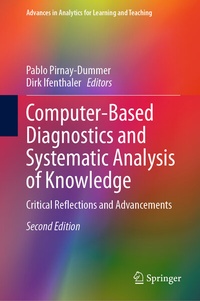
Computer-Based Diagnostics and Systematic Analysis of Knowledge
Description

This volume explores the rapidly advancing field of technology-supported knowledge assessment. Across academia, research on learning and instruction, AI-based analysis, psychology, and education, there is a pressing need for a comprehensive collection of foundations and methodologies related to knowledge. While the market offers books on individual and locally developed methods, a holistic overview is currently lacking. It aims to fill that gap, inspiring projects globally and benefiting knowledge-intensive developments in both digital and traditional learning environments. Understanding the state and processes of knowledge often poses a bottleneck in the quality of designs and implementations. This book addresses this challenge by focusing on mostly automated, easy-to-implement strategies, supporting the crucial task of understanding knowledge.
More details
Other editions
Additional editions
Previous edition
Persons
Pablo Pirnay-Dummer is Professor of Educational Psychology at Martin Luther University of Halle-Wittenberg, Germany. His research interests are the processes of language in learning, computer-linguistic methods for the psychological identification of knowledge in text, modelling and comparison of knowledge domains, expertise and complex problem-solving in processes of learning and instruction.
Dirk Ifenthaler is Professor and Chair of Learning, Design and Technology at the University of Mannheim, Germany and UNESCO Co-Chair on Data Science in Higher Education Learning and Teaching at Curtin University, Australia. Dirk's research focuses on the intersection of cognitive psychology, educational technology, data analytics, and organizational learning.
Content
Part 1 : Conceptual Perspectives Chapter 1: On The Process, Use And Methodological Challenges Of Assessing Knowledge.- Chapter 2: Framing Knowledge As Conceptual Structure.- Chapter 3: Knowledge In The Era Of Artificial Intelligence.- Chapter 4: A Framework For Data-Driven Computer-Based Diagnostics Of Competencies And Capabilities Across Contexts.- Part 2: Applied Perspective s.- Chapter 5: T-MITOCAR. An Epistemological Approach To Assessing Artifacts Of Knowledge.- Chapter 6: Designing Effective Technologies to Support Self-Regulated Strategies Development for Writing.- Chapter 7: Sequential Pattern Mining On Cyber Ranges For A Computer-Based Diagnostic Of Cybersecurity Skills.- Chapter 8: Tracking Competency Development In Highly Interactive Digital Learning Environments . - Chapter 9: Modeling Creativity In Education. Assessing Creativity In Students Scratch Projects: A Study On Human-AI Collaboration For Creativity Assessment.- Chapter 10: The Next Level In Personalized Learning: Adaptation Of Educational Chatbots To Students' Individual Learning.- Chapter 11: Technology-Enhanced Feedback In K-12 Schools: Utilizing T-MITOCAR For Knowledge Artifact And Feedback.- Chapter 12: Bridging The Gap Between Math Formalism And Natural Language.
