

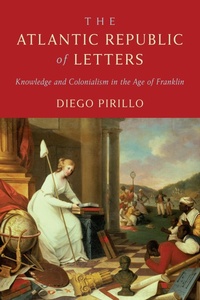
The Atlantic Republic of Letters
Description

Places Benjamin Franklin's Philadelphia in the context of a broader Atlantic intellectual world and investigates the entanglement among books, knowledge, and colonialism
The Atlantic Republic of Letters offers an alternative intellectual history of early America. Focusing on Benjamin Franklin's Philadelphia, the book frames Euro-American colonialism as an intellectual enterprise, which was established not only through military and economic means but also through books, ideas, and cultural institutions.
Through research in dozens of archives and rare book libraries, Diego Pirillo brings together two interconnected histories. First, he recovers the place of British America in the cosmopolitan world of the Republic of Letters, studying the communication system that facilitated the transatlantic circulation of knowledge. Second, he shows that knowledge was weaponized in the effort to survey and control North America. While fashioning themselves as independent and cosmopolitan scholars, Franklin and his associates, including James and Martha Logan, Isaac Norris II, Pierre Eugène Du Simitière, and Jane Colden, among others, were in fact deeply tied to political power and tailored their ideas to the needs of their patrons. They served as agents of empire and helped to devise and put into practice the colonial project. Not only were books, libraries, and cultural institutions funded by the wealth created by the slave trade and the expropriation of Indigenous land, but, as Pirillo argues, the very taxonomies and classification systems that Euro-American scholars devised directly shaped the colonial enterprise.
In this respect, The Atlantic Republic of Letters illuminates the relationship among books, intellectuals, and colonial governance, and explores the ways in which knowledge circulated and shaped conquest.
More details
Person
Content
- Cover
- Series Editors
- Title Page
- Copyright
- Dedication
- Epigraphs
- Contents
- Introduction
- Part I: Communicating Knowledge
- Chapter 1. Letters and Natural History
- Chapter 2. European Periodicals and American Readers
- Chapter 3. The Age of Dictionaries
- Chapter 4. How to Organize a Library
- Part II: Knowledge and Colonialism
- Chapter 5. Negotiating on the Frontier
- Chapter 6. Silencing Slavery in the Archive
- Chapter 7. Museums, Antiquarians, and Indigenous Dispossession
- Conclusion
- Notes
- Bibliography
- Index
- Acknowledgments
