

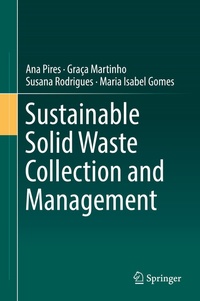
Sustainable Solid Waste Collection and Management
Description

This volume focuses on the collection of waste and waste streams as an integral aspect of sustainable waste management. The authors take economic models and behavioral studies into account to go beyond just descriptions of waste collections technologies and collection route design. Models and tools for sustainable waste collection are described in detail, and the authors provide a comprehensive, integrated methodology to design waste collection systems that reduce environmental impacts, are economically viable, and achieve buy-in and participation from target populations.
Part I of the book provides fundamentals and context on waste hierarchy, including waste prevention, reduction and reuse, waste collection itself, and steps such as preparation for recycling, recycling, treatment, and landfilling. Background in environmental, social, and economic concerns surrounding waste collection is also provided here. Part II addresses tools for design, operation, and maintenance of wastecollection systems. Part III focuses on how the tools presented in Part II can be used to support sustainability assessments and decisions that consider the entire life cycle of waste and the role of waste collection programs in waste prevention, reduction, reuse, recycling, treatment, and disposal. Part IV addresses the challenges of developing sustainable waste management systems and addresses the role of waste collection in sustainable waste management in the future.More details
Other editions
Additional editions
Persons
Ana Pires has a Ph.D. in Environmental Engineering from FCT NOVA. She is an associate researcher at the MARE research center (Center for Marine and Environmental Sciences). Her research interests include the development of methodologies to assess and implement sustainable solid waste systems. She is dedicated to life cycle assessment, carbon footprint, cost-benefit analysis, and multi-criteria decision making. Other interests are related to consumer behavior, recycling behavior, and marine litter.
Graça Martinho is an Associate Professor in the Department of Environmental Sciences and Engineering at FCt NOVA and MARE associate member. She is responsible for lecturing waste management in FCT NOVA's environmental engineering master's and doctoral programs. Her main fields of research include planning and policy instruments for waste management, waste collection and recycling and social psychology applied to waste management.
Susana Rodrigues has a Ph.D. in Environmental Studies from FCT NOVA. She has expertized as a consultant and as a manager of waste collection system in several waste companies. She is an associate member of MARE.
Maria Isabel Gomes is Associate Professor of the Department of Mathematics at FCT NOVA. Her research focuses on network design and planning, facility location, transportation and routing problems in both industry and waste collection contexts. She is an associate member of CMA research center (Center for Mathematics and Applications).
