

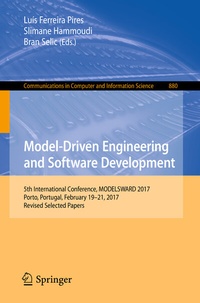
Model-Driven Engineering and Software Development
Description

This book constitutes thoroughly revised and selected papers from the 5th International Conference on Model-Driven Engineering and Software Development, MODELSWARD 2017, held in Porto, Portugal, in February 2017.
The 20 thoroughly revised and extended papers presented in this volume were carefully reviewed and selected from 91 submissions. They contribute to the development of highly relevant research trends in model-driven engineering and software development such as methodologies for MDD development and exploitation, model-based testing, model simulation, domain-specific modeling, code generation from models, new MDD tools, multi-model management, model evolution, and industrial applications of model-based methods and technologies.
More details
Other editions
Additional editions
Content
Sommelier: A Tool for Validating TOSCA Application TopologiesSommelier: A Tool for Validating TOSCA Application Topologies.- Evaluation of XIS-Reverse, a Model-Driven Reverse Engineering Approach for Legacy Information Systems.- Formal and Virtual Multi-level Design Space Exploration.- Automated Synthesis of a Real-time Scheduling for Cyber-physical Multi-core Systems.- A Model based Approach for Complex Dynamic Decision-making.- Deterministic High-level Executable Models Allowing Efficient Runtime Verification.- A Consistency-preserving Editing Model for Dynamic Filtered Engineering of Model-driven Product Lines.- Model-driven STEP Application Protocol Extensions Combined with Feature Modeling Considering Geometrical Information.- A Model Driven Engineering Approach for Heterogeneous Model Composition.- Generative versus Interpretive Model-Driven Development: Moving Past `It Depends'.- Applying Integrated Domain-Specific Modeling for Multi-concerns Development of Complex Systems.-A Domain-Specific Modeling Approach for Testing Environment Emulation.- A Framework for UML-based Component-based Design and Code Generation for Reactive Systems.- Automatic UI Generation for Aggregated Linked Data Applications by using Sharable Application Ontologies.- Surveying Co-Evolution in Modeling Ecosystems.- Functional Decomposition for Software Architecture Evolution.- Model-Driven Approach to Handle Evolutions of OLAP Requirements and Data Source Model.- Complex Event Processing for User-Centric Management of IoT Systems.- Efficient Distributed Execution of Multi-component Scenario-Based Models.- Modelling the World of a Smart Room for Robotic Co-working.
