

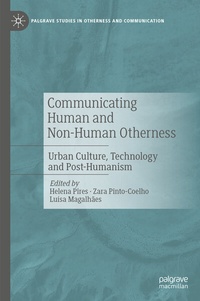
Communicating Human and Non-Human Otherness
Description

This book approaches the generic theme of the series - studies in otherness and communication - from the perspectives of urban culture and posthumanist studies. It brings together a broad variety of essays examining the different ways in which agency reinvents itself, whether in the urban space, through the multiple forms and devices of art and culture, or through the relationship with technology and the surrounding environment, as a result of the contemporary conditions of post-humanism and the anthropocene. The sense of becoming other is added through a new paradigm that combines 1) a theoretical-essayistic mode, supported by illustrative cases with 2) the description of artistic processes and literary production. The essays are written by an international group of humanities and social sciences scholars/artists, consisting of Cristina Álvares, Pier Luca Marzo, Edwige Armand, Chiara Mengozzi, Ricardo G. Soeiro, Panagiotis Ferentinos, Mónica Aubán Borrell, Luis Campos Medina, Bill Psarras, Cíntia Sanmartin Fernandes, Micael Herschmann, Mitja Velikonja, Teresa Mora and Tiago Porteiro.
More details
Other editions
Additional editions
Persons
Helena Pires is Professor at the Department of Communication Sciences at the University of Minho, is a member of the Communication and Society Research Centre, Portugal.
Zara Pinto-Coelho is Professor at the Department of Communication Sciences at the University of Minho, is a member of the Communication and Society Research Centre, Portugal..
Luísa Magalhães is co-editor of the Palgrave Studies in Otherness and Communication book series, is a researcher at the Centre for Philosophical and Humanistic Studies (CEFH) and Professor in Communication Sciences at the Catholic University of Portugal.
Content
1. Introduction.- Part 1: haring childhood geographies, inventing a common home: a study on "Duets".- 2. Walking towards / with the Other: Contemporary art practices/performances between visible and invisible layers, sites, and borders .- 3. The map of the Others.- 4. Don't Trans*Phobe, Trans*Form Yourself - (Anti-)Homophobic and (Anti-)Patriarchal Graffiti of the Post-Socialist Transition.- 5. The street and the circles as a space for women's (re)existence in the city of Rio de Janeiro.- 6. Living in High-Density Towers. Ghetto, Precariousness and Becoming-Other.- Part 2: Otherness and the critique of the subject: from psychoanalysis to posthumanism.- 7. Creation and posthumanism .- 8. Representing ecosystems: from prosopopoeia to the poetics of perspective.- 9. A grain of sand in the anthropocentric machine: On the poetry of W. Szymborska.- 10. The proposed title: (Re)activating More-than-human Knowledge in Eduardo Navarro's Sensory Performative Practices.- 11. The imaginary of otherness in the Technocene era.
