

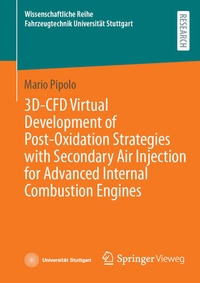
3D-CFD Virtual Development of Post-Oxidation Strategies with Secondary Air Injection for Advanced Internal Combustion Engines
Description

Upcoming automotive regulations require near-zero emissions, making cold-start catalyst heating a key challenge. This work investigates post oxidation through secondary air injection into the exhaust manifold to oxidise unburned fuel from rich combustion, generating heat and accelerating catalyst warm-up. The study combines experimental tests on a turbocharged four-cylinder engine with 3D-CFD simulations. A constant flow SAI system was installed near the exhaust valves, achieving stoichiometric conditions before the catalyst and increasing exhaust temperature during cold start due to oxidation reactions. Two numerical approaches were employed: a full engine simulation using the 3D-CFD tool QuickSim to extract detailed boundary conditions, and a detailed exhaust manifold model in StarCCM+ using these conditions to resolve mixing and chemical reactions. Results show that secondary air injection effectively increases exhaust temperatures upstream of the catalyst, and optimisation strategies such as higher air temperature, modified manifold design, and fuel post-injection can further improve post-oxidation efficiency.
More details
Other editions
Additional editions
Person
Mario Pipolo completed his Ph.D. at the University of Stuttgart (Germany) in 2025. His research focused on post-oxidation processes in internal combustion engines, particularly secondary air injection strategies analyzed using advanced 3D CFD simulations. He now works in motorsport engine development, specializing in the virtual development and optimization of high-performance engines.
Content
Introduction.- Fundamentals of 3D-CFD Simulations for ICEs.- Post-Oxidation in Internal Combustion Engines.- Methodology and Simulation Tools.- The Full Engine Virtual Test Bench.- Detailed Exhaust Model and Post-Oxidation Strategies.- Conclusion and Outlook.- Bibliography.
