

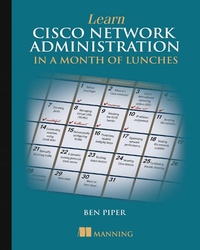
Learn Cisco Network Administration in a Month of Lunches
1st Edition
Published on 1. May 2017
312 pages
978-1-63835-137-5 (ISBN)
Description

Summary
Learn Cisco Network Administration in a Month of Lunches is a tutorial designed for beginners who want to learn how to administer Cisco switches and routers. Just set aside one hour a day (lunchtime would be perfect) for a month, and you'll start learning practical Cisco Network administration skills faster than you ever thought possible.
Purchase of the print book includes a free eBook in PDF, Kindle, and ePub formats from Manning Publications.
About the Technology
Cisco's ultrareliable routers and switches are the backbone of millions of networks, but "set and forget" is not an acceptable attitude. Fortunately, you don't have to be an old-time administrator to set up and maintain a Cisco-based network. With a handful of techniques, a little practice, and this book, you can keep your system in top shape.
About the Book
Learn Cisco Network Administration in a Month of Lunches is designed for occasional and full-time network administrators using Cisco hardware. In 22 bite-sized lessons, you'll learn practical techniques for setting up a Cisco network and making sure that it never fails. Real-world labs start with configuring your first switch and guide you through essential commands, protocols, dynamic routing tricks, and more.
What's Inside
About the Reader
This book is written for readers with no previous experience with Cisco networking.
About the Author
Ben Piper is an IT consultant who holds numerous Cisco, Citrix, and Microsoft certifications including the Cisco CCNA and CCNP. He has created many video courses on networking, Cisco CCNP certification, Puppet, and Windows Server Administration.
Table of Contents
Learn Cisco Network Administration in a Month of Lunches is a tutorial designed for beginners who want to learn how to administer Cisco switches and routers. Just set aside one hour a day (lunchtime would be perfect) for a month, and you'll start learning practical Cisco Network administration skills faster than you ever thought possible.
Purchase of the print book includes a free eBook in PDF, Kindle, and ePub formats from Manning Publications.
About the Technology
Cisco's ultrareliable routers and switches are the backbone of millions of networks, but "set and forget" is not an acceptable attitude. Fortunately, you don't have to be an old-time administrator to set up and maintain a Cisco-based network. With a handful of techniques, a little practice, and this book, you can keep your system in top shape.
About the Book
Learn Cisco Network Administration in a Month of Lunches is designed for occasional and full-time network administrators using Cisco hardware. In 22 bite-sized lessons, you'll learn practical techniques for setting up a Cisco network and making sure that it never fails. Real-world labs start with configuring your first switch and guide you through essential commands, protocols, dynamic routing tricks, and more.
What's Inside
- Understand your Cisco network, including the difference between routers and switches
- Configure VLANs and VLAN trunks
- Secure your network
- Connect and configure routers and switches
- Establish good maintenance habits
About the Reader
This book is written for readers with no previous experience with Cisco networking.
About the Author
Ben Piper is an IT consultant who holds numerous Cisco, Citrix, and Microsoft certifications including the Cisco CCNA and CCNP. He has created many video courses on networking, Cisco CCNP certification, Puppet, and Windows Server Administration.
Table of Contents
- Before you begin
- What is a Cisco network?
- A crash course on Cisco's Internetwork Operating System
- Managing switch ports
- Securing ports by using the Port Security feature
- Managing virtual LANs (VLANs)
- Breaking the VLAN barrier by using switched virtual interfaces
- IP address assignment by using Dynamic Host Configuration Protocol
- Securing the network by using IP access control lists
- Connecting switches using trunk links
- Automatically configuring VLANs using the VLAN Trunking Protocol
- Protecting against bridging loops by using the Spanning Tree Protocol
- Optimizing network performance by using port channels
- Making the network scalable by connecting routers and switches together
- Manually directing traffic using the IP routing table
- A dynamic routing protocols crash course
- Tracking down devices
- Securing Cisco devices
- Facilitating troubleshooting using logging and debugging
- Recovering from disaster
- Performance and health checklist
- Next steps
More details
Other editions
Additional editions
Ben Piper
Learn Cisco in a Month of Lunches
Book
06/2017
Manning Publications
€37.50
Shipment within 10-20 days
Person
Ben Piper
Content
- Intro
- Learn Cisco Network Administration in a Month of Lunches
- Copyright
- Brief Table of Contents
- Table of Contents
- Preface
- Acknowledgments
- About this Book
- About the Author
- Chapter 1. Before you begin
- Chapter 2. What is a Cisco network?
- Chapter 3. A crash course on Cisco's Internetwork Operating System
- Chapter 4. Managing switch ports
- Chapter 5. Securing ports by using the Port Security feature
- Chapter 6. Managing virtual LANs (VLANs)
- Chapter 7. Breaking the VLAN barrier by using switched virtual interfaces
- Chapter 8. IP address assignment by using Dynamic Host Configuration Protocol
- Chapter 9. Securing the network by using IP access control lists
- Chapter 10. Connecting switches using trunk links
- Chapter 11. Automatically configuring VLANs using the VLAN Trunking Protocol
- Chapter 12. Protecting against bridging loops by using the Spanning Tree Protocol
- Chapter 13. Optimizing network performance by using port channels
- Chapter 14. Making the network scalable by connecting routers and switches together
- Chapter 15. Manually directing traffic using the IP routing table
- Chapter 16. A dynamic routing protocols crash course
- Chapter 17. Tracking down devices
- Chapter 18. Securing Cisco devices
- Chapter 19. Facilitating troubleshooting using logging and debugging
- Chapter 20. Recovering from disaster
- Chapter 21. Performance and health checklist
- Chapter 22. Next steps
- Common show commands
- Index
- List of Figures
- List of Tables
