

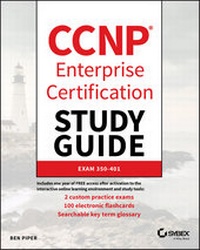
CCNP Enterprise Certification Study Guide
Description

From one of the most trusted study guide publishers comes CCNP Enterprise Certification Study Guide: Exam 350-401. This guide helps you develop practical knowledge and best practices for critical aspects of enterprise infrastructure so you can gain your CCNP Enterprise certification. If you're hoping to attain a broader range of skills and a solid understanding of Cisco technology, this guide will also provide fundamental concepts for learning how to implement and operate Cisco enterprise network core technologies.
By focusing on real-world skills, each chapter prepares you with the knowledge you need to excel in your current role and beyond. It covers emerging and industry-specific topics, such as SD-WAN, network design, wireless, and automation. This practical guide also includes lessons on:
* Automation
* Network assurance
* Security
* Enterprise infrastructure
* Dual-stack architecture
* Virtualization
In addition to helping you gain enterprise knowledge, this study guidecan lead you toward your Cisco specialist certification.
When you purchase this guide, you get access to the information you need to prepare yourself for advances in technology and new applications, as well as online study tools such as:
* Bonus practice exams
* Pre-made flashcards
* Glossary of key terms
* Specific focus areas
Expand your skillset and take your career to the next level with CCNP Enterprise Certification Study Guide.
More details
Other editions
Additional editions
Person
Ben Piper is an IT consultant who has created more than 20 training courses, covering Cisco routing and switching, Amazon Web Services, Puppet configuration management, and Windows Server Administration. He is the co-author of AWS Certified Cloud Practitioner Study Guide: Foundational (CLF-C01) Exam, AWS Certified Solutions Architect Study Guide: Associate (SAA-C01) Exam, AWS Certified SysOps Administrator Practice Tests: Associate (SOA-C01) Exam, and Learn Cisco Network Administration in a Month of Lunches.
Content
Introduction
Networking is uniquely challenging in that it's not a single technology, but a collection of interdependent technologies that every other aspect of IT depends on. Without networking, there are no connected applications and that means there are no IT employees. Even if you're not sure that you want networking to become your permanent career, becoming an expert at networking will open the doors for other in-demand areas of IT, including security, software development, and cloud computing.
Cisco's Professional Network Certifications
In 2019, Cisco announced updates to its Cisco Certified Network Professional (CCNP) certification program. There are six professional level certifications to choose from:
- CCNP Enterprise
- CCNP Data Center
- CCNP Security
- CCNP Service Provider
- CCNP Collaboration
- Cisco Certified DevNet Professional
Each certification requires passing one core exam and one concentration exam. The core exam for the CCNP Enterprise certification is 350-401 ENCOR, "Implementing Cisco Enterprise Network Core Technologies." The concentration exams let you focus on a specific specialty, such as routing, wireless, network design, automation, or software-defined networking (SDN). Regardless of the concentration exam you choose, you must pass the ENCOR exam to attain your CCNP Enterprise certification.
Is CCNP Certification Right for You?
Many who attain the Cisco Certified Network Associate (CCNA) don't go on to pursue more advanced Cisco certifications. So why should you consider the CCNP Enterprise certification, and is it right for you? It may be right for you if
- You have a passion for networking.
- You want to set yourself apart as someone who has a passion for technology and isn't just in it for the money (although there is plenty of that!).
- You want to specialize in security, wireless, network automation, cloud, or software-defined networking.
- You enjoy tweaking the "nerd knobs" on individual technologies just to see what will happen.
- You love facing and overcoming the challenges of troubleshooting.
Study Tips
Before taking the CCNP ENCOR exam, there are a few things to keep in mind. There's no reason that you can't pass the exam the first time. To help you do that, I want to share with you some study tips that have helped me pass several Cisco certification exams on the first try. One of the neglected skills required on any Cisco exam is speed. Being able to troubleshoot a 10-router Open Shortest Path First (OSPF) topology is good. Taking 15 minutes to do it is not so good. I can't stress enough the importance of spending quality time with the command-line interface (CLI). You should spend at least 50 percent of your study time on configuring and troubleshooting a variety of topologies and technologies.
There's an old Latin proverb that repetition is the mother of learning. Repetition-in terms of both study and practice-is going to be your best friend. Understanding networking requires making connections that aren't always obvious, and the more you practice and study, the more opportunities your mind has to make those connections. For years I've used SuperMemo (https://super-memory.com), a flashcard-like program that lets you create your own question-and-answer pairs, quizzes you, and shows you how well you're retaining the information. What makes SuperMemo superior to flashcards is that it identifies the information you've already retained, and it doesn't waste time continuing to quiz you on it. That means you can safely load your collection with hundreds of items while still using your time efficiently.
One last tip: As you read this study guide cover to cover, keep a running list of questions and things you're not sure about. Chances are if you find something confusing, a lot of other people did too, and that makes it good fodder for the exam. Be sure to visit https://benpiper.com/encor for book resources, updates, and errata.
Prerequisites and Lab Requirements
The CCNA certification isn't required to attain the CCNP Enterprise certification. Nevertheless, I strongly recommend that you obtain your CCNA certification or the equivalent experience before embarking on your CCNP Enterprise journey. Refer to the CCNA exam blueprint (www.cisco.com/c/en/us/training-events/training-certifications/certifications/associate/ccna.html) for a full list of topics you should already be familiar with. Because the CCNP Enterprise is a professional-level certification, I don't review some of the basics covered by the CCNA such as subnetting, IPv4, and IPv6 addressing.
You'll need a virtual or physical lab, which you should already have from your previous networking studies. Your lab should be able to support at least eight routers and two layer 3 switches running IOS version 15.2 or later. You should be able to configure your lab on your own by looking at layer 2 and layer 3 diagrams. Topology diagrams will be included in each chapter.
If your existing lab doesn't meet the requirement, Cisco Virtual Internet Routing Lab (http://virl.cisco.com) includes virtual machine images for a variety of switches and routers. These images are virtual machines that run using QEMU and are light on CPU and memory, so you don't need a beast of a server to run simulations, although more resources always help. Other options, although not blessed by Cisco, are GNS3 (https://gns3.com) and EVE-NG (www.eve-ng.net).
How to Use This Book
Hands-on experience is crucial for exam success. Each chapter in this study guide contains hands-on exercises that you should strive to complete during or immediately after your reading of the chapter. The exercises are there to test your understanding, and not to cover every possible permutation of configurations. The exercises are your foundation, and you should build on them by experimenting with them, breaking things, and then figuring out how to fix them.
Each chapter contains review questions to thoroughly test your understanding of the services and concepts covered in that chapter. They also test your ability to integrate the concepts with information from preceding chapters. I've designed the questions to help you realistically gauge your understanding and identify your blind spots. Once you complete the assessment in each chapter, referring to the answer key will give you not only the correct answers but a detailed explanation as to why they're correct. Even if you feel comfortable on a certain topic, resist the urge to skip over the pertinent chapter. I strongly encourage you to carefully read this book from cover to cover so that you can discover your strengths and weaknesses-particularly the ones you may not be aware of. Remember, even though you can't learn networking just by reading a book, it's equally true that you can't learn without reading a book.
The book also contains a self-assessment exam with 36 questions, two practice exams with 50 questions each to help you gauge your readiness to take the exam, and flashcards to help you learn and retain key facts needed to prepare for the exam.
What Does This Book Cover?
This book covers topics you need to know to prepare for the CCNP ENCOR exam:
Chapter 1: Networking Fundamentals This chapter overviews the fundamentals of networking theory and network design.
Chapter 2: Spanning Tree Protocols This chapter covers Spanning Tree protocols, including Rapid Spanning Tree and Multiple Instance Spanning Tree. We also cover VLANs, trunking, and pruning.
Chapter 3: Enterprise Network Design In this chapter, you'll learn the advantages and disadvantages of different physical and layer 2 network designs. We also dive into EtherChannels and first-hop redundancy protocols.
Chapter 4: Wireless LAN (WLAN) This chapter explains the fundamentals of radio frequency, WLAN 802.11 standards, wireless security, and WLAN controller (WLC) design and deployment considerations.
Chapter 5: Open Shortest Path First (OSPF) In this chapter, you'll learn how to configure and troubleshoot OSPF adjacencies, authentication, route filtering, summarization, and more.
Chapter 6: Enhanced Interior Gateway Routing Protocol (EIGRP) This chapter covers advanced EIGRP concepts, including redistribution, multipathing, and path control.
Chapter 7: The Border Gateway Protocol (BGP) In this chapter, you'll learn all about BGP, including path selection, redistribution, summarization, and filtering.
Chapter 8: Network Address Translation and Multicast This two-for-the-price-of-one chapter gives you complete coverage of network address translation and multicast.
Chapter 9: Quality of Service This chapter covers QoS concepts, including queuing, policing, shaping, and classification.
Chapter 10: Network Virtualization This chapter dives deep into virtualization concepts such as server virtualization, network virtualization, generic routing encapsulation, IPsec, LISP, and...
