

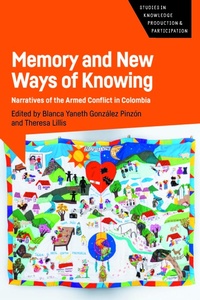
Memory and New Ways of Knowing
Narratives of the Armed Conflict in Colombia
Published on 13. May 2025
266 pages
978-1-80041-632-1 (ISBN)
Description

This book is a collaborative project which centres on the testimonios of more than 100 survivors of the harsh realities of the 80-year Colombian armed conflict, drawing on multiple disciplinary areas and practices: linguistics, philology and linguistics, education, journalism, academia, art and film, literature, human rights, sociology, urban geography, cosmogony and grassroots activism. Using extracts from testimonios in multiple forms - oral, written, film, textiles - and mobilising the concepts of Testimony, Narrative and Memory, the book explores how survivors of all ages configure and reconfigure their experiences, worldviews and identities, striving towards the building of new knowledges which will help ensure the non-repetition of violence. The book will be of interest to all who are committed to understanding conflict and post-conflict societies in the search for peace.
This book is open access under a CC BY ND licence.
This book is open access under a CC BY ND licence.
Reviews / Votes
This is an inspirational work, with a strong combination of nuanced theorizing and compelling data in the form of testimonios. The book invites readers to think about how narrative works towards building memory, creating change and imagining new futures. * Bronwyn T. Williams, University of Louisville, USA * This is a rigorous, multidisciplinary work which will be a reference point among studies seeking to explore the lived experiences of armed conflict. Built from the accounts of survivors in multiple forms - spoken and written accounts, film, textiles - the book provides a counterhegemonic perspective which works ethically and aesthetically towards the goal of 'non repetition' of violence and provides hope for a peaceful future. * Nora Solari, International Educational Consultant and Expert in Language, Literature and Latin Pedagogy, Argentina * A book which is both academically rigorous and emotionally moving, documenting the lived experiences of the ongoing Colombian armed conflict. The book draws on multiple voices to underline the hopes for building peace and reconciliation, as well as restorative and social justice. * Melba Libia Cardenas, Universidad Nacional de Colombia * The individual memories in this book form a collective memory that strengthens the processes of reconciliation and justice in Colombia. They call upon us, as a society, to assume a historical responsibility for making visible the survivors who faced conflict with stark resilience. * Shima Pardo, Journalist and Program Coordinator of the Feminist Movement "Ruta Pacifica de las Mujeres", Colombia * Despite the multitude of perspectives from the victims, the reader is left with the important impression that individuals and groups, who normally are marginalized and forgotten when war history is written, now have become included in the history about the long-lasting civil war in Colombia. This is so, even if the narratives they leave behind are quite varied and open for interpretation. Moreover, the victims have also been able to find a certain degree of personal healing through the testimonies they have given as a part of this process. * Wenche Iren Hauge, Journal of Peace Research, 2025 *More details
Series
Language
English
Place of publication
Bristol
United Kingdom
Target group
College/higher education
Product notice
Reflowable
ISBN-13
978-1-80041-632-1 (9781800416321)
Copyright in bibliographic data and cover images is held by Nielsen Book Services Limited or by the publishers or by their respective licensors: all rights reserved.
Schweitzer Classification
Other editions
Additional editions
Blanca Yaneth Gonzalez Pinzon | Theresa Lillis
Memory and New Ways of Knowing
Narratives of the Armed Conflict in Colombia
Book
05/2025
Multilingual Matters
€42.40
Shipment within 10-20 days
Persons
Blanca Yaneth Gonzalez Pinzon is an independent researcher, committed to transforming pedagogy and curricula. She is a founding member of the Reading and Writing Network in Higher Education of Colombia and External Pedagogical Advisor to the Colombian Association of Universities.
Theresa Lillis is Professor Emeritus of English Language and Applied Linguistics at The Open University, UK. She has published widely on academic, grassroots and professional writing and the politics of participation in knowledge-making.
Theresa Lillis is Professor Emeritus of English Language and Applied Linguistics at The Open University, UK. She has published widely on academic, grassroots and professional writing and the politics of participation in knowledge-making.
Content
Map
Contributors
Acknowledgements
About the Production of this Book
Acronyms
Introduction
Part 1: Historical Context of the Colombian Armed Conflict and Theoretical Approaches to Analysing its Narratives
Chapter 1. Luis Eduardo Celis: Colombia, Eight Decades in Search of Peace and Democracy
Chapter 2. Blanca Yaneth Gonzalez Pinzon and Claudia Bungard: Theoretical Approaches to Analysing Conflict Narratives
Part 2: Narratives of the Colombian Armed Conflict
Chapter 3. Blanca Yaneth Gonzalez Pinzon: Narrative as an Emotional Resource for the Empowerment of the Survivors of the Colombian Armed Conflict
Chapter 4. Jose Navia Lame: 'Walking the Word' with the Nasa People: A Perspective from the Narrative of The Strength of the Umbilical Cord (La Fuerza del Ombligo)
Chapter 5. Cecilia Traslavina Gonzalez: Narratives to Transform War Imaginaries in Colombia: An Animation Workshop with Ex-Guerrilla Children
Chapter 6. Claudia Bungard: Testimonios of Armed Conflict Survivors: Participants in Narrative Workshops in Medellin
Chapter 7. Mario Ramirez-Orozco: The Memory of the Future: The Voice of FARC-EP Reincorporated Combatants in the Construction of Peace Imaginaries
Chapter 8. Emilia Perassi: Weaving Memory and Unweaving Trauma: Textile Narratives on the Conflict in Colombia
Part 3: Reflections
Chapter 9. Theresa Lillis: Voicing Experiences of Conflict and Violence: Placed, Dis-Placed and Re-Placed Resources
Chapter 10. Jose Vicente Arizmendi Correa: Chronos and Kairos: A Time to Resist and A Time to Speak Out
Chapter 11. Blanca Yaneth Gonzalez Pinzon: Closing Thoughts
Index
Contributors
Acknowledgements
About the Production of this Book
Acronyms
Introduction
Part 1: Historical Context of the Colombian Armed Conflict and Theoretical Approaches to Analysing its Narratives
Chapter 1. Luis Eduardo Celis: Colombia, Eight Decades in Search of Peace and Democracy
Chapter 2. Blanca Yaneth Gonzalez Pinzon and Claudia Bungard: Theoretical Approaches to Analysing Conflict Narratives
Part 2: Narratives of the Colombian Armed Conflict
Chapter 3. Blanca Yaneth Gonzalez Pinzon: Narrative as an Emotional Resource for the Empowerment of the Survivors of the Colombian Armed Conflict
Chapter 4. Jose Navia Lame: 'Walking the Word' with the Nasa People: A Perspective from the Narrative of The Strength of the Umbilical Cord (La Fuerza del Ombligo)
Chapter 5. Cecilia Traslavina Gonzalez: Narratives to Transform War Imaginaries in Colombia: An Animation Workshop with Ex-Guerrilla Children
Chapter 6. Claudia Bungard: Testimonios of Armed Conflict Survivors: Participants in Narrative Workshops in Medellin
Chapter 7. Mario Ramirez-Orozco: The Memory of the Future: The Voice of FARC-EP Reincorporated Combatants in the Construction of Peace Imaginaries
Chapter 8. Emilia Perassi: Weaving Memory and Unweaving Trauma: Textile Narratives on the Conflict in Colombia
Part 3: Reflections
Chapter 9. Theresa Lillis: Voicing Experiences of Conflict and Violence: Placed, Dis-Placed and Re-Placed Resources
Chapter 10. Jose Vicente Arizmendi Correa: Chronos and Kairos: A Time to Resist and A Time to Speak Out
Chapter 11. Blanca Yaneth Gonzalez Pinzon: Closing Thoughts
Index
