

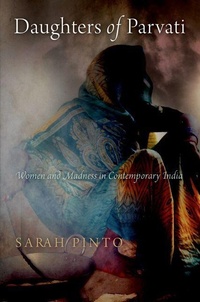
Daughters of Parvati
Women and Madness in Contemporary India
1st Edition
Published on 11. January 2014
296 pages
978-0-8122-0928-0 (ISBN)
Description

In her role as devoted wife, the Hindu goddess Parvati is the divine embodiment of viraha, the agony of separation from one's beloved, a form of love that is also intense suffering. These contradictory emotions reflect the overlapping dissolutions of love, family, and mental health explored by Sarah Pinto in this visceral ethnography.
Daughters of Parvati centers on the lives of women in different settings of psychiatric care in northern India, particularly the contrasting environments of a private mental health clinic and a wing of a government hospital. Through an anthropological consideration of modern medicine in a nonwestern setting, Pinto challenges the dominant framework for addressing crises such as long-term involuntary commitment, poor treatment in homes, scarcity of licensed practitioners, heavy use of pharmaceuticals, and the ways psychiatry may reproduce constraining social conditions. Inflected by the author's own experience of separation and single motherhood during her fieldwork, Daughters of Parvati urges us to think about the ways women bear the consequences of the vulnerabilities of love and family in their minds, bodies, and social worlds.
Daughters of Parvati centers on the lives of women in different settings of psychiatric care in northern India, particularly the contrasting environments of a private mental health clinic and a wing of a government hospital. Through an anthropological consideration of modern medicine in a nonwestern setting, Pinto challenges the dominant framework for addressing crises such as long-term involuntary commitment, poor treatment in homes, scarcity of licensed practitioners, heavy use of pharmaceuticals, and the ways psychiatry may reproduce constraining social conditions. Inflected by the author's own experience of separation and single motherhood during her fieldwork, Daughters of Parvati urges us to think about the ways women bear the consequences of the vulnerabilities of love and family in their minds, bodies, and social worlds.
Reviews / Votes
"Pinto's complex and moving ethnography explores women's lives in the context of different psychiatric care settings in a North Indian city. Woven together with Pinto's own experiences of love's breakdowns between India and Boston, Daughters of Parvati centres on the ways women take on the vulnerabilities and dependencies of marriage and family, and how psychiatric care, pharmaceuticals, and institutions mediate when relationships fall apart. [A]n illuminating ethnography [and] a complex and intimate example of feminist ethnography at its most vulnerable and powerful....[A] magisterial contribution to anthropological studies of global psychiatry and of kinship and care. It is also a moving and intimately reflexive book suggesting the power of ethnographic writing in its limits and possibilities." (Journal of the Royal Anthropological Institute) ""[A] compelling ethnography about women's engagement with Western psychiatric care in North India. In bearing witness to the difficult lives of women on the verge of mental and relational breakdowns, Pinto offers a nuanced account of the gendered particularities of everyday psychiatric practice in India. Her observations of the Indian context open windows onto global anthropological debates about the ethics of institutional care and medical therapeutics, the vicissitudes of biopolitical power and subject making, and the challenges of reflexive research in conditions of human crises and abuses....[S]ome of the most sophisticated anthropological writings on the subject." (American Anthropologist) "Daughters of Parvati is critical reading for scholars of medical anthropology, disability studies, genderand sexuality studies, and feminist methodologies...Pinto's work reveals not only the limits and constraints of our ethnographic methodologies (and, in turn, clinical and diagnostic settings) but also, crucially, their possibilities.
" (Isis) "One of the most compelling ethnographies I have read in recent years." (Veena Das, Medical Anthropology Quarterly) "A poignant, compelling, complex, and provocative example of anthropological storytelling. Based on original and evidently difficult fieldwork focused on the treatment of women's mental illnesses in north India, the book offers a gendered reading of psychiatry. It is also very much an intimate and intensely reflexive ethnography." (Ann Grodzins Gold, Syracuse University) "An important book, making interventions in how we think about choreographies of clinical mental health work with families broken and repaired. Its ethnographic specificities have to do with India, but its accounts of medical, familial, and narrative crises are of broad theoretical import." (Michael M. J. Fischer, Massachusetts Institute of Technology)
All prices
More details
Series
Language
English
Place of publication
Pennsylvania
United States
Target group
Professional and scholarly
Illustrations
2 illus.
2 illus.
File size
3,72 MB
ISBN-13
978-0-8122-0928-0 (9780812209280)
Copyright in bibliographic data and cover images is held by Nielsen Book Services Limited or by the publishers or by their respective licensors: all rights reserved.
Schweitzer Classification
Other editions
Additional editions

Book
07/2022
University of Pennsylvania Press
€25.00
Shipment within 3-4 weeks

Book
02/2014
University of Pennsylvania Press
€65.00
Shipment within 10-20 days
Person
Sarah Pinto is Professor of Anthropology at Tufts University and author of Where There Is No Midwife: Birth and Loss in Rural India.
Content
Note on Transliterations Introduction: Love and Affliction Chapter 1. Rehabilitating Ammi Chapter 2. On Dissolution Chapter 3. Moksha and Mishappenings Chapter 4. On Dissociation Chapter 5. Making a Case Chapter 6. Ethics of Dissolution Bibliography Index Acknowledgments

