

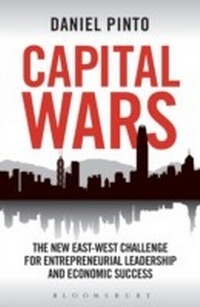
Capital Wars
The New East-West Challenge for Entrepreneurial Leadership and Economic Success
1st Edition
Published on 30. January 2014
256 pages
978-1-4729-0507-9 (ISBN)
Description

Just a few years is all it took for the debt crisis to bring down the mighty 'twin towers' of American and European capitalism and undo two centuries of Western dominance on the world's economic and political stage. Daniel Pinto offers a unique insight into how the East is winning the battle for economic supremacy, thereby shaping the new world order and leaving America and Europe with no choice but to reinvent themselves.
Drawing on his own experience at the highest levels of business and finance, Pinto dismisses the common notion that globalisation is to blame for anaemic growth, massive unemployment and over-indebtedness. Instead, he argues that by killing our own entrepreneurial spirit, we have set the stage for the demise of the West and the rise of emerging powers.
Capital Wars is a road map designed to re-energise large corporations, better control financial markets and reposition the entrepreneur at the centre of the Western capitalist model in order to regain economic dominance.
Drawing on his own experience at the highest levels of business and finance, Pinto dismisses the common notion that globalisation is to blame for anaemic growth, massive unemployment and over-indebtedness. Instead, he argues that by killing our own entrepreneurial spirit, we have set the stage for the demise of the West and the rise of emerging powers.
Capital Wars is a road map designed to re-energise large corporations, better control financial markets and reposition the entrepreneur at the centre of the Western capitalist model in order to regain economic dominance.
Reviews / Votes
Daniel Pinto has written an important and penetrating critique of Western capitalism. Pinto argues that the West has lost the spirit of entrepreneurial capitalism embodied in owner managed companies much more common in the Far East. Western companies, he argues, have become bureaucratic behemoths, struggling with regulation and notions of 'good governance'. Meanwhile, he warns us, the shift in economic power continues to move to Asia. This book deserves a wide circulation in the corridors of Whitehall. * former Chancellor of the Exchequer, United Kingdom * In Capital Wars, Daniel Pinto makes a compelling case for a new kind of entrepreneurial spirit needed to resuscitate Western economies. Five years after the global financial crisis delivered a near-fatal blow to our capitalist model, he argues that a new breed of modern-day entrepreneur is essential to build the wealth-creating businesses of the future. His forward-looking perspective is a breath of fresh air and he's absolutely right; if businesses in the more developed economies do rise to the challenge of 'entrepreneurial reinvigoration', it'll put us back on track to deliver long-term economic growth and shared prosperity in the West. * Chairman of JCB * Risky, long-term research and development, not short term profit hunting, leads to sustainable growth. It is why I have kept Dyson private. It allows us to explore technology properly, to get meaningful results. This approach is too slow and risky for some shareholders - Capital Wars addresses this head on. * founder of the Dyson Company * Daniel Pinto has written a remarkable book. He begins with an informed and merciless analysis of how the West has strayed; and then goes on to propose a practical programme for change that makes instinctive and inspiring sense: all in admirable English. If our leaders are wise enough to read, digest and apply, the West will be entitled to fear less and hope for more than current opinion holds. * CEO, WPP * Daniel Pinto offers a timely challenge to the West via a fascinating exploration of the dynamic East. * former CEO of BP and the UK Government's Lead Non-Executive Director * This is not another ponderous tome by a dabbling academic outsider, but a broad, spirited, articulate and incredibly well-informed assessment of both global economic performance over the past two decades and prospects for the future. * CHOICE connect, a publication of the Association of College and Research Libraries, a division of the American Library Assocation *More details
Edition
1. Auflage
Language
English
Place of publication
London
United Kingdom
Target group
Professional and scholarly
ISBN-13
978-1-4729-0507-9 (9781472905079)
Copyright in bibliographic data and cover images is held by Nielsen Book Services Limited or by the publishers or by their respective licensors: all rights reserved.
Schweitzer Classification
Other editions
Additional editions
Daniel Pinto
Capital Wars
The New East-West Challenge for Entrepreneurial Leadership and Economic Success
Book
01/2014
Bloomsbury Information
€50.95
Article exhausted; check different version
Person
Daniel Pinto lives in London and is co-founder and CEO of Stanhope Capital, one of the major independent asset-management groups in Europe and the founder and Chairman of the think tank New City Initiative (NCI), which has been at the forefront of the debate about ways of reforming the world of financial services in the wake of the 2008 financial crisis. A former investment banker, Pinto has served for 20 years as a financial adviser to governments, executives of large groups, industrialists, entrepreneurs and some of the richest families in the old and new worlds. A regular contributor of articles and editorials on economic and financial issues to leading newspapers (International Herald Tribune, The Independent, Telegraph, Le Monde, Le Figaro, Les Echos) Pinto sits on several prominent boards and investment committees. He received an MBA from Harvard Business School, graduated from Institut d'Etudes Politiques de Paris with an MA in Economics & Finance and holds an MSc in Finance from Universite Paris-Dauphine. Pinto holds dual French and British citizenships.
Content
- Cover
- Contents
- Introduction
- Part One: From the capitalism of creators to the capitalism of apparatchiks: the rise and fall of the West
- 1 The end of our illusions
- 1. Illusions, the drivers of our decline
- 2. The opposing forces
- 3. 'You have the growth, we'll have the debt!'
- 4. Banks and States: both arsonists and fire-fighters
- 5. A rope to hang ourselves or to pull ourselves out of the rut?
- 2 The impossible gamble of redistribution without growth
- 1. The implosion of Western social models
- 2. Powerless governments: too fast for the economy, too slow for the markets
- 3. European deconstruction
- 4. The crumbling city on the hill
- 3 From empire-builders to administrators: chronicle of a death foretold
- 1. The end of the empire-builder, the root of the West's demise
- 2. Can we still make elephants dance?
- 3. The rise of the nomadic investor
- 4. From financial myopia to the erosion of our competitiveness
- 5. Divergent interests as a system
- 6. Corporate governance: when the tree hides the forest
- 7. Litigation culture and risk-aversion
- 8. Requiem for an entrepreneur
- 9. The end of the partnership and the triumph of the Banker-King: 'Heads I win, tails you lose'
- Part Two: Their conquests, our recipes: how emerging powers made our entrepreneurial capitalism their own
- 1 Emerging powers: how the war was (almost) won
- 1. Two winning models, one horizon
- 2. The secrets of Statentrepreneurial capitalism
- 3. The comeback of family capitalism
- 4. The domestic victory: the creation of the new middle class
- 2 How we were robbed of our own capitalism
- 1. The Entrepreneur-State-Market triangle: a Western invention
- 2. The architects of yesterday and tomorrow
- 3 The new geopolitics of money
- 1. The weapons of financial dissuasion
- 2. The assault on international organisations
- 3. The dangerous temptation of protectionism
- 4. Currency wars
- 5. How to buy a continent: the example of Africa
- 6. Intellectual property: the last bastion of the West
- 7. Environmental protection: might makes right
- Part Three: Rebuilding upon the ruins of Western capitalism
- 1 First step: bring down the myths
- 1. Emerging countries are winning the economic war, but can they reign?
- 2. The economic Maginot Line fantasy: one man's wealth is not another man's poverty
- 2 Turning the apparatchik CEO back into a real entrepreneur
- 1. Reconciling our listed companies with the long term
- 2. CEOs must think like business owners: 'put your money where your mouth is!'
- 3. Appraise and compensate business leaders over time
- 4. Re-energise corporate boards and redefine the 'standards of good governance'
- 5. Rebuild bridges with shareholders and increase their loyalty
- 3 Transforming finance from an end to a means
- 1. Retool but don't punish finance
- 2. Putting the client and the economy back at the heart of banking
- 3. Making non-bank finance accountable too
- 4. To stabilise the financial system, encourage competition, and bring back the partnership mindset
- 4 Repositioning the business-creator as the cornerstone of capitalism
- 1. No entrepreneur, no capitalism
- 2. Fiscal and administrative moratoria for young entrepreneurs
- 3. Facilitate the transmission of family-held businesses
- 4. Make entrepreneurship commonplace from student age onwards
- 5. Rebuild bridges between large corporations and SMEs
- 6. Incentivise banks to lend to SMEs
- 7. Boost venture capital
- Conclusion: Reinvent the magic triangle
- Acknowledgements
- Index
- A
- B
- C
- D
- E
- F
- G
- H
- I
- J
- K
- L
- M
- N
- O
- P
- R
- S
- T
- U
- V
- W
- X
- Z
