

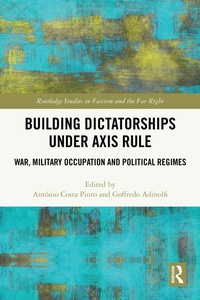
Building Dictatorships under Axis Rule
War, Military Occupation and Political Regimes
Published on 6. March 2025
324 pages
978-1-040-31366-4 (ISBN)
Description

This book offers a broad comparative perspective on regime building under Axis rule during the Second World War, exploring case studies in Europe and Asia.
Military occupation represents the highest degree of political, social and economic control over an occupied state and its society. This collective book analyses how the three poles of Axis rule-Nazi Germany, Italian Fascism and Authoritarian Japan-lead the dynamics of institution-building of political regimes of occupation under their direct or indirect control.
The contributions examine how the ideological, political and economic relationship between the occupying forces and different segments of national and local elites were present in the institutional crafting of new regimes. Military occupation opened a window of opportunity for the takeover of power by different segments of these authoritarian elites and the tension and forced pacts between different projects of institutionalization of dictatorships were a clear sign of this dynamic process. In this context, the debates and the praxis of the construction of new dictatorial political systems are analysed, looking to identify the design of their institutions, the segments of the political elites that hegemonize them, the diffusion and promotion models present, and the attitudes of the Axis powers before them.
This volume is ideal for all those interested in the study of War, Dictatorships and the global history and politics of Fascism.
Military occupation represents the highest degree of political, social and economic control over an occupied state and its society. This collective book analyses how the three poles of Axis rule-Nazi Germany, Italian Fascism and Authoritarian Japan-lead the dynamics of institution-building of political regimes of occupation under their direct or indirect control.
The contributions examine how the ideological, political and economic relationship between the occupying forces and different segments of national and local elites were present in the institutional crafting of new regimes. Military occupation opened a window of opportunity for the takeover of power by different segments of these authoritarian elites and the tension and forced pacts between different projects of institutionalization of dictatorships were a clear sign of this dynamic process. In this context, the debates and the praxis of the construction of new dictatorial political systems are analysed, looking to identify the design of their institutions, the segments of the political elites that hegemonize them, the diffusion and promotion models present, and the attitudes of the Axis powers before them.
This volume is ideal for all those interested in the study of War, Dictatorships and the global history and politics of Fascism.
More details
Series
Language
English
Place of publication
London
United Kingdom
Publishing group
Taylor & Francis Ltd
Target group
College/higher education
Professional and scholarly
Illustrations
2 Tables, black and white
File size
3,62 MB
ISBN-13
978-1-040-31366-4 (9781040313664)
Copyright in bibliographic data and cover images is held by Nielsen Book Services Limited or by the publishers or by their respective licensors: all rights reserved.
Schweitzer Classification
Other editions
Additional editions
Antonio Costa Pinto | Goffredo Adinolfi
Building Dictatorships under Axis Rule
War, Military Occupation and Political Regimes
Book
approx. 07/2026
1st Edition
Routledge
€57.50
Not yet published
Antonio Costa Pinto | Goffredo Adinolfi
Building Dictatorships under Axis Rule
War, Military Occupation and Political Regimes
Book
03/2025
1st Edition
Routledge
€208.20
Shipment within 10-20 days

Antonio Costa Pinto | Goffredo Adinolfi
Building Dictatorships Under Axis Rule
War, Military Occupation and Political Regimes
Book
03/2025
Routledge
Unfortunately, price unknown
Available (delivery time upon request)
Persons
Antonio Costa Pinto is a professor of politics at Lusofona University, Campus of Lisbon and a research professor at the Institute of Social Science, University of Lisbon. His research interests include fascism, democratisation and political elites. Recent publications include: Looking for An Authoritarian Third Way in the Era of Fascism. Diffusion, Models and Interactions in Europe and Latin America (2021).
Goffredo Adinolfi is a research fellow at the Centre for Research and Studies in Sociology of the University Institute of Lisbon. His research interests are mainly focused on anti-liberal thought, fascism and populism. He is the author of The Rise of Mass Parties, Liberal Italy, and the Fascist Dawn (1919-1924) (2025).
Goffredo Adinolfi is a research fellow at the Centre for Research and Studies in Sociology of the University Institute of Lisbon. His research interests are mainly focused on anti-liberal thought, fascism and populism. He is the author of The Rise of Mass Parties, Liberal Italy, and the Fascist Dawn (1919-1924) (2025).
Content
1. Building Dictatorships under Axis Rule. Towards a Global Overview
Antonio Costa Pinto
2. Hacha's Protectorate. Limping Corporatism and Calibrated Collaboration in Bohemia and Moravia under Nazi Rule
Radka Sustrova
3. 'Hitler Gave the Slovaks a State': On the Fascistization of Christian Nationalism and Social Catholicism in Tiso's Slovakia, 1939-1942
Miloslav Szabo
4. "Not to recognise oneself as a serf is the worst of servitudes." Marshall Petain as a dictator, July 1940-August 1944 Marc-Olivier Baruch
5. Norway under Vidkun Quisling: 'Not guilty!'
Stein U. Larsen
6. The short-lived national-socialist Arrow-Cross government in Hungary: imported Fascism vs. local conservatism?
Catherine Horel
7. The Ustasha Regime, State, and Nation-Building Process. State 'Independence' in the Axis 'New Order'
Goran Miljan
8. The Nedic Regime in Occupied Serbia. Conflicting Loyalties and Aims
Rastko Lompar
9. Building a puppet state: Italian Occupation and collaboration in Albania, 1939-1943
Enriketa Pandelejmoni
10. The Italian Social Republic. Legitimation Struggles and Unfulfilled Visions
Goffredo Adinolfi
11.State (dis)continuity in occupied Greece: regimes of emergency
Aristotle Kallis
12. Ideology and control: Instruments of authoritarianism in Japanese Manchuria
Thomas David DuBois
13. From Constitutional Mirage to Party Hegemony: Building the Wang Jingwei Regime in Japanese-Occupied China (1939-1942)
David Serfass
Antonio Costa Pinto
2. Hacha's Protectorate. Limping Corporatism and Calibrated Collaboration in Bohemia and Moravia under Nazi Rule
Radka Sustrova
3. 'Hitler Gave the Slovaks a State': On the Fascistization of Christian Nationalism and Social Catholicism in Tiso's Slovakia, 1939-1942
Miloslav Szabo
4. "Not to recognise oneself as a serf is the worst of servitudes." Marshall Petain as a dictator, July 1940-August 1944 Marc-Olivier Baruch
5. Norway under Vidkun Quisling: 'Not guilty!'
Stein U. Larsen
6. The short-lived national-socialist Arrow-Cross government in Hungary: imported Fascism vs. local conservatism?
Catherine Horel
7. The Ustasha Regime, State, and Nation-Building Process. State 'Independence' in the Axis 'New Order'
Goran Miljan
8. The Nedic Regime in Occupied Serbia. Conflicting Loyalties and Aims
Rastko Lompar
9. Building a puppet state: Italian Occupation and collaboration in Albania, 1939-1943
Enriketa Pandelejmoni
10. The Italian Social Republic. Legitimation Struggles and Unfulfilled Visions
Goffredo Adinolfi
11.State (dis)continuity in occupied Greece: regimes of emergency
Aristotle Kallis
12. Ideology and control: Instruments of authoritarianism in Japanese Manchuria
Thomas David DuBois
13. From Constitutional Mirage to Party Hegemony: Building the Wang Jingwei Regime in Japanese-Occupied China (1939-1942)
David Serfass
