

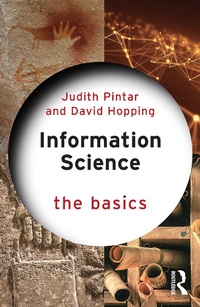
Information Science
The Basics
1st Edition
Published on 30. December 2022
276 pages
978-1-000-81797-3 (ISBN)
Description

Information Science: The Basics provides an accessible introduction to the multifaceted field of Information Science (IS).
Inviting readers to explore a modern field of study with deep historical foundations, the book begins by considering the complexities of the term "information" and the information life cycle from classification to preservation. Each chapter examines a different area within IS, surveying its history, technologies, and practices with a critical eye. This interdisciplinary field incorporates a wide range of approaches which it shares with humanities, social science, and technology fields. What makes IS unique is its emphasis on the connections between information, technology, and society. The need to share information more effectively in response to social, environmental, and biomedical challenges has never been so urgent; the volume discusses the risks as well as benefits that come with the emerging technologies that make it possible. The book also explores how IS, with its long-standing commitment to intellectual freedom and digital inclusion, and its keen attention to the protection of privacy, data ethics, and algorithmic transparency, can contribute to the creation of a more open and equitable society.
Information Science: The Basics is essential reading for anyone who wishes to know more about information and the impact it has on our world. It will be particularly useful for anyone intending to study IS at the undergraduate level or considering a shift to a career in the information professions.
Inviting readers to explore a modern field of study with deep historical foundations, the book begins by considering the complexities of the term "information" and the information life cycle from classification to preservation. Each chapter examines a different area within IS, surveying its history, technologies, and practices with a critical eye. This interdisciplinary field incorporates a wide range of approaches which it shares with humanities, social science, and technology fields. What makes IS unique is its emphasis on the connections between information, technology, and society. The need to share information more effectively in response to social, environmental, and biomedical challenges has never been so urgent; the volume discusses the risks as well as benefits that come with the emerging technologies that make it possible. The book also explores how IS, with its long-standing commitment to intellectual freedom and digital inclusion, and its keen attention to the protection of privacy, data ethics, and algorithmic transparency, can contribute to the creation of a more open and equitable society.
Information Science: The Basics is essential reading for anyone who wishes to know more about information and the impact it has on our world. It will be particularly useful for anyone intending to study IS at the undergraduate level or considering a shift to a career in the information professions.
More details
Series
Edition
1. Auflage
Language
English
Place of publication
London
United Kingdom
Publishing group
Taylor & Francis Ltd
Target group
College/higher education
Product notice
Reflowable
ISBN-13
978-1-000-81797-3 (9781000817973)
Copyright in bibliographic data and cover images is held by Nielsen Book Services Limited or by the publishers or by their respective licensors: all rights reserved.
Schweitzer Classification
Other editions
Additional editions
Book
12/2022
1st Edition
Routledge
€28.00
Shipment within 15-20 days
Book
12/2022
1st Edition
Routledge
€111.58
Shipment within 15-20 days

Book
12/2022
Taylor & Francis
Unfortunately, price unknown
Available (delivery time upon request)
Persons
Judith Pintar is a faculty member and directs the Game Studies & Design program in the School of Information Sciences at the University of Illinois Urbana-Champaign. In 2020, she was named a University of Illinois Distinguished Teacher/Scholar. She teaches introduction to information sciences, and interactive narrative design. Her research interests include game studies, gameful pedagogy, digital literacies, immersive storytelling, narrative AI, the digital afterlife, propaganda, persuasion, and disinformation.
David Hopping is faculty member and Director of Workforce Development/Continuing Education in the School of Information Sciences at the University of Illinois Urbana-Champaign. He teaches web design, information architecture, and web content strategies. His research interests include social and community informatics, sociological theories of human rights, action research and public policy relating to digital inclusion and digital literacy, and biofeedback game design in virtual environments.
David Hopping is faculty member and Director of Workforce Development/Continuing Education in the School of Information Sciences at the University of Illinois Urbana-Champaign. He teaches web design, information architecture, and web content strategies. His research interests include social and community informatics, sociological theories of human rights, action research and public policy relating to digital inclusion and digital literacy, and biofeedback game design in virtual environments.
Content
Preface; Introduction; Chapter One: Collecting Information; Chapter Two: Classifying Information; Chapter Three: Organizing Information; Chapter Four: Retrieving Information; Chapter Five: Utilizing Information; Chapter Six: Governing Information; Chapter Seven: Studying Information; Chapter Eight: Designing Information; Chapter Nine: Preserving Information; Chapter Ten: Imagining Information; Bibliography; Index.
