

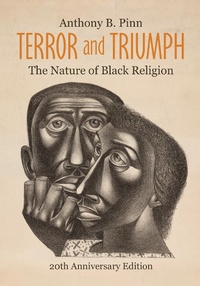
Terror and Triumph
Description

Given the unique history of African Americans and their diverse religious flowering in Black Christianity, the Nation of Islam, voodoo, and others, what is the heart and soul of African American religious life?
As a leader in both Black religious studies and theology, Anthony Pinn has probed the dynamism and variety of African American religious expressions. In this work, based on the Edward Cadbury Lectures at the University of Birmingham, England, he searches out the basic structure of Black religion, tracing the Black religious spirit in its many historical manifestations.
Pinn finds in the terrors of enslavement of Black bodies and subsequent oppressions the primal experience to which the Black religious impulse provides a perennial and cumulative response. Oppressions entailed the denial of personhood and creation of an object: the negro. Slave auctions, punishments, and, later, lynchings created an existential dread but also evoked a quest, a search, for complex subjectivity or authentic personhood that still fuels Black religion today.
In this 20th anniversary edition of Pinn's groundbreaking work, the author offers a new reflection on the argument in retrospect and invites a panel of five contemporary scholars to examine what it means for current and future scholarship. Contributors include Keri Day, Sylvester Johnson, Anthony G. Reddie, Calvin Warren, and Carol Wayne White.
More details
Other editions
Additional editions
Person
Content
- Cover Page
- Title Page
- Copyright Page
- Contents
- Preface to the Anniversary Edition
- Preface
- 1. "Look, a Negro!": How the New World African Became an Object of History
- Framing the Initial Contact
- The African as a "Problem": Phase One
- The African as a "Problem": Phase Two, or Slavery
- Slavery and Dehumanization
- Dehumanization and Postslavery America
- Part One: Constructing Terror
- 2. "How Much for a Young Buck?": Slave Auction and Identity
- Slavery and the Business of Production
- The Middle Passage
- The Other "Middle Passage"
- Slave Auctions: Peddling Flesh
- Slave Trading and Social Arrangements
- Slave Auctions and Historical Displacement: Objects Defined
- Slave Auctions as Ritual of Reference
- 3. Rope Neckties: Lynching and Identity
- The Price of Freedom
- Disenfranchisement and Movement
- The Good Ol' Days: Social Order and Popular Punishment
- Blacks and the Practice of Lynching
- Rope, Violence, and Social Control
- Destruction of Flesh and the Containment of Chaos
- Lynching as Ritual of Reference
- Part Two: Waging War
- 4. Houses of Prayer in a Hostile Land: Responses of Black Religion to Terror
- Blacks and Religion
- The Art of Christianization
- Blacks and Independent Religious Institutions
- Religion, Socioeconomic Transformation, and Political Liberation
- Religion, Conduct, and Aesthetics as Liberation
- Spiritual Practices, Ecstatic Behavior, and Liberation
- Theological Rhetoric as Liberation
- 5. Covert Practices: Further Responses of Black Religion to Terror
- Blacks and Their Proper Religion
- Religion and Socioeconomic Development as Liberation
- Health and Aesthetics as Liberation
- Ethical Conduct as Liberation
- Theology of Special-ness as Liberation
- Theological Anthropology on Its Head
- Louis Farrakhan and the Nation's Agenda
- 6. "I'll Make Me a World": Black Religion as Historical Context
- Fragile Cultural Memory and the Study of Religion
- Method, Part One: Archaeology as Metaphor and Practice
- Method, Part Two: Archaeology and the Hermeneutic of Style
- Hermeneutic of Style and the Body
- Display of Black Bodies: Expressive and Decorative Culture
- Bodies Celebrated: Visual Arts and Literature
- Bodies in Motion: The Ethics of Perpetual Rebellion
- Part Three: Seeking Triumph
- 7. Crawling Backward: Toward a Theory of Black Religion's Center
- Dehumanization and Subjectivity
- Conversion Experience and Complex Subjectivity
- Conversion and the Nature of Religion
- Black Religion as Quest for Complex Subjectivity
- Experiencing Religion
- Why Is This Religion?
- 8. Finding the Center: Methodological Issues Considered
- Psychology of Religion and Centering
- Psychology of Religion and the Hermeneutic of Inner Meaning
- History of Religions and the Hermeneutic of the Ontological Dimension
- Art History and the Meaning of Things
- Art Criticism-Talking about Things Hidden from Sight
- An Interdisciplinary Venture, or Introducing Relational Centralism
- Part Four: Critical Reflections
- 9. "We Can Feel the Spirit in This!": A Black Pentecostal, Black Atlantic Dialogue with Terror and Triumph
- 10. Reflections on Terror and Triumph at Twenty Years: Contributions and Lingering Questions
- 11. Blackness, Indigenous Africa, and the Essence of Black Religion in Terror and Triumph: The Nature of Black Religion
- 12. The Triumph of Terror and Triumph: The Nature of Black Religion
- 13. Rituals of Reference: Anthony Pinn, Frantz Fanon, and Ontological Yearning
- 14. Capturing the Beauty of Materialism: Black Bodies, Ontic Desires, and Processes of Humanization
- Notes
- Selected Bibliography
- African-Derived Religious Practices
- Art, Art Theory, and Art Criticism
- Christianity
- Cultural Criticism
- Disenfranchisement
- Islam and the Nation of Islam
- Philosophy and Critical Theory
- Religious Thought
- Slavery and the Slave Trade
- Theory of Religion
- Index to the Main Text
