

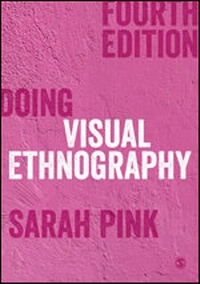
Doing Visual Ethnography
4th Edition
Published on 16. December 2020
304 pages
978-1-5297-4397-5 (ISBN)
Description

This book is the definitive guide to understanding and doing visual ethnography.
Sarah Pink's landmark text provides you with both the critical theoretical foundations and the creative tools and techniques you need to conduct your own visual ethnography.
Covering the material and the digital, and tying key concepts and ideas to real world contexts throughout, this fully updated fourth edition:
Provides clear and critical guidance on research planning and ethics
Discusses new and emerging technologies, including digitally connected devices and wearable cameras.
Introduces contemporary methods such as futures ethnography, distance ethnography, team ethnography, and the use of documentary.
Explores the latest theory and practice in photographic and video ethnography.
Shows you how visual ethnography can be applied, participatory, and even interventional.
A milestone in visual and ethnographic research, this book is a must-have for students and researchers across the social sciences. It is an essential invitation, and companion, to doing impactful, creative, and critical visual research.
Sarah Pink's landmark text provides you with both the critical theoretical foundations and the creative tools and techniques you need to conduct your own visual ethnography.
Covering the material and the digital, and tying key concepts and ideas to real world contexts throughout, this fully updated fourth edition:
Provides clear and critical guidance on research planning and ethics
Discusses new and emerging technologies, including digitally connected devices and wearable cameras.
Introduces contemporary methods such as futures ethnography, distance ethnography, team ethnography, and the use of documentary.
Explores the latest theory and practice in photographic and video ethnography.
Shows you how visual ethnography can be applied, participatory, and even interventional.
A milestone in visual and ethnographic research, this book is a must-have for students and researchers across the social sciences. It is an essential invitation, and companion, to doing impactful, creative, and critical visual research.
Reviews / Votes
Sarah Pink's work has been in the forefront of social research methods for decades. With this revised edition of Doing Visual Ethnography, she builds on her clear and compelling descriptions of how to do visual methods by incorporating discussion of the latest digitised ways of seeing, as well as emphasising the importance of multisensory, participatory and future-oriented approaches. Readers across the humanities and social sciences will find much in this book to intrigue and inspire them. -- Deborah Lupton The fourth edition of Sarah Pink's classic, Doing Visual Ethnography, is a tour de force. On each and every page of this important, wonderfully updated and insightful book, Pink demonstrates - in clear and compelling prose - a profound mastery of the technological, practical, theoretical and ethical intricacies of image-based ethnographic research in contemporary society.This work is more than the presentation of a how-to set of of visual methodologies. Indeed, Doing Visual Ethnography is nothing less than a sophisticated and comprehensive model for conducting social science research in the 21st century - a gift for present and future ethnographers. -- Paul Stoller
More details
Edition
Fourth Edition
Language
English
Place of publication
London
United Kingdom
Publishing group
Sage Publications Ltd (Digital)
Target group
College/higher education
ISBN-13
978-1-5297-4397-5 (9781529743975)
Copyright in bibliographic data and cover images is held by Nielsen Book Services Limited or by the publishers or by their respective licensors: all rights reserved.
Schweitzer Classification
Other editions
Additional editions
Sarah Pink
Doing Visual Ethnography
Book
01/2021
4th Edition
SAGE Publications Ltd
€162.60
Shipment within 15-20 days
Sarah Pink
Doing Visual Ethnography
Book
01/2021
4th Edition
SAGE Publications Ltd
€55.64
Shipment within 15-20 days
Person
Sarah Pink is Professor of Design and Emerging Technologies, Founding Director of the Emerging Technologies Research Lab at Monash University Australia and Associate Director of Monash Energy Institute. She is International Guest Professor at Halmstad University in Sweden, Adjunct Distinguished Professor at RMIT University Australia, where she was previously Director of the Digital Ethnography Research Centre. She is also Visiting Professor in the Design School and Fellow of the Institute of Advanced Studies at Loughborough University, where she was formerly Professor of Social Sciences. Sarah is a Fellow of the Academy of the Social Sciences in Australia.
Sarah is a world leader in innovative digital, visual and sensory research and dissemination methodologies, which she engages in interdisciplinary projects with design, engineering and creative practice disciplines to engage with contemporary issues and challenges. She is known globally for her design anthropological research and collaboration across disciplines and with partners inside and outside academia. She has developed and collaborated in visual ethnography research across the world, including in the United Kingdom, Spain, Sweden, Australia, Brazil, Chile and Indonesia.
Sarah is a world leader in innovative digital, visual and sensory research and dissemination methodologies, which she engages in interdisciplinary projects with design, engineering and creative practice disciplines to engage with contemporary issues and challenges. She is known globally for her design anthropological research and collaboration across disciplines and with partners inside and outside academia. She has developed and collaborated in visual ethnography research across the world, including in the United Kingdom, Spain, Sweden, Australia, Brazil, Chile and Indonesia.
Content
Part I: Interdisciplinary Theory and Practice
Chapter 1: Interdisciplinary Visual Ethnography
Chapter 2: Seeing, Knowing and Sharing
Chapter 3: Design, Ethics and Practice
Part II: Making, Knowing and Meaning
Chapter 4: Photographic Ethnography Practice
Chapter 5: Video Ethnography Practice
Chapter 6: Making Visual Ethnographic Meanings
Part III: Sharing, Intervention and Futures
Chapter 7: Visual Ethnography in Scholarship
Chapter 8: Documentary and Visual Ethnography
Chapter 9: Interventional Visual Ethnography
Chapter 1: Interdisciplinary Visual Ethnography
Chapter 2: Seeing, Knowing and Sharing
Chapter 3: Design, Ethics and Practice
Part II: Making, Knowing and Meaning
Chapter 4: Photographic Ethnography Practice
Chapter 5: Video Ethnography Practice
Chapter 6: Making Visual Ethnographic Meanings
Part III: Sharing, Intervention and Futures
Chapter 7: Visual Ethnography in Scholarship
Chapter 8: Documentary and Visual Ethnography
Chapter 9: Interventional Visual Ethnography
