

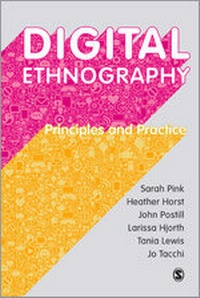
Digital Ethnography
Principles and Practice
1st Edition
Published on 9. October 2015
216 pages
978-1-4739-4314-8 (ISBN)
Description

This sharp, innovative book champions the rising significance of ethnographic research on the use of digital resources around the world. It contextualises digital and pre-digital ethnographic research and demonstrates how the methodological, practical and theoretical dimensions are increasingly intertwined. Digital ethnography is central to our understanding of the social world; it can shape methodology and methods, and provides the technological tools needed to research society. The authoritative team of authors clearly set out how to research localities, objects and events as well as providing insights into exploring individuals' or communities' lived experiences, practices and relationships.
The book:
Defines a series of central concepts in this new branch of social and cultural research
Challenges existing conceptual and analytical categories
Showcases new and innovative methods
Theorises the digital world in new ways
Encourages us to rethink pre-digital practices, media and environments
This is the ideal introduction for anyone intending to conduct ethnographic research in today's digital society.
The book:
Defines a series of central concepts in this new branch of social and cultural research
Challenges existing conceptual and analytical categories
Showcases new and innovative methods
Theorises the digital world in new ways
Encourages us to rethink pre-digital practices, media and environments
This is the ideal introduction for anyone intending to conduct ethnographic research in today's digital society.
Reviews / Votes
An essential book for anyone looking to research our contemporary media-saturated context and the implications it has for how we live our lives today. Digital Ethnography comes with an exciting and inspiring range of case studies that demonstrate how thoroughly digitally mediated we are, and how previous methodological concepts can be adapted and applied. This book sets a benchmark for ensuring a truly unique approach to digital ethnography, in an age where 'the digital' has become second nature -- Adrienne Evans This is a delightful book - lively, engaging, challenging - providing us with the best available resource for exploring the exciting field of digital ethnography. It is an indispensable text for anyone interested in understanding the diversity and complexity of how the digital is woven into everyday life. -- Martin Hand The real strength of this book is that it is jam packed with good clear examples of research. It is not merely an exhortation to digital ethnography, it shows how much and how well this has already been carried out. The result is a powerful case for this approach as one of the best ways of gaining a properly informed, contextualized and conceptually grounded understanding of our new digital worlds. -- Daniel Miller New phenomena invite us to rethink our ways of knowing about the world and about ourselves - as researchers and participants in an increasingly digitally-mediated world. In an inspiring yet concrete way, this volume unfolds a new sensibility towards everyday life in a digital age. -- Sonia Livingstone This book brings together a hugely stimulating set of examples to inspire ethnographers working in contemporary media-saturated worlds. The pioneering authorial team use their wealth of material to great effect in outlining strategies ethnographers can use to develop theoretically rich insights into the digital. -- Christine Hine Filled with fascinating examples and clear theoretical perspectives, this refreshing book will be of great help for ethnographers as they strive to account for the many ways digital media shape and are shaped by everyday life. -- Nancy Baym The Digital Ethnography Research Lab to which the book refers is currently performing groundbreaking work on 'data ethnography' that goes very far in answering questions about how ethnographers can effectively deal with 'data'The clear focus of the book on the necessity of studying the materiality (not only the media content, but also the behavior, the usage profiles) of certain media forms, and the various ways in which this can be done, adds an important dimension to discussions about digital communication technologies. In addition, the book also encourages thinking about new ways of empirical research into media materiality in different disciplines and research fields -- Donya Alinejad * KWALON *
More details
Language
English
Place of publication
London
United Kingdom
Target group
College/higher education
ISBN-13
978-1-4739-4314-8 (9781473943148)
Copyright in bibliographic data and cover images is held by Nielsen Book Services Limited or by the publishers or by their respective licensors: all rights reserved.
Schweitzer Classification
Other editions
Additional editions

Book
10/2015
1st Edition
SAGE Publications Ltd
€164.40
Shipment within 15-20 days
Book
10/2015
1st Edition
SAGE Publications Ltd
€86.90
Shipment within 15-20 days
Persons
Sarah Pink is Professor of Design and Emerging Technologies, Founding Director of the Emerging Technologies Research Lab at Monash University Australia and Associate Director of Monash Energy Institute. She is International Guest Professor at Halmstad University in Sweden, Adjunct Distinguished Professor at RMIT University Australia, where she was previously Director of the Digital Ethnography Research Centre. She is also Visiting Professor in the Design School and Fellow of the Institute of Advanced Studies at Loughborough University, where she was formerly Professor of Social Sciences. Sarah is a Fellow of the Academy of the Social Sciences in Australia.
Sarah is a world leader in innovative digital, visual and sensory research and dissemination methodologies, which she engages in interdisciplinary projects with design, engineering and creative practice disciplines to engage with contemporary issues and challenges. She is known globally for her design anthropological research and collaboration across disciplines and with partners inside and outside academia. She has developed and collaborated in visual ethnography research across the world, including in the United Kingdom, Spain, Sweden, Australia, Brazil, Chile and Indonesia.
Larissa Hjorth is Professor in the Games Program at the School of Media & Communication, at RMIT University, Australia.
Sarah is a world leader in innovative digital, visual and sensory research and dissemination methodologies, which she engages in interdisciplinary projects with design, engineering and creative practice disciplines to engage with contemporary issues and challenges. She is known globally for her design anthropological research and collaboration across disciplines and with partners inside and outside academia. She has developed and collaborated in visual ethnography research across the world, including in the United Kingdom, Spain, Sweden, Australia, Brazil, Chile and Indonesia.
Larissa Hjorth is Professor in the Games Program at the School of Media & Communication, at RMIT University, Australia.
Content
Chapter 1: Ethnography in a Digital World
Chapter 2: Researching Experiences
Chapter 3: Researching Practices
Chapter 4: Researching Things
Chapter 5: Researching Relationships
Chapter 6: Researching Social Worlds
Chapter 7: Researching Localities
Chapter 8: Researching Events
Chapter 2: Researching Experiences
Chapter 3: Researching Practices
Chapter 4: Researching Things
Chapter 5: Researching Relationships
Chapter 6: Researching Social Worlds
Chapter 7: Researching Localities
Chapter 8: Researching Events
