

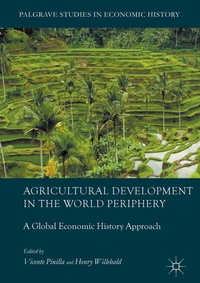
Agricultural Development in the World Periphery
Description

This book brings together analysis on the conditions of agricultural sectors in countries and regions of the world's peripheries, from a wide variety of international contributors. The contributors to this volume proffer an understanding of the processes of agricultural transformations and their interaction with the overall economies of Africa, Asia and Latin America. Looking at the nineteenth and twentieth centuries - the onset of modern economic growth - the book studies the relationship between agriculture and other economic sectors, exploring the use of resources (land, labour, capital) and the influence of institutional and technological factors in the long-run performance of agricultural activities. Pinilla and Willebald challenge the notion that agriculture played a negligible role in promoting economic development in the nineteenth and twentieth centuries, when the impulse towards industrialization in the developing world was more impactful.
More details
Other editions
Additional editions
Persons
Vicente Pinilla is Professor in Economic History at the University of Zaragoza, Spain. He has taught economic history since 1986 and held appointments at the University of Bristol, UK, London School of Economics, UK, University of California at Davis, US, University of Maastricht, the Netherlands, and Ecole des Hautes Etudes en Sciences Sociales, Paris, France.
Henry Willebald is Professor in Development Economics and Economic History at the University of the Republic, Uruguay. He has held visiting appointments at the University of Barcelona, Spain, University of Zaragoza, Spain, and Groningen University, The Netherlands. He was formerly Director of Economic Research in Faculty of Economics, University of the Republic, Uruguay, and President of the Uruguayan Economic History Association.
Content
Chapter 1. Agricultural Development in the World Periphery: A General Overview.- Chapter 2. Between the Engine and the Fifth Wheel: An Analytical Survey of the Shifting Roles of Agriculture in Development Theory.- Chapter 3. The World Periphery in Global Agricultural and Food Trade, 1900-2000.- Chapter 4. Plantations and Economic Development in the Twentieth Century: The End of an Era?.- Chapter 5. Ghana's Recurrent Miracle: Cocoa Cycles and Deficient Structural Change.- Chapter 6. Initial Conditions and Agricultural Development in Zambia, 1915-2015.- Chapter 7. Maize and Gold: South African Agriculture's Transition from Suppression to Support, 1886-1948.- Chapter 8. The Agriculture-Macroeconomy Growth Link in India, Pakistan, and Bangladesh, 1900-2000.- Chapter 9. Southeast Asian Agricultural Growth, 1930-2010.- Chapter 10. The Two Rice Deltas of Vietnam: A Century of Failure and Success.- Chapter 11. Transforming Indonesia: Structural Change from a Regional Perspective, 1968-2010.- Chapter 12. Perspectives on Agricultural and Grain Output Growth in China from the 19th Century to the Present Day.- Chapter 13. The Goose That Laid the Golden Eggs? Agricultural Development in Latin America in the 20th Century.- Chapter 14. Agricultural Development in Australia, 1845-2015.- Chapter 15. From Backwardness to Global Agricultural Powerhouse: The Transition of Brazilian Agriculture.- Chapter 16. Development Models, Agricultural Policies and Agricultural Growth: Peru, 1950-2010.- Chapter 17. Land Frontier Expansion in Settler Economies, 1830-1950: Was it a Ricardian Process?.- Chapter 18. Technological Change and Productivity Growth in the Agrarian Systems of New Zealand and Uruguay, 1870-2010.
