

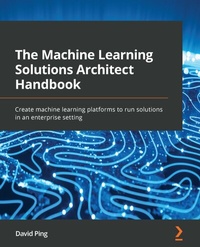
The Machine Learning Solutions Architect Handbook
Create machine learning platforms to run solutions in an enterprise setting
1st Edition
Published on 3. June 2024
442 pages
978-1-80107-041-6 (ISBN)
Description

Build highly secure and scalable machine learning platforms to support the fast-paced adoption of machine learning solutionsKey Features - Explore different ML tools and frameworks to solve large-scale machine learning challenges in the cloud
- Build an efficient data science environment for data exploration, model building, and model training
- Learn how to implement bias detection, privacy, and explainability in ML model development
Book DescriptionWhen equipped with a highly scalable machine learning (ML) platform, organizations can quickly scale the delivery of ML products for faster business value realization. There is a huge demand for skilled ML solutions architects in different industries, and this handbook will help you master the design patterns, architectural considerations, and the latest technology insights you'll need to become one. You'll start by understanding ML fundamentals and how ML can be applied to solve real-world business problems. Once you've explored a few leading problem-solving ML algorithms, this book will help you tackle data management and get the most out of ML libraries such as TensorFlow and PyTorch. Using open source technology such as Kubernetes/Kubeflow to build a data science environment and ML pipelines will be covered next, before moving on to building an enterprise ML architecture using Amazon Web Services (AWS). You'll also learn about security and governance considerations, advanced ML engineering techniques, and how to apply bias detection, explainability, and privacy in ML model development. By the end of this book, you'll be able to design and build an ML platform to support common use cases and architecture patterns like a true professional. What you will learn - Apply ML methodologies to solve business problems
- Design a practical enterprise ML platform architecture
- Implement MLOps for ML workflow automation
- Build an end-to-end data management architecture using AWS
- Train large-scale ML models and optimize model inference latency
- Create a business application using an AI service and a custom ML model
- Use AWS services to detect data and model bias and explain models
Who this book is forThis book is for data scientists, data engineers, cloud architects, and machine learning enthusiasts who want to become machine learning solutions architects. You'll need basic knowledge of the Python programming language, AWS, linear algebra, probability, and networking concepts before you get started with this handbook.
- Build an efficient data science environment for data exploration, model building, and model training
- Learn how to implement bias detection, privacy, and explainability in ML model development
Book DescriptionWhen equipped with a highly scalable machine learning (ML) platform, organizations can quickly scale the delivery of ML products for faster business value realization. There is a huge demand for skilled ML solutions architects in different industries, and this handbook will help you master the design patterns, architectural considerations, and the latest technology insights you'll need to become one. You'll start by understanding ML fundamentals and how ML can be applied to solve real-world business problems. Once you've explored a few leading problem-solving ML algorithms, this book will help you tackle data management and get the most out of ML libraries such as TensorFlow and PyTorch. Using open source technology such as Kubernetes/Kubeflow to build a data science environment and ML pipelines will be covered next, before moving on to building an enterprise ML architecture using Amazon Web Services (AWS). You'll also learn about security and governance considerations, advanced ML engineering techniques, and how to apply bias detection, explainability, and privacy in ML model development. By the end of this book, you'll be able to design and build an ML platform to support common use cases and architecture patterns like a true professional. What you will learn - Apply ML methodologies to solve business problems
- Design a practical enterprise ML platform architecture
- Implement MLOps for ML workflow automation
- Build an end-to-end data management architecture using AWS
- Train large-scale ML models and optimize model inference latency
- Create a business application using an AI service and a custom ML model
- Use AWS services to detect data and model bias and explain models
Who this book is forThis book is for data scientists, data engineers, cloud architects, and machine learning enthusiasts who want to become machine learning solutions architects. You'll need basic knowledge of the Python programming language, AWS, linear algebra, probability, and networking concepts before you get started with this handbook.
All prices
More details
Other editions
New editions
David Ping
The Machine Learning Solutions Architect Handbook
Practical strategies and best practices on the ML lifecycle, system design, MLOps, and generative AI
E-Book
09/2024
2nd Edition
Packt Publishing
€29.99
Available for download
Additional editions
David Ping
The Machine Learning Solutions Architect Handbook
Create machine learning platforms to run solutions in an enterprise setting
Book
01/2022
Packt Publishing
€99.80
Shipment within 3-4 weeks
Person
Ping David :
David Ping is an accomplished author and industry expert with over 28 years of experience in the field of data science and technology. He currently serves as the leader of a team of highly skilled data scientists and AI/ML solutions architects at AWS. In this role, he assists organizations worldwide in designing and implementing impactful AI/ML solutions to drive business success. David's extensive expertise spans a range of technical domains, including data science, ML solution and platform design, data management, AI risk, and AI governance. Prior to joining AWS, David held positions in renowned organizations such as JPMorgan, Credit Suisse, and Intel Corporation, where he contributed to the advancements of science and technology through engineering and leadership roles. With his wealth of experience and diverse skill set, David brings a unique perspective and invaluable insights to the field of AI/ML.
David Ping is an accomplished author and industry expert with over 28 years of experience in the field of data science and technology. He currently serves as the leader of a team of highly skilled data scientists and AI/ML solutions architects at AWS. In this role, he assists organizations worldwide in designing and implementing impactful AI/ML solutions to drive business success. David's extensive expertise spans a range of technical domains, including data science, ML solution and platform design, data management, AI risk, and AI governance. Prior to joining AWS, David held positions in renowned organizations such as JPMorgan, Credit Suisse, and Intel Corporation, where he contributed to the advancements of science and technology through engineering and leadership roles. With his wealth of experience and diverse skill set, David brings a unique perspective and invaluable insights to the field of AI/ML.
Content
Table of Contents - Machine Learning and Machine Learning Solutions Architecture
- Business Use Cases for Machine Learning
- Machine Learning Algorithms
- Data Management for Machine Learning
- Open Source Machine Learning Libraries
- Kubernetes Container Orchestration Infrastructure Management
- Open Source Machine Learning Platforms
- Building a Data Science Environment Using AWS ML Services
- Building an Enterprise ML Architecture with AWS ML Services
- Advanced ML Engineering
- ML Governance, Bias, Explainability, and Privacy
- Building ML Solutions with AWS AI Services
- Business Use Cases for Machine Learning
- Machine Learning Algorithms
- Data Management for Machine Learning
- Open Source Machine Learning Libraries
- Kubernetes Container Orchestration Infrastructure Management
- Open Source Machine Learning Platforms
- Building a Data Science Environment Using AWS ML Services
- Building an Enterprise ML Architecture with AWS ML Services
- Advanced ML Engineering
- ML Governance, Bias, Explainability, and Privacy
- Building ML Solutions with AWS AI Services
