

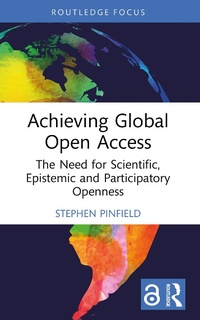
Achieving Global Open Access
The Need for Scientific, Epistemic and Participatory Openness
1st Edition
Published on 10. July 2024
134 pages
978-1-040-10061-5 (ISBN)
Description

Achieving Global Open Access explores some of the key conditions that are necessary to deliver global Open Access (OA) that is effective and equitable.
Often assumed to be a self-evident good, OA has been subject to growing criticism for perpetuating global inequities and epistemic injustices. It has been seen as imposing exploitative business and publishing models and as exacerbating exclusionary research evaluation cultures and practices. Pinfield engages with these issues, recognising that the global OA debate is now not just about publishing business models and academic reward structures, but also about what constitutes valid and valuable knowledge, how we know, and who gets to say. The book argues that, for OA to deliver its potential, it first needs to be associated with 'epistemic openness', a wider and more inclusive understanding of what constitutes valid and valuable knowledge. It also needs to be accompanied by 'participatory openness', enabling contributions to knowledge from more diverse communities. Interacting with relevant theory and current practice, the book discusses the challenges in implementing these different forms of openness, the relationships between them, and their limits.
Achieving Global Open Access is essential reading for academics and students engaged in the study of Library and Information Science, Open Access and Publishing. It will also be valuable and interesting to library and publishing professionals around the world.
Often assumed to be a self-evident good, OA has been subject to growing criticism for perpetuating global inequities and epistemic injustices. It has been seen as imposing exploitative business and publishing models and as exacerbating exclusionary research evaluation cultures and practices. Pinfield engages with these issues, recognising that the global OA debate is now not just about publishing business models and academic reward structures, but also about what constitutes valid and valuable knowledge, how we know, and who gets to say. The book argues that, for OA to deliver its potential, it first needs to be associated with 'epistemic openness', a wider and more inclusive understanding of what constitutes valid and valuable knowledge. It also needs to be accompanied by 'participatory openness', enabling contributions to knowledge from more diverse communities. Interacting with relevant theory and current practice, the book discusses the challenges in implementing these different forms of openness, the relationships between them, and their limits.
Achieving Global Open Access is essential reading for academics and students engaged in the study of Library and Information Science, Open Access and Publishing. It will also be valuable and interesting to library and publishing professionals around the world.
More details
Series
Edition
1. Auflage
Language
English
Place of publication
London
United Kingdom
Publishing group
Taylor & Francis Ltd
Target group
College/higher education
Professional and scholarly
File size
0,46 MB
ISBN-13
978-1-040-10061-5 (9781040100615)
Copyright in bibliographic data and cover images is held by Nielsen Book Services Limited or by the publishers or by their respective licensors: all rights reserved.
Schweitzer Classification
Other editions
Additional editions
Stephen Pinfield
Achieving Global Open Access
The Need for Scientific, Epistemic and Participatory Openness
Book
05/2026
1st Edition
Routledge
€30.00
Shipment within 10-20 days
Stephen Pinfield
Achieving Global Open Access
The Need for Scientific, Epistemic and Participatory Openness
Book
07/2024
1st Edition
Routledge
€78.80
Shipment within 10-20 days

Stephen Pinfield
Achieving Global Open Access
The Need for Scientific, Epistemic and Participatory Openness
Book
07/2024
Taylor & Francis
Unfortunately, price unknown
Available (delivery time upon request)
Person
Stephen Pinfield is Professor of Information Services Management at the University of Sheffield, UK, and Senior Research Fellow in the Research on Research Institute. He has a particular interest in scholarly communication, open science, and research policy. He has been involved in national and international policy development, and the creation of systems and services, since the early 2000s. He was founding Director of Sherpa from 2002 to 2012, an initiative managing projects and providing services to support the global open access community.
Content
1 Introduction
2 Critique of global open access
3 Scientific openness as a starting point
4 Epistemic openness and constructionism
5 Epistemic openness and knowledge-based oppression
6 Epistemic openness and the "ecologies of knowledges"
7 Epistemic openness and critical realism
8 Participatory openness and enabling inclusion
9 Conclusion: The need for scientific, epistemic, and participatory openness
2 Critique of global open access
3 Scientific openness as a starting point
4 Epistemic openness and constructionism
5 Epistemic openness and knowledge-based oppression
6 Epistemic openness and the "ecologies of knowledges"
7 Epistemic openness and critical realism
8 Participatory openness and enabling inclusion
9 Conclusion: The need for scientific, epistemic, and participatory openness
