

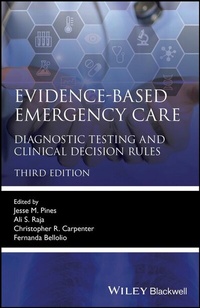
Evidence-Based Emergency Care
Description

DIAGNOSTIC TESTING AND CLINICAL DECISION RULES
THIRD EDITION
Improve and streamline the diagnostic decision-making process in emergency care
The newly revised third edition of Evidence-Based Emergency Care: Diagnostic Testing and Clinical Decision Rules offers an updated review of the evidence and expert discussion of relevant issues in diagnostic testing in the everyday practice of emergency medicine. This book also provides a detailed overview of the science of diagnostic testing and reviews the process behind the development of clinical decision rules. The focus is asking and answering practical questions using original research studies, while commenting on the best available evidence for relevant clinical topics.
Readers will also find:
* Comprehensive explorations of COVID-19, telemedicine, trauma, cardiology, infectious disease, and surgical and abdominal complaints
* Practical discussions of urology, neurology, hematology, ophthalmology, pulmonology, rheumatology, and geriatric medicine
* Exploration of practice and policy considerations of testing in an era of limited resources
The book is perfect for emergency medicine physicians, nurses, and other allied health professionals. Readers of Evidence-Based Emergency Care: Diagnostic Testing and Clinical Decision Rules, Third Edition will also earn a place in the libraries of administrators and managers in healthcare settings seeking to optimize the use of scarce resources while maintaining the highest standards of care.
More details
Other editions
Additional editions
Persons
Edited by
Jesse M. Pines, MD, MBA, MSCE is the National Director of Clinical Innovation at US Acute Care Solutions and a Professor of Emergency Medicine at Drexel University. He is board-certified in emergency medicine.
Fernanda Bellolio, MD, MSc is the Chair for Research and a Professor of Emergency Medicine in the Department of Emergency Medicine at the Mayo Clinic. She is board-certified in emergency medicine.
Christopher R. Carpenter, MD, MSc is the Director of Evidence Based Medicine and a Professor of Emergency Medicine in the Division of Emergency Medicine at Barnes Jewish Hospital at Washington University. He is board-certified in emergency medicine.
Ali S. Raja, MD, MBA, MPH is Executive Vice Chair of the Department of Emergency Medicine at Massachusetts General Hospital and a Professor of Emergency Medicine at Harvard Medical School. He is board-certified in emergency medicine and clinical informatics.
Content
About the Editors x
List of Contributors xiii
Foreword xvi
Acknowledgments xviii
Section 1: The Science of Diagnostic Testing and Clinical Decision Rules
1 Diagnostic Testing in Emergency Care 3
2 Evidence- Based Medicine: The Process 14
3 The Epidemiology and Statistics of Diagnostic Testing 23
4 Clinical Decision Rules 43
5 Appropriate Testing in an Era of Limited Resources: Practice and Policy Consideration 53
6 Understanding Bias in Diagnostic Research 73
Section 2: Trauma
7 Cervical Spine Fractures 95
8 Blunt Abdominal Trauma 121
9 Acute Knee Injuries 128
10 Acute Ankle and Foot Injuries 134
11 Blunt Head Injury in Children 141
12 Adult Blunt Head Injury 162
13 Chest Trauma 174
14 Occult Hip Fracture 182
15 Blunt Soft Tissue Neck Trauma 189
16 Occult Scaphoid Fractures 195
17 Penetrating Abdominal Trauma 205
18 Penetrating Trauma to the Extremities and Vascular Injuries 214
Section 3: Cardiology
19 Heart Failure 227
20 Syncope 237
21 Chest Pain 256
22 Palpitations 276
Section 4: Infectious Disease
23 Bacterial Meningitis in Children 291
24 Serious Bacterial Infections in Children Aged 0 to 60/90 Days 299
25 Necrotizing Soft Tissue Infection 309
26 Infective Endocarditis 321
27 Pharyngitis 327
28 Rhinosinusitis 335
29 Pneumonia 340
30 Urinary Tract Infection 353
31 Sepsis 360
32 Adult Septic Arthritis 377
33 Osteomyelitis 388
34 Sexually Transmitted Infections (STIs) 401
35 Influenza 409
36 Fever without a Source 3-36 Months 416
Section 5: Surgical and Abdominal Complaints
37 Acute Nonspecific Nontraumatic Abdominal Pain 425
38 Small Bowel Obstruction 439
39 Acute Pancreatitis 447
40 Acute Appendicitis 457
41 Acute Cholecystitis 472
42 Aortic Emergencies 482
43 Ovarian Torsion 489
Section 6: Urology
44 Nephrolithiasis 499
45 Testicular Torsion 512
Section 7: Neurology
46 Nontraumatic Subarachnoid Hemorrhage 523
47 Acute Stroke 536
48 Transient Ischemic Attack 547
49 First- Episode Seizure 559
Section 8: Miscellaneous: Hematology Ophthalmology Pulmonology Rheumatology and Geriatrics
50 Pulmonary Embolism 571
51 Deep Vein Thrombosis 583
52 Temporal Arteritis 591
53 Intraocular Pressure 598
54 Asthma 608
55 Acute Low Back Pain 621
56 Intravascular Volume Status 631
57 Geriatric Screening 638
58 Skin and Soft Tissue Infections 658
59 Shared Decision- Making in Diagnostic Testing 664
60 Cognitive Biases and Mitigation Strategies in Emergency Diagnosis 678
61 Diagnosis in Telemedicine 699
62 Diagnosing COVID- 19 723
Index 735
Chapter 1
Diagnostic Testing in Emergency Care
Jesse M. Pines1,2 and Christopher R. Carpenter3
1 US Acute Care Solutions, Canton, OH, USA
2 Department of Emergency Medicine, Drexel University, Philadelphia, PA, USA
3 Department of Emergency Medicine, Washington University School of Medicine, St. Louis, MO, USA
Highlights
- Emergency physicians are experts in diagnostic testing
- The choice of ED-based testing depends on the resources of the hospital
- Validated clinical decision rules can help guide ED testing decisions
- Pauker and Kassirer test-treatment thresholds are a helpful tool in determining the use and value of diagnostic tests
As emergency department (ED) physicians, we spend a good deal of our time ordering, interpreting, and waiting for the results of diagnostic tests. ED physicians are the experts when it comes to determining who needs a test to rule out a potentially life-threatening condition. There are several reasons for this expertise. First and foremost, we see a lot of patients with undifferentiated symptoms in a decision-dense and time-constrained environment. Especially for those working in busy hospitals, the expectation is to see everyone in a timely way, provide quality care, and ensure patients have a good experience. Some patients and consultants value lab or imaging tests more than the history and physical exam tests that formulate clinical intuition, a phenomenon called "technological tenesmus."1 However, if we order time-consuming tests on everyone, ED crowding and inefficiency will worsen, costs of care will go up, and patients will experience even longer waits than they already do. In addition, there is increased pressure to carefully choose who needs and who does not need tests in an evidence-based manner, particularly as costs of care have risen so dramatically in recent years particularly in the United States.2,3
Differentiating which patients will benefit from ED testing is a complex process. Over the past 40 years, science and research in ED diagnostic testing and clinical decision rules have advanced considerably. Today, there is a greater understanding of test performance, specifically the reliability, sensitivity, specificity, and overall accuracy of tests. Validated clinical decision rules exist to provide objective criteria to help distinguish who does and does not need a test. Serious, potentially life-threatening conditions such as intracranial bleeding and cervical spine (C-spine) fractures can be safely ruled out based on clinical grounds alone, with acceptable accuracy and precision. There are also accurate risk stratification tools to estimate the probability for conditions like pulmonary embolism (PE) before any tests are even ordered. Since the second edition of this textbook, Academic Emergency Medicine created the "Evidence-Based Diagnostics" series to synthesize the ever-expanding volume of emergency medicine-specific research around history, physical exam, labs, and imaging for common diagnoses like subarachnoid hemorrhage, congestive heart failure, urinary tract infection, and mesenteric ischemia.4,5 Similarly, the Society for Academic Emergency Medicine launched Guidelines for Reasonable and Appropriate Care to provide emergency medicine's first Grading of Recommendations Assessment Development and Evaluation (GRADE)-based diagnostic recommendations that contemplate issues like costs and health inequities.6-8 This third edition will summarize the key recommendations from these two new resources.
How do we decide who to test and who not to test? There are some patients who clearly need tests, such as the head-injured patient who has altered mental status and who may have a head bleed. In such a case, the outcome may be dependent upon how quickly the bleeding can be detected with a computed tomography (CT) scan. There are also patients who obviously do not need tests at an individual point in time, such as patients with a simple toothache or a mild headache without concerning features. Finally, there is a large group of patients in the middle for whom testing decisions can sometimes be challenging. This group of patients may leave you feeling "on the fence" about testing. In this large middle category, it may not be clear whether to order a test or even how to interpret a test once you have the results. And when unexpected test results come back, it may not be clear how best to use those results to guide patient care.
Let us give some examples of how diagnostic testing can be a challenge in the ED. You are starting your shift and are signed out a patient for whom your colleague has ordered a D-dimer assay (a test for PE). She is 83 years old and developed acute shortness of breath, chest pain, and hypoxia (room air oxygen saturation = 89%). She has a history of a prior PE and her physical examination is unremarkable, except for mild left anterior chest wall tenderness and notably clear lung sounds. The D-dimer comes back negative. Has PE been satisfactorily ruled out? Should you order a CT scan of the chest, or maybe even consider a ventilation-perfusion (V/Q) scan? Was D-dimer the right test for her to begin with?
Let's consider a different scenario. Consider a positive D-dimer assay in a 22-year-old male with atypical chest pain, no risk factors, and normal physical examination including a heart rate of 70 beats per minute and an oxygen saturation of 100% on room air. What do you do then? Would he benefit from a CT scan of the chest to further evaluate the possibility of PE? What are the potential harms of liberally obtaining CT on every patient in whom the physician or the patient is concerned about PE just to be absolutely certain? Or is he so low risk that he's probably fine anyway? Of course, you might wonder, if he was so low risk, why was the D-dimer ordered in the first place?
As a third example, you are evaluating a 77-year-old female who has fallen down, has acute hip pain, and is unable to ambulate. The hip radiograph is negative. Should you pursue CT or magnetic resonance imaging (MRI) for a radiographically occult hip fracture? While you contemplate time-consuming advanced imaging, you also consider that regardless of whether or not CT or MRI demonstrates no fracture will she be able to go home?
These are examples of when test results may not confirm you're a priori clinical suspicion. What do you do in those cases? Should you believe the test result or believe your clinical judgment before ordering the test? Were these the optimal tests in the first place? Remember back to conversations with your professors in emergency medicine on diagnostic testing. Didn't they always ask, "How will a test result change your management?" and "What will you do if it's positive, negative, or indeterminate?"
The purpose of diagnostic testing is to reach a state where we are adequately convinced of the presence or absence of a condition. Test results must be interpreted in the context of the prevalence of the suspected disease state: your clinical suspicion of the presence or absence of disease in the individual patient. For example, coronary artery disease is common. However, if we look for coronary disease in a young healthy population, we are unlikely to find it because it is not common in young people. There are also times when your clinical suspicion is so high that you do not need objective testing. In certain patients, you can proceed with treatment. For example, some emergency physicians may choose to treat a dislocated shoulder based on the clinical examination rather than first obtaining a radiograph, particularly in patients with a history of prior dislocations. However, testing is often needed to confirm a diagnosis or to rule out more severe, life-threatening diseases.
The choice over whether to test or not test in the ED also depends upon the resources of the hospital and of the patient. Most hospitals allow easy access to radiographic testing and laboratory testing. In other hospitals, obtaining a diagnostic test may not be as easy. Some hospitals may not have the staff available for certain types of tests at night or on weekends (like MRIs and ultrasounds). Sometimes patients may not need a test if you believe that they are reliable to return if symptoms worsen. For others, you may believe that a patient's emergency presentation may be the only time he or she will have access to diagnostic testing. For example, saying to a patient, "Follow up with your doctor this week for a stress test" may be impractical if the patient does not have a primary doctor or does not have good access to medical care. Many clinicians practice in environments where they cannot order a lot of tests (like developing countries). You also may practice in an office environment that simply does not have easy access to testing. However, regardless of the reason why we order tests in the ED or other acute settings, what is certain is that the use of diagnostic testing in many cases can change how you manage a patient's care.
Sometimes, you may question your choice of whether to test, to not test, or to involve a specialist early. Should you get a CT scan first or just call a surgeon in...
