

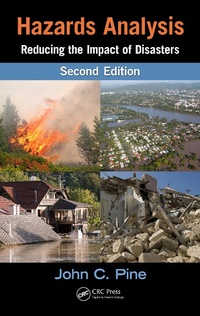
Hazards Analysis
Reducing the Impact of Disasters, Second Edition
2nd Edition
Published on 10. September 2014
338 pages
978-1-040-08309-3 (ISBN)
Description

The impacts of natural and man-made disasters have increased exponentially over the past few decades. Moreover, with our global interconnectedness and the growing scale of disasters, today's catastrophic disasters can have regional, national, and even global economic consequences.
Following in the tradition of the successful first edition, Hazards Analysis: Reducing the Impact of Disasters, Second Edition provides a structure and process for understanding the nature of natural and human-caused disasters. Stressing the role of hazard risk management for public, private, and nonprofit organizations, the author and expert contributors cover problem solving, risk analysis, and risk communications to ensure readers are in a position to identify key problems associated with hazards and the risks that they present.
The book details a systematic process of hazards identification, vulnerability determination, and consequence assessment for the natural, built, and human environment. Using a cross-disciplinary approach, this book effectively demonstrates how to use the results of vulnerability assessment, spatial analysis, and community planning to reduce adverse disaster outcomes and foster social, economic, and environmental sustainability. Throughout, the book stresses that hazards analysis is not an isolated process but one that must engage the local community.
Complete with clearly set objectives, key terms, discussion questions, satellite images and maps, and ancillary websites for further study, this authoritative guide covers every element of the hazard analysis process in a step-by-step format. Hazards Analysis presents time-proven strategies for building sustainable communities, identifying and prioritizing risks, and establishing successful disaster prevention and relief strategies prior to a disaster.
Following in the tradition of the successful first edition, Hazards Analysis: Reducing the Impact of Disasters, Second Edition provides a structure and process for understanding the nature of natural and human-caused disasters. Stressing the role of hazard risk management for public, private, and nonprofit organizations, the author and expert contributors cover problem solving, risk analysis, and risk communications to ensure readers are in a position to identify key problems associated with hazards and the risks that they present.
The book details a systematic process of hazards identification, vulnerability determination, and consequence assessment for the natural, built, and human environment. Using a cross-disciplinary approach, this book effectively demonstrates how to use the results of vulnerability assessment, spatial analysis, and community planning to reduce adverse disaster outcomes and foster social, economic, and environmental sustainability. Throughout, the book stresses that hazards analysis is not an isolated process but one that must engage the local community.
Complete with clearly set objectives, key terms, discussion questions, satellite images and maps, and ancillary websites for further study, this authoritative guide covers every element of the hazard analysis process in a step-by-step format. Hazards Analysis presents time-proven strategies for building sustainable communities, identifying and prioritizing risks, and establishing successful disaster prevention and relief strategies prior to a disaster.
Reviews / Votes
"Professionals who work in disaster planning and emergency management will find the second edition of Hazards Analysis: Reducing the Impact of Disasters to be a valuable resource."-John M. White, CPP, President and CEO of Protection Management, LLC, in Security Management
More details
Edition
2nd edition
Language
English
Place of publication
London
United Kingdom
Publishing group
Taylor & Francis Ltd
Target group
Professional and scholarly
Illustrations
64 Illustrations, black and white
ISBN-13
978-1-040-08309-3 (9781040083093)
Copyright in bibliographic data and cover images is held by Nielsen Book Services Limited or by the publishers or by their respective licensors: all rights reserved.
Schweitzer Classification
Other editions
Additional editions
Book
09/2014
2nd Edition
CRC Press
€164.50
Article not available for order
Person
John C. Pine serves as the director of the Research Institute for Environment, Energy & Economics (RIEEE), and professor in the department of Geography and Planning, Appalachian State University, Boone, North Carolina. He joined the Appalachian faculty in 2009 after serving thirty years at Louisiana State University in Baton Rouge where he directed the graduate and undergraduate Disaster Science and Management Program. At Louisiana State University, he was a professor in the Department of Geography and Anthropology and the department of Environmental Sciences. His research on disasters and emergency management centers on emergency planning, risk assessment, and disaster recovery.
He has worked for many years with public agencies at the federal, state, and local levels as well as non-profit and private entities to identify strategies to enhance preparedness and community sustainability. His publications focus on hazards and disasters including Technology and Emergency Management from John Wiley (2007) and Tort Liability Today from the Public Risk Management Association (2005).
He is currently on the board of directors of the National Committee for the New River, the Learning Lodge at Grandfather Mountain, and an advisory board for the American Meteorological Society. His publications have been included in The Journal of Disaster Studies, Policy and Management, Disasters, Journal of Race and Society, International Journal of Mass Emergencies and Disasters, Oceanography, Journal of Emergency Management, Natural Disaster Review, Journal of Environmental Health, and the Journal of Hazardous Materials. He received his doctorate in higher education administration and public administration from the University of Georgia, Athens, in 1979.
He has worked for many years with public agencies at the federal, state, and local levels as well as non-profit and private entities to identify strategies to enhance preparedness and community sustainability. His publications focus on hazards and disasters including Technology and Emergency Management from John Wiley (2007) and Tort Liability Today from the Public Risk Management Association (2005).
He is currently on the board of directors of the National Committee for the New River, the Learning Lodge at Grandfather Mountain, and an advisory board for the American Meteorological Society. His publications have been included in The Journal of Disaster Studies, Policy and Management, Disasters, Journal of Race and Society, International Journal of Mass Emergencies and Disasters, Oceanography, Journal of Emergency Management, Natural Disaster Review, Journal of Environmental Health, and the Journal of Hazardous Materials. He received his doctorate in higher education administration and public administration from the University of Georgia, Athens, in 1979.
Content
Introduction to Hazards Analysis. Hazard Identification. Modeling of Natural and Environmental Hazards. Spatial Analysis. Risk Analysis: Assessing the Risks of Natural Hazards. Social, Economic and Ecological Vulnerability. Risk Communication. The Hazards Risk Management Process. Planning for Sustainable and Disaster Resilient Communities. Disaster-Resilient Communities: A New Hazards Risk Management Framework.
