

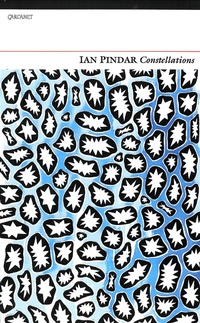
Constellations
Published on 20. March 2013
112 pages
978-1-84777-649-5 (ISBN)
Description

Constellations begins by celebrating sunlight and ends with the appearance of the moon, the coming of winter, snow and 'perpetual night'. In poems of compelling beauty Pindar takes us from a summer love affair by the sea to war and its aftermath, when night falls and 'the song that was promised has been sung'.
Reviews / Votes
'An open-eyed, rolling arrangement of poems.'This review was originally published in the Guardian on 8 June 2012.
While Emporium, like many first collections of poetry, gathered a range of forms and subjects, Ian Pindar presents this keenly focused second volume just over a year later. These 88 numbered (and otherwise untitled) lyric poems range from four to 30 lines, in six loosely thematic sections. The title proves useful in suggesting the way the poems operate individually as well as in concert. Many of the poems evoke a sensibility engendered by a 'constellation' of physical qualities, that together nuance mood and thought. The first poem's opening stanza sums it up well: 'Sweetness, some cloudlessness, some shapes, / a random horse, the rolling arrangement / of the mind, with open eyes.'
The poems in Constellations often follow such a 'rolling arrangement', 'open eye[d]' to a rich and vivid sense of place or, occasionally, character.
In the first two sections, 'Life is a holiday', with the speaker's pleasure in life, romantic love and landscape intermingling with abstract observations. Pindar finds a rich array to celebrate, as toward the end of '3': 'The concupiscence of spring, the shimmering of summer, / the fullness of autumn, the ceremony of winter.' The compelling first poem of section III, however, turns outward in considering one marketplace's experience of the recession. The first sentence underscores its seemingly illogical nature: 'When the bottom fell out of the market, the oranges / rolled down the hill, down the white lane.' In this surprising juxtaposition, the abstract market has concrete consequences. Throughout this section, the experiences become less individual, more social. This movement sets up the theological explorations of IV, a diverse consideration of poetry in V, and a restless reflection on the 'perpetual night' of mortality in VI.
The poems' most idiosyncratic feature is their overt repetition, where a word recurs within a few lines, sometimes in the very same line. For example, '28' begins 'The Earth, the base of heaven without heaven, / is awake again, the world of flux a world of forms.' Here, the first use of 'heaven' positions it in relation to the Earth, only for its second use to take it away. The next appearance of repetition collapses two worlds into one. Often the repetition suggests such coherence, as though use of the same word again indicates this world's ultimate cohesion. As a poetic technique it succeeds when the repetition layers the word's meaning, and fails when the repetition diminishes the word's power. In '36', amid 'the uniforms / and wrecked houses', the speaker observes 'the positions of the dead, / the dead positions'. The poems are most effective when precise images build into nuanced observations, as toward the end of '21', where 'the seductive endurance of the particular' is noticed.
The pleasure of Constellations lies in their lyrics' easy movement among images and observations, their development less linear than cumulative. On one level, '26' describes a woman painting a watercolour; on another, it explores the simultaneous act of representation and the loss of that moment in its record: 'the declaration of an image, its figurative aspect, / not the scene itself but a record of its absence / the maddening absence of reality'.
In such denser passages, where the observations leap from one to another in a momentum compelling both for the intriguing train of thought and for the music of the lines, Pindar achieves 'a difficult // furthering; intense, informal immediacy' in his distinctive approach to the lyric.
More details
Language
English
Place of publication
London
United Kingdom
Publishing group
Carcanet Press Ltd
File size
0,60 MB
ISBN-13
978-1-84777-649-5 (9781847776495)
Copyright in bibliographic data and cover images is held by Nielsen Book Services Limited or by the publishers or by their respective licensors: all rights reserved.
Schweitzer Classification
Other editions
Additional editions

Ian Pindar
Constellations
Book
05/2012
Carcanet Press Ltd
€21.00
Article exhausted; check different version
Person
Ian Pindar was born in London in 1970. He published his first work, a life of James Joyce, in 2004. Emporium, his debut poetry collection, appeared in 2011. Constellations is his second collection. His poems have appeared in The English Review, The Forward Book of Poetry 2011 and 2012, London Magazine, Magma, New Poetries III, Oxford Poetry, PN Review, Poetry Review, Stand, the Times Literary Supplement and Wave Composition. Pindar won second prize in the National Poetry Competition 2009, a supplementary prize in the Bridport Prize 2010 and was shortlisted for the 2010 Forward Prize (Best Single Poem). He lives in Oxfordshire.
Content
- Cover
- Title Page
- Dedication
- Contents
- Acknowledgements
- I
- 1
- 2
- 3
- 4
- 5
- 6
- 7
- 8
- 9
- II
- 10
- 11
- 12
- 13
- 14
- 15
- 16
- 17
- 18
- 19
- 20
- 21
- 22
- 23
- 24
- 25
- 26
- 27
- 28
- 29
- III
- 30
- 31
- 32
- 33
- 34
- 35
- 36
- 37
- 38
- 39
- 40
- 41
- 42
- 43
- 44
- 45
- 46
- 47
- 48
- 49
- 50
- 51
- 52
- 53
- IV
- 54
- 55
- 56
- 57
- 58
- 59
- 60
- V
- 61
- 62
- 63
- 64
- 65
- 66
- 67
- 68
- 69
- 70
- 71
- 72
- 73
- 74
- VI
- 75
- 76
- 77
- 78
- 79
- 80
- 81
- 82
- 83
- 84
- 85
- 86
- 87
- 88
- About the Author
- Also by Ian Pindar from Carcanet Press
- Copyright
