

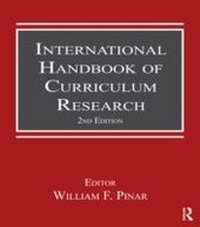
International Handbook of Curriculum Research
2nd Edition
Published on 15. October 2013
572 pages
978-1-136-83112-6 (ISBN)
Description

Continuing its calling to define the field and where it is going, the Second Edition of this landmark handbook brings up to date its comprehensive reportage of scholarly developments and school curriculum initiatives worldwide, providing a panoramic view of the state of curriculum studies globally. Its international scope and currency and range of research and theory reflect and contribute significantly to the ongoing internationalization of curriculum studies and its growth as a field worldwide.
Changes in the Second Edition:
Five new or updated introductory chapters pose transnational challenges to key questions curriculum research addresses locally.
Countries absent in the First Edition are represented: Chile, Colombia, Cypress, Ethiopia, Germany, Iran, Luxembourg, Nigeria, Peru, Poland, Portugal, Singapore, South Africa, Spain, and Switzerland.
39 new or updated chapters on curriculum research in 34 countries highlight curriculum research that is not widely known in North America.
This handbook is an indispensable resource for prospective and practicing teachers, for curriculum studies scholars, and for education students around the world.
Changes in the Second Edition:
Five new or updated introductory chapters pose transnational challenges to key questions curriculum research addresses locally.
Countries absent in the First Edition are represented: Chile, Colombia, Cypress, Ethiopia, Germany, Iran, Luxembourg, Nigeria, Peru, Poland, Portugal, Singapore, South Africa, Spain, and Switzerland.
39 new or updated chapters on curriculum research in 34 countries highlight curriculum research that is not widely known in North America.
This handbook is an indispensable resource for prospective and practicing teachers, for curriculum studies scholars, and for education students around the world.
More details
Series
Edition
2nd edition
Language
English
Place of publication
London
United Kingdom
Publishing group
Taylor & Francis Ltd
Target group
College/higher education
Edition type
Revised edition
Illustrations
15 s/w Tabellen
15 Tables, black and white
File size
7,06 MB
ISBN-13
978-1-136-83112-6 (9781136831126)
Copyright in bibliographic data and cover images is held by Nielsen Book Services Limited or by the publishers or by their respective licensors: all rights reserved.
Schweitzer Classification
Other editions
Additional editions
William F. Pinar
International Handbook of Curriculum Research
Book
10/2013
2nd Edition
Routledge
€401.77
Shipment within 15-20 days
William F. Pinar
International Handbook of Curriculum Research
Book
09/2013
2nd Edition
Routledge
€178.56
Shipment within 15-20 days
Person
William F. Pinar is Canada Research Chair in the Faculty of Education at the University of British Columbia, Canada.
Content
CONTENTS
Acknowledgments
IntroductionWilliam F. Pinar
Section I
Five Essays of Introduction
Chapter 1The Internationalization of Curriculum ResearchTero Autio
Chapter 2Race and Education in the Age of Digital CapitalismCameron McCarthy, Ergin Bulut, Rushika Patel
Chapter 3Wisdom Responses to GlobalizationDavid Geoffrey Smith
Chapter 4The Globalization of Curriculum Research: Lessons from EuropeDaniel Troehler
Chapter 5A Nonviolent Perspective on Internationalizing Curriculum StudiesHongyu Wang
Section II
39 Essays on Curriculum Research in 34 Countries
Chapter 6Curriculum Studies in Argentina: Documenting the Constitution of a FieldSilvina Feeney and Flavia Terigi
Chapter 7The Curriculum Field in Brazil since the 1990sAlice Casimiro Lopes and Elizabeth Macedo
Chapter 8Curriculum Tendencies in BrazilSilvia Elizabeth Miranda de Moraes
Chapter 9Curricular Landscapes, Neoliberal Densities: Curriculum Reform and Research in ChileClaudia Matus Canovas
Chapter 10Curriculum Studies in China: Retrospect and ProspectZhang Hua and Zhenyu Gao
Chapter 11Curriculum Studies in ColombiaJuny Montoya-Vargas
Chapter 12Curriculum Studies in Cyprus: Intellectual History and Present CircumstancesNikoletta Christodoulou
Chapter 13Curriculum Development and Research in Ethiopia
Woube Kassaye
Chapter 14Governing Autonomy: Subjectivity, Freedom, and Knowledge in Finnish Curriculum Discourse Antti Saari, Sauli Salmela, Jarkko Vilkkilae
Chapter 15Curriculum, Evaluation, and Control in GermanyWolfgang Boettcher
Chapter 16Competence-Oriented Curriculum Reform in the Federal Republic of GermanyCharlotte Roehner
Chapter 17In Search of a Diverse Curriculum: Toward the Making of a Postmodern Hong Kong in the 21st CenturyEdmond Hau-Fai Law
Chapter 18The Iranian Curriculum Field Recounted: Understanding the Multiplicity of DiscoursesMahmound Mehrmohammadi
Chapter 19 Curriculum Inquiry in the Republic of IrelandKevin Williams and Elaine McDonald
Chapter 20Curriculum Planning from the National to the Glocal: The Israeli CaseYehoshua Mathias and Naama Sabar
Chapter 21"Cities and Signs": Understanding Curriculum Studies in ItalyPaula M. Salvio
Chapter 22Educational Reform in Contemporary JapanTadahiko Abiko
Chapter 23Japanese Educational Reform for the Twenty-First Century: The Impact of New Course Studies towards the Post-Modern Era in Japan Shigeru Asanuma
Chapter 24Political Change and Development of Centralized Curriculum Policy in South KoreaYonghwan Lee
Chapter 25Curriculum Studies as Reconceptualization Discourse: A Tale of South KoreaYoung Chun Kim, Dong Sung Lee, and Jae Hong Joo
Chapter 26Tomorrow Never Dies A Socio-Historical Analysis of the Luxembourgish CurriculumThomas Lenz, Anne Rohstock and Catherina Schreiber
Chapter 27Curriculum Research in MexicoFrida Diaz Barriga
Chapter 28Curriculum Research in the NetherlandsWillem Wardekker, Monique Volman, and Jan Terwel
Chapter 29Curriculum Studies in NigeriaRosita Okekenwa Igwe
Chapter 30Curriculum Theory and Research in Norway: Traditions, Trends and TopicsKirsten Sivesind and Berit Karseth
Chapter 31Theoretical Approaches Underlying Primary Education Curricula in Peru Lileya Manrique, Diana Revilla and Pilar Lamas
Chapter 32Poland: Through Golden and Dark Ages of History and EducationAleksandra Luczak
Chapter 32Curriculum Research in Portugal: Emergence, Research, and EuropeanizationJose Augusto Pacheco and Filipa Seabra
Chapter 34Curriculum: A Constant Concern in RomaniaRodica Mariana Niculescu
Chapter 35The History of Curriculum in Russia Vladimir Blinov
Chapter 36Curriculum in SingaporeViniti Vaish
Chapter 37Curriculum Reform and the Field of Curriculum in SpainCesar Coll and Elena Martin
Chapter 38Curriculum Research in South AfricaLesley LeGrange
Chapter 39From Rationalist Autonomy to Scientific Empiricism: A History of Curriculum in SwitzerlandRebekka Horlacher and Andrea De Vincenti
Chapter 40A Review of Curriculum Study in TaiwanHwang, Jenq-Jye, Chang, Chia-Yu, Chen, Derwen
Chapter 41Curriculum Research in Turkey: From the Ottoman Empire to the RepublicSuemer Aktan
Chapter 42Curriculum Studies in Turkey since 2000Dilek Goezuetok
Chapter 43Developing Curriculum History: A British PerspectiveIvor F. Goodson
Chapter 44Curriculum Research in the United States: Crisis, Reconceptualization, InternationalizationWilliam F. Pinar
Contributors
Acknowledgments
IntroductionWilliam F. Pinar
Section I
Five Essays of Introduction
Chapter 1The Internationalization of Curriculum ResearchTero Autio
Chapter 2Race and Education in the Age of Digital CapitalismCameron McCarthy, Ergin Bulut, Rushika Patel
Chapter 3Wisdom Responses to GlobalizationDavid Geoffrey Smith
Chapter 4The Globalization of Curriculum Research: Lessons from EuropeDaniel Troehler
Chapter 5A Nonviolent Perspective on Internationalizing Curriculum StudiesHongyu Wang
Section II
39 Essays on Curriculum Research in 34 Countries
Chapter 6Curriculum Studies in Argentina: Documenting the Constitution of a FieldSilvina Feeney and Flavia Terigi
Chapter 7The Curriculum Field in Brazil since the 1990sAlice Casimiro Lopes and Elizabeth Macedo
Chapter 8Curriculum Tendencies in BrazilSilvia Elizabeth Miranda de Moraes
Chapter 9Curricular Landscapes, Neoliberal Densities: Curriculum Reform and Research in ChileClaudia Matus Canovas
Chapter 10Curriculum Studies in China: Retrospect and ProspectZhang Hua and Zhenyu Gao
Chapter 11Curriculum Studies in ColombiaJuny Montoya-Vargas
Chapter 12Curriculum Studies in Cyprus: Intellectual History and Present CircumstancesNikoletta Christodoulou
Chapter 13Curriculum Development and Research in Ethiopia
Woube Kassaye
Chapter 14Governing Autonomy: Subjectivity, Freedom, and Knowledge in Finnish Curriculum Discourse Antti Saari, Sauli Salmela, Jarkko Vilkkilae
Chapter 15Curriculum, Evaluation, and Control in GermanyWolfgang Boettcher
Chapter 16Competence-Oriented Curriculum Reform in the Federal Republic of GermanyCharlotte Roehner
Chapter 17In Search of a Diverse Curriculum: Toward the Making of a Postmodern Hong Kong in the 21st CenturyEdmond Hau-Fai Law
Chapter 18The Iranian Curriculum Field Recounted: Understanding the Multiplicity of DiscoursesMahmound Mehrmohammadi
Chapter 19 Curriculum Inquiry in the Republic of IrelandKevin Williams and Elaine McDonald
Chapter 20Curriculum Planning from the National to the Glocal: The Israeli CaseYehoshua Mathias and Naama Sabar
Chapter 21"Cities and Signs": Understanding Curriculum Studies in ItalyPaula M. Salvio
Chapter 22Educational Reform in Contemporary JapanTadahiko Abiko
Chapter 23Japanese Educational Reform for the Twenty-First Century: The Impact of New Course Studies towards the Post-Modern Era in Japan Shigeru Asanuma
Chapter 24Political Change and Development of Centralized Curriculum Policy in South KoreaYonghwan Lee
Chapter 25Curriculum Studies as Reconceptualization Discourse: A Tale of South KoreaYoung Chun Kim, Dong Sung Lee, and Jae Hong Joo
Chapter 26Tomorrow Never Dies A Socio-Historical Analysis of the Luxembourgish CurriculumThomas Lenz, Anne Rohstock and Catherina Schreiber
Chapter 27Curriculum Research in MexicoFrida Diaz Barriga
Chapter 28Curriculum Research in the NetherlandsWillem Wardekker, Monique Volman, and Jan Terwel
Chapter 29Curriculum Studies in NigeriaRosita Okekenwa Igwe
Chapter 30Curriculum Theory and Research in Norway: Traditions, Trends and TopicsKirsten Sivesind and Berit Karseth
Chapter 31Theoretical Approaches Underlying Primary Education Curricula in Peru Lileya Manrique, Diana Revilla and Pilar Lamas
Chapter 32Poland: Through Golden and Dark Ages of History and EducationAleksandra Luczak
Chapter 32Curriculum Research in Portugal: Emergence, Research, and EuropeanizationJose Augusto Pacheco and Filipa Seabra
Chapter 34Curriculum: A Constant Concern in RomaniaRodica Mariana Niculescu
Chapter 35The History of Curriculum in Russia Vladimir Blinov
Chapter 36Curriculum in SingaporeViniti Vaish
Chapter 37Curriculum Reform and the Field of Curriculum in SpainCesar Coll and Elena Martin
Chapter 38Curriculum Research in South AfricaLesley LeGrange
Chapter 39From Rationalist Autonomy to Scientific Empiricism: A History of Curriculum in SwitzerlandRebekka Horlacher and Andrea De Vincenti
Chapter 40A Review of Curriculum Study in TaiwanHwang, Jenq-Jye, Chang, Chia-Yu, Chen, Derwen
Chapter 41Curriculum Research in Turkey: From the Ottoman Empire to the RepublicSuemer Aktan
Chapter 42Curriculum Studies in Turkey since 2000Dilek Goezuetok
Chapter 43Developing Curriculum History: A British PerspectiveIvor F. Goodson
Chapter 44Curriculum Research in the United States: Crisis, Reconceptualization, InternationalizationWilliam F. Pinar
Contributors
