

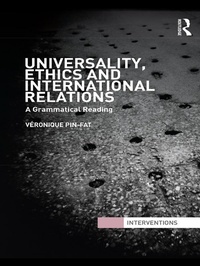
Universality, Ethics and International Relations
A Grammatical Reading
Published on 16. October 2009
168 pages
978-1-135-28247-9 (ISBN)
Description

Universality Ethics and International Relations introduces students to the key debates about ethics in international relations theory. This book explores the reasons why grappling with universality and ethics seems to be a profound endeavour and where we end up when we do.
By offering a new way of thinking about ethics in International Relations, Pin-Fat shows that there are several varieties of universality which are offered as the answer to ethics in global politics; the divine universality of Hans Morgenthau, the ideal universality of Charles R. Beitz and the binary universality of Michael Walzer. Taking the reader on a grammatical odyssey through each, the book concludes that profound searches for the foundations of universality can't fulfil our deepest desires for an answer to ethics in global politics. Pin-Fat suggests that the failure of these searches reveals the ethical desirability of defending universality as (im)possible.
An ideal text for use in a wide variety of courses, including ethics in international relations, international relations theory, and international political theory, this work provides a valuable new contribution to this rapidly developing field of research.
By offering a new way of thinking about ethics in International Relations, Pin-Fat shows that there are several varieties of universality which are offered as the answer to ethics in global politics; the divine universality of Hans Morgenthau, the ideal universality of Charles R. Beitz and the binary universality of Michael Walzer. Taking the reader on a grammatical odyssey through each, the book concludes that profound searches for the foundations of universality can't fulfil our deepest desires for an answer to ethics in global politics. Pin-Fat suggests that the failure of these searches reveals the ethical desirability of defending universality as (im)possible.
An ideal text for use in a wide variety of courses, including ethics in international relations, international relations theory, and international political theory, this work provides a valuable new contribution to this rapidly developing field of research.
Reviews / Votes
'A sophisticated and refreshing argument against the metaphysical seductions of universalism in IR theory. Pin-Fat's Wittgensteinian 'grammatical reading' takes theories of international ethics back to the rough ground in ways that challenge realist, cosmopolitan and communitarian approaches.' - Kimberly Hutchings, London School of Economics, UK'Central to critical discourses in International Relations are questions related to what constitutes the 'universal', how it is used in political thought, and the ways in which it relates to operations of power in global politics. Veronique Pin-Fat's 'grammatical' reading is one of the most original interventions on the relationship between ethics, universality, and international politics, bringing not only Wittgenstein, but her own voice to our deliberations. This is one of the most challenging contributions to international relations theory in general and to critical thought in particular.' - Vivienne Jabri, Kings College London, UK A sophisticated and refreshing argument against the metaphysical seductions of universalism in IR theory. Pin-Fat's Wittgensteinian 'grammatical reading' takes theories of international ethics back to the rough ground in ways that challenge realist, cosmopolitan and communitarian approaches.
Kimberly Hutchings, London School of Economics, UK
More details
Series
Language
English
Place of publication
London
United Kingdom
Publishing group
Taylor & Francis Ltd
Target group
College/higher education
File size
1,11 MB
ISBN-13
978-1-135-28247-9 (9781135282479)
Copyright in bibliographic data and cover images is held by Nielsen Book Services Limited or by the publishers or by their respective licensors: all rights reserved.
Schweitzer Classification
Other editions
Additional editions
Book
10/2009
1st Edition
Routledge
€251.50
Shipment within 15-20 days
Book
10/2009
1st Edition
Routledge
€70.90
Shipment within 15-20 days
Person
Veronique Pin-Fat is senior lecturer in International Relations in the Centre for International Politics at the University of Manchester. She is co-editor of Sovereign Lives: Power in Global Politics (2004) with Jenny Edkins and Michael J. Shapiro.
Content
1. Reading Grammatically: Reading, Representation and the Limits of Language 2. Universality as Conjunctive Solution: Ethics 'and' International Relations 3. Divine Universality: Morgenthau, Alchemy and the National-Interest 4. Ideal Universality: Beitz, Reason and the Ghost of Houdini 5. Binary Universality: Walzer, Thinning the Thick and Fattening up the Thin 6. In Defence of Universality: (Im)possible Universalism
