

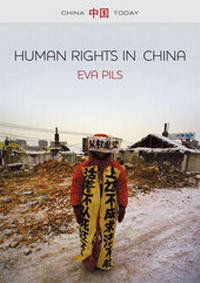
Human Rights in China
Description

Reviews / Votes
"Justice, tradition, contention: only Eva Pils could assess each of these complex constructs in the context of contemporary China, but also argue effectively that human rights have evolved as a social practice. In addition to systematically eviscerating authoritarians' shallow claims to uphold the rule of law, Pils offers a rich view of bottom-up, extraordinarily persistent activism - and the prospect of change in China." Sophie Richardson, Human Rights Watch "This timely book reflects the ongoing shifts in China's human rights performance and offers insights into the larger ideological, procedural and institutional background in which lawyers in China carry out their struggles. Her sharp critiques of the Chinese system are not only legally valid and morally sound, but also theoretically relevant." Hualing Fu, University of Hong KongMore details
Other editions
Additional editions
Person
Content
Introduction
In 1991, the Chinese government published a White Book on Human Rights which declared its commitment to the 'lofty goal' of human rights, as well as support for the United Nation's treaty framework.1 Two years after its violent suppression of the June Fourth movement for democracy, and at a time of major political transitions around the world, China found itself under some pressure to overcome its global image as a dictatorship prepared to murder its young. It needed to reconnect to the international community.2 This community, in turn, expected it to change and, eventually, conform to a liberal model. China was already then a signatory to some United Nations (UN) human rights treaties and was to sign (and in most cases ratify) several more in years to come.
As of today, China takes an active part in some of the United Nations based mechanisms, notably the Universal Periodic Review (UPR) process.3 It has written 'respect and protection of human rights' into its Constitution, and produced two five-year Human Rights Action Plans (the most recent one for 2016-20).4 It also argues that it has greatly furthered human rights goals by 'lifting millions out of poverty'5 and that, anyway, there is no universal idea of human rights.6
These claims have met with criticism from many quarters. The catalogues of Chinese human rights violations are long. They include torture and other abuses in the criminal justice system, the lack of media and internet freedom; land rights, labour rights, 'birth planning' policies; and various kinds of discrimination, including against the physically or mentally disabled, the persecution of dissidents, communities of faith and minorities.7 The news media, reports by non-governmental organizations' (NGO), reports generated by UN bodies and processes and foreign governments' commentary on human rights in China8 testify to a strong interest in how and why human rights in China are violated, and how they can be defended and protected. Their comments on human rights issues in China are complemented by scholars, domestic and international, journalists, artists, and so on; and these comments often draw attention to the bleak and dire.9
Yet, even the bleakest comments tend to be framed in a language of reform, of potential, expected, and on the whole likely, albeit sometimes obstructed or thwarted, improvement. There has long been a widely held belief that China is - must be - on a path of slow transition towards improved rule of law.10 The magic word appeared to be 'engagement' - through engaging China at governmental and non-governmental levels, it would be possible to bring the relevant actors round to the ideas inspiring rule of law and human rights, thus preparing the ground for a liberal transition. Complementing and, arguably, nurturing this expectation, a large industry of governmental and academic programmes led by NGOs or government-organized NGOs (GONGOs), working with Chinese institutions to promote rule of law and civil society, sprang up.
Some versions of the 'incremental reform' argument went even further, asserting that Party-State leadership was in fact best suited to achieve the difficult transition towards rule of law.11 The continued violation of certain human rights seemed to be a regrettable but necessary evil attendant on China's slow, incremental transformation. It required acceptance of certain domestic taboos around 'sensitive' human rights topics, such as the topic of persecuted 'enemies of the People'. 'Economic reforms first, political reforms later', in the words of one of the Chinese scholars of the 'Chinese model'.12 The claim that China was undergoing a gradual, incremental reform process appeared to solve some problems of engagement, allowing transnational actors to stay clear of downright political issues,13 and domestic ones to stay safer. In some ways, it might be said to suit everybody.
Almost everybody. In the earlier years, the victims of human rights violations did not have much of a voice; and the more 'sensitive' their cases, the less they could be discussed domestically. But throughout the post-Mao reform era, and especially from the 1990s onwards, victims - or survivors - of rights violations grew more vocal. The ideas, the vocabulary, arguments and techniques of rights advocacy these programmes disseminated reached those who needed them through oblique and serendipitous channels. Networks inside and outside of China developed and overcame some of the divides induced by control and self-censorship; and gradually, they also changed how victims saw themselves, and how advocates related to them and to the system surrounding them. They started disrupting the 'incremental reform' narrative.
Both the paradigmatic claim that China is transitioning to better rule of law through top-down reform and human rights protection, and the arguments for authoritarian governance call for a critical assessment. This book discusses human rights in China in the light of this need. It challenges the paradigmatic, predictive expectation of transition through top-down reform as increasingly untenable. But it also argues that human rights' enduring importance and vibrancy is demonstrated by human rights advocates who challenge the system's authoritarian practices and principles.
We can only understand the bottom-up dynamic of human rights if we are not imprisoned in too narrow and authority-driven a conception of rights, and if we are sensitive to political context. In Nickel's introductory definition - helpful as a starting point - human rights are 'norms that help to protect all people everywhere from severe political, legal, and social abuses'.14 The discussion in the following chapters will focus on a few of these rights, here considered as central nodes in a web of interconnected human rights principles - expression and thought, liberty and life, and socio-economic and anti-discrimination rights. It will engage with rules and principles that have been created to safeguard these rights through international treaties and domestic legal norms, and use the further definitions contained in these texts. But it will not claim that these or any other definitions close down disagreement over the rights they safeguard. Treaties and national constitutions have given us a shared language and some basis of consensus, of recognition-in-principle;15 but they give rise to interpretive social practices that sustain deep disagreement.16 State governments, courts and legislatures, and international bodies may get to decide about legal human rights norms; but according to the view adopted here, they too do not have a monopoly on defining what human rights are or how they ought to be understood, just by virtue of holding power or status.
Conversely, while international human rights treaties create institutional obligations the concluding state parties did not previously have, whether the people in these states have human rights does not depend on their governments' signing of treaties - rather, there is a moral argument for 'human rights universalism' (such as is expressed in Nickel's definition). Once a state has acknowledged obligations under human rights law, it is generally 'not necessary to argue the moral issues from the ground up';17 generally - but not always. As will be seen in the chapters to come, acceptance of the authority of international human rights law can turn out to be especially weak in China's authoritarian environment, and rights defenders keep having to make the argument that human rights ought to be respected.
A non-positivist, non-voluntarist approach to human rights does not mean that human rights is a hopelessly 'subjective' idea that cannot be defended against criticism. It means, rather, that human rights is a contested concept;18 that the argument for human rights is persuasive rather than peremptory; that 'the authorities' interpreting human rights, whoever they are, may get it wrong just like anyone else; and that any textual expression of human rights or constitutional principles is not conclusive of what these rights and principles mean. As discussed throughout this book, the textual basis for a human rights argument may in fact be thin or contradictory; it may consist in no more than a sentence in the Constitution, or a clause in a treaty that is routinely ignored; and it may be buried underneath language that is in tension with human rights; or made to an institution downright hostile to the very idea of rights.19 Human rights defenders' claims here discussed as part of the social practice of human rights include many instances where the defenders cannot get access to the institutions, because the Party-State will not let them, or where even when they do get access, their human rights arguments go unheard.
The chapters to follow therefore track ways in which rights defenders in contemporary Chinese society use the concepts of human rights (renquan) and rights (quanli), as well as official or establishment discourse about rights. They draw interpretively on fieldwork,20 as well as a variety of textual and audio-visual resources, including legal instruments, scholarly literature, NGO reports, media reports and commentary, conversations and documentaries. They emphasize...
