

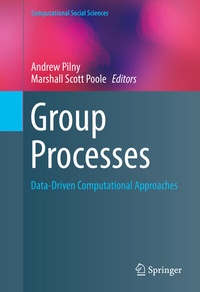
Group Processes
Description

Indeed, the use of methods under the name of computational social science have exploded over the years. However, attention has been focused on original research rather than pedagogy, leaving those interested in obtaining computational skills lacking a much needed resource. Although the methods here can be applied to wider areas of social science, they are specifically tailored to group process research.
A number of data-driven methodsadapted to group process research are demonstrated in this current volume. These include text mining, relational event modeling, social simulation, machine learning, social sequence analysis, and response surface analysis. In order to take advantage of these new opportunities, this book provides clear examples (e.g., providing code) of group processes in various contexts, setting guidelines and best practices for future work to build upon.
This volume will be of great benefit to those willing to learn computational methods. These include academics like graduate students and faculty, multidisciplinary professionals and researchers working on organization and management science, and consultants for various types of organizations and groups.
More details
Other editions
Additional editions
Persons
Andrew Pilny (Ph.D., University of Illinois) is an assistant professor in the Department of Communication at the University of Kentucky. His main research areas concern the development of effective organizing social systems and structures. His research has been applied to nonprofit organizations, social movement groups, work teams, and dark organizations. Andy also specializes in social network analysis.
Marshall Scott Poole (Ph.D., University of Wisconsin) is the David L. Swanson Professor of Communication, Senior Research Scientist at the National Center for Supercomputing Applications, and Director of I-CHASS: The Institute for Computing in the Humanities, Arts, and Social Sciences at the University of Illinois. He is also a CCSS Fellow in the Organization Science Program at Vrije University in Amsterdam, Netherlands. His research interests include group and organizational communication, information and communication technologies, collaboration, organizational change and innovation, and theory construction.
