

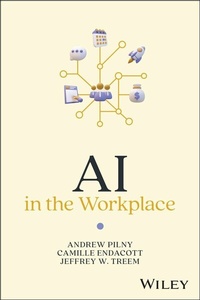
AI in the Workplace
Description

Offers a smart, witty guide to understanding AI's role in the future of work
With AI tools now integrated into everything from hiring systems and team collaboration platforms to strategic decision-making processes, there's a pressing need to move beyond either fear or hype. AI in the Workplace explores how artificial intelligence is reshaping organizational life, often in ways that are subtle yet deeply consequential. This book answers that need by providing an accessible, critical, and often humorous guide for understanding what AI is, how it works, and what it means for the ways we work and interact in professional settings.
AI in the Workplace demystifies AI through a blend of theory, storytelling, and practical insight. Readers are introduced to foundational AI concepts without overwhelming technical detail and are given frameworks to think through pressing questions of algorithmic management, workplace surveillance, bias, and ethics. Through contemporary case studies, real-world examples, reflective exercises, and actionable strategies, the book equips readers to think critically and act thoughtfully in the evolving AI landscape, whether that means embracing tools, resisting trends, or something in between.
Helping readers grasp how AI is not simply replacing human labor, but reorganizing work itself, AI in the Workplace:
- Introduces the novel Human-Story-Text-AI Network model to conceptualize AI's integration into organizational life
- Examines algorithmic management through a critical lens to offer a fresh perspective on emerging managerial practices
- Discusses overlooked issues such as bias in training data and the sociopolitical dimensions of data-centric AI
- Includes hands-on thought experiments at the end of each chapter to stimulate discussion and critical thinking
- Explores "Singularity Management" and the implications of AI on human roles, ethics, and empathy in organizations
- Offers a five-part framework (the "5 Es") to guide ethical and strategic decision-making in AI-driven environments
- Provides a strategy that balances innovation and safety for regulating AI in the workplace
Perfect for students and professionals alike, AI in the Workplace serves advanced undergraduate and graduate courses in Communication, Business, Technology Management, and related fields. It is also an invaluable resource for executive education and professional development in AI adoption, leadership, and organizational change.
More details
Other editions
Additional editions
Persons
ANDREW PILNY, is an Associate Professor in the departments of Communication and Sociology at the University of Kentucky.
CAMILLE ENDACOTT, is an Assistant Professor in the Department of Communication Studies at the University of North Carolina, Charlotte.
JEFFREY W. TREEM, is the Theodore R. and Annie Laurie Sills Professor at the Northwestern University Medill School of Journalism, Media, Integrated Marketing Communications.
Content
Preface ix
About the Authors xi
Ai Use Disclosure Statement xiii
1 Organizing in the Age of AI 1
Metaphors of AI 2
A Brief History of Organizing as Communication Networks 4
A Preview of the Rest of This Book 19
2 AI and Algorithmic Management 21
A Definition: What Is (Not) AI? 23
How Does AI Learn? 29
Unpacking Algorithmic Management 33
A Sociomaterial Soup: Where Technology and Human Practices Stew Together 34
The Nature of Algorithms 36
On Coevolution 38
Coleman's Boat 39
Singularity Management 42
Thought Experiment: The Algorithmic Apprentice 45
3 How Do Organizations Even Use AI? 47
An Introduction to the Typology 48
Predictive AI 50
Perceptual AI 53
Generative AI 55
Decisional AI 58
Optimization AI 61
Organizational AI 63
Robotic AI 66
Broader Challenges of AI in the Workplace 69
4 Consequences of Algorithmic Management 73
AI Is Coming for Some Jobs 73
You Can't Argue with an Algorithm 76
Reskill, Upskill, for What Skill? 79
Somebody's Watching You 82
When AI Is Not So Intelligent 85
AI's Training Data Is Biased... and Racist and Sexist and Ageist and Xenophobic 89
We Can, but Should We? 94
Thought Experiment: The Great Malaise 95
The Great Question 96
5 AI Literacy and Large Language Models 97
Tokenization: How LLMs Gobble Up Text Data 97
Reinforcement Learning Through Human Feedback 110
How Are LLMs Evaluated? 112
Issues with Using LLMs in the Workplace 113
Can You Spot a Bot? 118
Thought Experiment: The Hallucinated Memo 121
6 Deciding Who Does What in an AI-Workplace 123
Finding Our Way in the Marketplace of AI Solutions 124
Explicitness 126
Evaluation 129
Experimentation 130
Engagement 132
Ethics 134
The Five Es, Revisited 137
Thought Exercise: Training HelpBot: The Perfect Hire, or a Perfect Disaster? 151
Some Important Questions to Think About 152
7 A Framework to Regulate, Survive, and Prosper with AI 153
Risk #1: Weaponization 153
Risk #2: Loss of Control 155
Risk #3: Reliability and Validity 155
Risk #4: Explainability and Interpretability 156
From Viagra to Male Enhancement: The Need for Regulating AI 157
Navigating AI: A Worker's Guide 169
Becoming an Expert Reverse Engineer 169
Decoding AI's Vision 170
How to Make a Peanut Butter and Jelly Sandwich 171
Waste Your Time 174
Resistance: When to Push Back Against the Algorithm 177
Conclusion 180
One Final Thought Experiment: The Elephants Who Paint Pictures 181
Index 183
CHAPTER 1
Organizing in the Age of AI
Okay, let's get something out of the way right up front. Yes, this is another book about artificial intelligence (AI). And we know what you might be thinking: Do we really need another one of these? Between the op-ed think pieces, the TED Talks, and that guy from your office who can't stop talking about ChatGPT vs. Grok, it feels like AI is the new gluten-it's everywhere, and everyone has an opinion on it, whether they understand it or not. But stick with us here because this book is different. We're not talking about AI as some glorious "thing of the future" or a dystopian plot twist in The Terminator franchise. We're talking about something far more intimate, more immediate. This is about how AI is quietly, sometimes not-so-quietly, transforming one of the most fundamental aspects of our lives: how we collectively organize to get work done.
And speaking of actually getting work done (or avoiding it, depending on your current life strategy), if you're wondering whether we used AI to help write this book, well-yeah, of course we did. But before you roll your eyes and imagine us sitting back while ChatGPT spins out some grand treatise on "AI in the workplace," let's be clear: we didn't just type "write us a book" and then kick our feet up. That would be lazy, dishonest, unethical, and-let's be real-would result in a pretty crappy book riddled with fake references. What we did do, however, was use various large language models (LLMs) in ways that we think are actually helpful, like getting suggestions for tone and finding metaphors that might actually keep you awake while reading about something like, say, how the attention mechanism works (don't worry, we'll get to that in Chapter 4, and yes, we know it's a slog). Indeed, later chapters (e.g., Chapter 7) reflect on how everyday workers can use AI to their advantage, so we would be quite the hypocrites if we didn't try to practice what we preach.
At the end of the day, we're not just blind cult members drinking the Kool-Aid of the tech revolution. Yet we recommend everyone who can use AI give it a try, even if you find it confusing, disturbing, or of little use. Why? Because knowledge about AI will only sharpen your critique of it. The more you know how it works, the better your arguments against its more insidious uses. Or, as Rage Against the Machine so poetically put it, know your enemy. So, despite whether you are pro-AI, anti-AI, or prefer you never have to hear the term again, there is a somewhat uncomfortable truth motivating this entire book.
AI isn't just another tool, it's an active agent. We do things with AI, and AI does things to, for, and alongside us. This duality of AI is why we think it profoundly shifts how humans will organize. So, before we start talking about automated performance reviews and surveillance systems that track your every mouse click, we need to take a step back. Because you can't really understand how AI is reshaping how we work without first understanding how humans have always organized themselves to work in the first place.
Metaphors of AI
But before we jump into the wild world of AI in the workplace, we want to take a moment to demystify AI just a little bit. While the technical aspects of AI can get mind-bendingly complex (there's actual math involved, sorry, see Chapter 2), what AI is doing in terms of process is not super mysterious. In fact, it's not even all that new. Let's break it down with a few different metaphors often associated with AI.
AI as Calculator
Think of most AI, at its core, as a glorified calculator. Remember your TI-86 behemoth that you probably played more games on than actually calculating stuff? (For those Generation Z or younger, Google it, we used to actually have physical calculators.) No offense to calculators, of course-they're indispensable-but they have a preset limit of operations they are able to perform. Similarly, when AI serves in this mode, it carries out prescribed formulas to process data and spit out results. The magic, if we can call it that, comes from the sheer scale and complexity of operations that AI systems can handle, especially with things like matrix algebra. While your average calculator is doing long division (and bless it for that), modern AI is solving equations to help us address quantum physics problems. It's math, but math that's playing in the big leagues.
AI as Predictor
Next up, AI can predict. Using existing data-things like previous work, texts, or task performance-it makes educated guesses about what's likely to happen next. Sometimes these predictions are the output, like when an AI system tells you there's a 70% chance of rain. Other times, prediction is simply part of the process. Take LLMs like ChatGPT, for example. Even when the output is a full sentence, story, or soliloquy, the AI is often forming that response by predicting, letter by letter, word by word, what's statistically most likely to follow based on your prompt. That's why AI systems can provide answers for anything, even when it has no earthly idea if it's right. It's not really "hallucinating," that is something humans do. It's guessing. Very confidently.
AI as Identifier
AI also excels at identifying things. If you feed it parameters-say, the unique pattern of a fingerprint or the DNA sequence from a hair left at the crime scene-it can sift through mountains of data to figure out whether there's a match. This is what makes AI pretty useful in fields like forensics or medical diagnostics. But it's not that AI is inherently smarter than us humans. It's just that, unlike humans, it doesn't get tired, bored, or distracted after analyzing its 100th fingerprint. Its ability to operate at scale is where the real power lies.
AI as Classifier
Now finally, think about good old-fashioned bureaucratic classification. AI's favorite pastime is sorting, labeling, and parsing through loads of data. It searches for patterns, identifies similarities and differences, and ultimately finds order in the rubble. Imagine an AI analyzing applications for a job. Not "reading" them the way you or I would, but sorting candidates into buckets-"high potential," "medium potential," "probably didn't proofread their résumé"-based on the information it's been trained to prioritize. It is drawing categories and, more importantly, enforcing them, which can be powerful and problematic, depending on how those categories are created.
None of these functions is good or bad in and of themselves. Whether they're meaningful at all depends on how they're used, who's using them, and for what. The calculator can tabulate for an efficient cost-cutting solution or a predatory bottom-line coup. The predictor can let you avoid a traffic jam or send you down a social media rabbit hole of misinformation and conspiracies. The classifier could end up ensuring more egalitarian hiring practices or entrench existing nepotistic biases at scale.
A Brief History of Organizing as Communication Networks
There are plenty of ways to think about how humans organize. You could go old-school and talk hierarchies-pyramids of power with kings, czars, and pharaohs on top and everyone else hoping not to be crushed by bureaucratic decree.1 Or take the Marxist route, framing organizing in terms of power, a tug-of-war between labor and capital.2 We could go on.
But we're going to try something a little different. It might seem reductionist at first, but bear with us. We're going to look at organizing through the lens of communication networks. Yes, it sounds like we're boiling down all of human collaboration to a mess of nodes and links, and maybe we are. But zooming out sometimes helps you see the forest instead of just the bark. And once you start seeing the world as a web of interconnections, it's hard to stop.
Viewing organizations as networks isn't new. Thinkers in management,3 sociology,4 and communication5 have long argued that organizations aren't just titles and org charts, they're relationships. Who talks to whom, who influences whom, and how ideas, resources, and power flow through those ties. The network view lets us zoom in and out-on people, patterns, or even whole systems-depending on the questions we're asking.
This kind of relational thinking runs through social science theoretical frameworks like socio-materiality,6 actor-network,7 and structuration8 (don't worry, we will unpack those in a bit). But perhaps the most eerily relevant take comes from Harari,9 who sees society itself as a vast, evolving information network. Strip down human history, he argues, and it's mostly us figuring out how to organize through information flows, all the way from cave paintings to AI-generated onboarding manuals. Which raises the big question: How can this idea help us understand where we've been, but perhaps more importantly, where are we going?
Human-only Networks
Imagine a world where communication is almost entirely composed of grunts, gestures, and what we'll generously call...
