

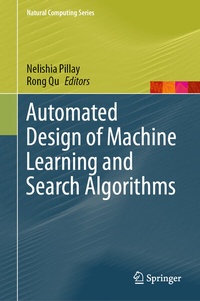
Automated Design of Machine Learning and Search Algorithms
Description

This book presents recent advances in automated machine learning (AutoML) and automated algorithm design and indicates the future directions in this fast-developing area. Methods have been developed to automate the design of neural networks, heuristics and metaheuristics using techniques such as metaheuristics, statistical techniques, machine learning and hyper-heuristics. The book first defines the field of automated design, distinguishing it from the similar but different topics of automated algorithm configuration and automated algorithm selection.
The chapters report on the current state of the art by experts in the field and include reviews of AutoML and automated design of search, theoretical analyses of automated algorithm design, automated design of control software for robot swarms, and overfitting as a benchmark and design tool. Also covered are automated generation of constructive and perturbative low-level heuristics, selection hyper-heuristics for automated design, automated design of deep-learning approaches using hyper-heuristics, genetic programming hyper-heuristics with transfer knowledge and automated design of classification algorithms. The book concludes by examining future research directions of this rapidly evolving field.
The information presented here will especially interest researchers and practitioners in the fields of artificial intelligence, computational intelligence, evolutionary computation and optimisation.
More details
Other editions
Additional editions
Persons
Nelishia Pillay is a professor at the University of Pretoria in South Africa. She holds the Multichoice Joint-Chair in Machine Learning and SARChI Chair in Artificial Intelligence. She is chair of the IEEE Technical Committee on Intelligent Systems Applications, IEEE Task Force on Hyper-Heuristics and the IEEE Task Force on Automated Algorithm Design, Configuration and Selection. Her research areas include hyper-heuristics, automated design of machine learning and search techniques, combinatorial optimization, genetic programming, genetic algorithms and deep learning. These are the focus areas of the NICOG (Nature-Inspired Computing Optimization) research group which she has established.
Rong Qu is an associate professor at the School of Computer Science, University of Nottingham. Her research interests include the modeling and optimisation of combinatorial optimisation problems in optimisation research and artificial intelligence. These include evolutionary algorithms, mathematical programming and metaheuristics integrated with machine learning to automate the design of intelligent algorithms. Dr. Qu is an associated editor at IEEE Computational Intelligence Magazine, IEEE Transactions on Evolutionary Computation, Journal of Operational Research Society and PeerJ Computer Science. She is a Senior IEEE Member since 2012 and the Vice-Chair of Evolutionary Computation Task Committee and Technical Committee on Intelligent Systems Applications at IEEE Computational Intelligence Society.Content
Chapter 1: Recent Developments of Automated Machine Learning and Search Techniques.- Chapter 2: Automated Machine Learning.- Chapter 3: A General Model for Automated Algorithm Design.- Chapter 4: Rigorous Performance Analysis of Hyper-Heuristics.- Chapter 5: AutoMoDe.- Chapter 6: A cross-domain method for generation of constructive and perturbative heuristics.- Chapter 7: Hyper-heuristics.- Chapter 8: Towards Real-time Federated Evolutionary Neural.- Chapter 9: Knowledge Transfer in Genetic Programming.- Chapter 10: Automated Design of Classification Algorithms.- Chapter 11: Automated Design (AutoDes).
