

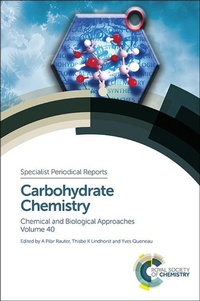
Carbohydrate Chemistry
Volume 40
1st Edition
Published on 20. March 2014
645 pages
978-1-84973-998-6 (ISBN)
Description

Volume 40 of Carbohydrate Chemistry: Chemical and Biological Approaches demonstrates the importance of the glycosciences for innovation and societal progress. Carbohydrates are molecules with essential roles in biology and also serve as renewable resources for the generation of new chemicals and materials. Honouring Professor Andre Lubineau's memory, this volume resembles a special collection of contributions in the fields of green and low-carbon chemistry, innovative synthetic methodology and design of carbohydrate architectures for medicinal and biological chemistry.
Green methodology is illustrated by accounts on the industrial development of water-promoted reactions (C-glycosylation, cycloadditions) and the design of green processes and synthons towards sugar-based surfactants and materials. The especially challenging transformations at the anomeric center are presented in several contributions on glycosylation methodologies using iron or gold catalysis, electrochemical or enzymatic (thio)glycosylation, exo-glycal chemistry and bioengineering of carbohydrate synthases. Then, synthesis and structure of multivalent and supramolecular oligosaccharide architectures are discussed and related to their physical properties and application potential, e.g. for deepening our understanding of biological processes, such as enzymatic pathways or bacterial adhesion, and design of antibacterial, antifungal and innovative anticancer vaccines or drugs.
Green methodology is illustrated by accounts on the industrial development of water-promoted reactions (C-glycosylation, cycloadditions) and the design of green processes and synthons towards sugar-based surfactants and materials. The especially challenging transformations at the anomeric center are presented in several contributions on glycosylation methodologies using iron or gold catalysis, electrochemical or enzymatic (thio)glycosylation, exo-glycal chemistry and bioengineering of carbohydrate synthases. Then, synthesis and structure of multivalent and supramolecular oligosaccharide architectures are discussed and related to their physical properties and application potential, e.g. for deepening our understanding of biological processes, such as enzymatic pathways or bacterial adhesion, and design of antibacterial, antifungal and innovative anticancer vaccines or drugs.
More details
Series
Language
English
Place of publication
Cambridge
United Kingdom
Target group
Professional and scholarly
ISBN-13
978-1-84973-998-6 (9781849739986)
DOI
10.1039/9781849739986
Copyright in bibliographic data and cover images is held by Nielsen Book Services Limited or by the publishers or by their respective licensors: all rights reserved.
Schweitzer Classification
Other editions
Additional editions
Book
03/2014
Royal Society of Chemistry
€467.89
Article not available at the moment
E-Book
03/2014
1st Edition
Royal Society of Chemistry
€433.99
Available for download
Persons
Dr Yves Queneau, Research Director at CNRS, is Head of the Organic and Bioorganic Chemistry Laboratory at INSA Lyon, Deputy-Director of the "Institut de Chimie et Biochimie Moleculaires et Supramoleculaires" (ICBMS), University of Lyon, France and Honorary Professor at the University of Hull, UK. After his doctorate on aqueous Diels-Alder reactions involving glycodienes under the supervision of Professor Andre Lubineau (Orsay, 1988) he was appointed as CNRS fellow and worked on cycloaddition reactions towards complex sugars. He then spent one year in 1992 in Professor Samuel J. Danishefsky's group in Memorial Sloan Kettering Cancer Center in New York, USA. He later moved to Lyon in a mixed CNRS-industrial research facility dedicated to sucrose chemistry (1995-2003) before joining its present position where he develops his research in organic and biological chemistry with a particular interest for the use of carbohydrates as renewable raw materials.
Content
Lubineau's green synthons for carbohydrate chemistry;
Recent Results in Synthetic Glycochemistry with Iron Salts;
Conformationally locked sugars and analogs as inhibitors;
The thiol-ene coupling;
Exo-glycals as useful tools for anomeric functionalisation;
Reactivity of allyl and vinyl pentosides in photo-initiated;
Enzymatic thioglycosylation;
Antigenicities roles of poly-N-acetyllactosamine-based sequences;
A model synthesis of a mucin;
Furano-specific enzymes;
Liquid Crystal Glycolipids;
Flexibility of C-Furanosides;
Chiral recognition by sucrose based macrocyclic receptors;
Sugar decorated receptors for chiral anions;
Anionic oligosaccharides: role, synthesis and applications;
Carbohydrates and vectorization of PDT tetrapyrrolic anticancer agents;
Glycopeptides;
Glycodendrimers;
Sugar-based hydrotropes;
Polysaccharides microbiens;
Multivalent glycidic constructs toward anti-cancer therapeutics;
C-Glycosylation invented by Pr. Lubineau's team;
Glycolipid-based nanosystems for drug;
How sugar polarity can be used in chemistry;
Advances in the glycosylation of glycoprotein hormones;
Carbohydrate-derived cyclic nitrones;
From conventional to greener catalytic methods for carbohydrate etherification;
Electrochemical glycosylation;
Carbohydrate chemistry and vaccines;
Recent Advances in Gold-Catalyzed Glycosylations;
Polyesters functionalized carbohydrates via organocatalytic ring-opening polymerization;
Highlights on carbohydrate-based influenza antiviral agents;
Glycation
Recent Results in Synthetic Glycochemistry with Iron Salts;
Conformationally locked sugars and analogs as inhibitors;
The thiol-ene coupling;
Exo-glycals as useful tools for anomeric functionalisation;
Reactivity of allyl and vinyl pentosides in photo-initiated;
Enzymatic thioglycosylation;
Antigenicities roles of poly-N-acetyllactosamine-based sequences;
A model synthesis of a mucin;
Furano-specific enzymes;
Liquid Crystal Glycolipids;
Flexibility of C-Furanosides;
Chiral recognition by sucrose based macrocyclic receptors;
Sugar decorated receptors for chiral anions;
Anionic oligosaccharides: role, synthesis and applications;
Carbohydrates and vectorization of PDT tetrapyrrolic anticancer agents;
Glycopeptides;
Glycodendrimers;
Sugar-based hydrotropes;
Polysaccharides microbiens;
Multivalent glycidic constructs toward anti-cancer therapeutics;
C-Glycosylation invented by Pr. Lubineau's team;
Glycolipid-based nanosystems for drug;
How sugar polarity can be used in chemistry;
Advances in the glycosylation of glycoprotein hormones;
Carbohydrate-derived cyclic nitrones;
From conventional to greener catalytic methods for carbohydrate etherification;
Electrochemical glycosylation;
Carbohydrate chemistry and vaccines;
Recent Advances in Gold-Catalyzed Glycosylations;
Polyesters functionalized carbohydrates via organocatalytic ring-opening polymerization;
Highlights on carbohydrate-based influenza antiviral agents;
Glycation
