

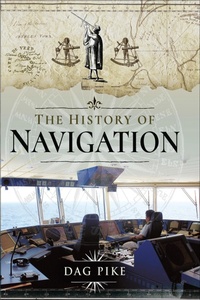
The History of Navigation
Description

A history of the development of navigation at sea throughout the ages, including the challenges faced and the advancements in technology.
"A concise overview of navigation at sea.Pike, a maritime writer with a lengthy maritime career, examines many aspects of ocean travel, including weather, oceanography, charting, routing, and buoyage, as well as various methods for marine navigation, such as celestial, electronic, terrestrial, and satellite.... Overall, this is a useful introductory volume for maritime studies and nautical science programs." - CHOICE
Today travellers by land, sea and air take accurate navigation for granted but it was not always thus.
The author, a highly experienced sailor, sets out to record the development of navigational techniques from the earliest time, five millenniums ago. As explorers started to venture offshore into the unknown they had to rely on the sun and stars for direction. From this, pioneers turned to mathematics, astrolabes, sextants and increasing accurate clocks to measure latitude and later longitude. More recently major breakthroughs with electronic navigation, GPS and other satellite systems have revolutionised travel.
Focusing primarily but not exclusively on marine navigation, the author weaves a fascinating course through the successes and failures of mankind's quest to explore his world. The result is a thoroughly entertaining and informative work which has no rival.
"Reads well, is concise, maintains the interest of the reader and includes just enough personal touch to "not" make you feel that it is an autobiography." -Naval Historical Foundation
More details
Other editions
Additional editions
Person
He has participated in six Atlantic record attempts and, as a member of the Italian Destriero project, made the fastest crossing averaging over 53 knots.
He lives at Bristol.
Content
- Cover
- Book Title
- Copyright
- Contents
- Introduction
- 1. In the Beginning
- 2. Over the Horizon
- 3. Soundings
- 4. Heading in the Right Direction
- 5. Speed
- 6. Fixing the Position
- 7. Charts and Pilot Books
- Plate section
- 8. Buoys and Lighthouses
- 9. Making Landfalls
- 10. Electronic Navigation
- 11. Passage-Planning and Weather
- 12. Collision Avoidance
- 13. The New Stars in the Sky
- 14. The Human Element
- 15. The Future
- Index
- Back Cover
