

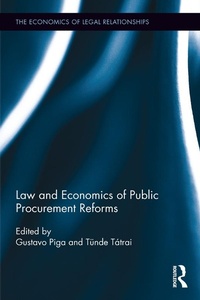
Law and Economics of Public Procurement Reforms
Published on 3. October 2017
274 pages
978-1-351-58480-7 (ISBN)
Description

Appropriate laws and regulations are essential tools to direct the action of procurers toward the public good and avoid corruption and misallocation of resources. Common laws and regulations across regions, nations and continents potentially allow for the further opening of markets and ventures to newcomers and new ideas to satisfy public demand.
Law and Economics of Public Procurement Reforms collects the original contributions related to the new European Union Directives approved in 2014 by the EU Parliament. They are of both economists and lawyers, and have been presented in a manner that allows for exchanges of views and "real time" interaction. This book features, for each section, an introductory exchange between two experts of different disciplines, made up of a series of sequential interactions between an economist and a lawyer, which enriches the liveliness of the debate and improve the mutual understanding between the two professions. Four sections characterize this book: Supporting social considerations via public procurement; Green public procurement; Innovation through innovative partnerships; and Lots - The Economic and Legal Challenges of Centralized Procurement. These themes have current relevance of the new European Public Procurement Directives.
Written by an impressive array of experts in their respected fields, this volume is of great importance to practitioners who work in the field of EU public procurement in the Member States of the EU, as well as academics and students who study public finance, public policy and regulation.
Law and Economics of Public Procurement Reforms collects the original contributions related to the new European Union Directives approved in 2014 by the EU Parliament. They are of both economists and lawyers, and have been presented in a manner that allows for exchanges of views and "real time" interaction. This book features, for each section, an introductory exchange between two experts of different disciplines, made up of a series of sequential interactions between an economist and a lawyer, which enriches the liveliness of the debate and improve the mutual understanding between the two professions. Four sections characterize this book: Supporting social considerations via public procurement; Green public procurement; Innovation through innovative partnerships; and Lots - The Economic and Legal Challenges of Centralized Procurement. These themes have current relevance of the new European Public Procurement Directives.
Written by an impressive array of experts in their respected fields, this volume is of great importance to practitioners who work in the field of EU public procurement in the Member States of the EU, as well as academics and students who study public finance, public policy and regulation.
More details
Series
Language
English
Place of publication
London
United Kingdom
Publishing group
Taylor & Francis Ltd
Target group
College/higher education
Illustrations
12 Tables, black and white; 11 Line drawings, black and white; 11 Illustrations, black and white
File size
1,99 MB
ISBN-13
978-1-351-58480-7 (9781351584807)
Copyright in bibliographic data and cover images is held by Nielsen Book Services Limited or by the publishers or by their respective licensors: all rights reserved.
Schweitzer Classification
Other editions
Additional editions
Gustavo Piga | Tunde Tatrai
Law and Economics of Public Procurement Reforms
Book
08/2020
1st Edition
Routledge
€65.50
Shipment within 15-20 days
Gustavo Piga | Tunde Tatrai
Law and Economics of Public Procurement Reforms
Book
10/2017
1st Edition
Routledge
€215.77
Shipment within 10-20 days
Persons
Gustavo Piga is Professor of Economics at the University of Rome Tor Vergata, Italy.
Tuende Tatrai is Associate Professor at the Corvinus University of Budapest, Hungary.
Tuende Tatrai is Associate Professor at the Corvinus University of Budapest, Hungary.
Content
Chapter 0
Giancarlo Spagnolo
Introduction - Vendor rating, performance and entry in public procurement
Chapter 1 Local preferences in public procurement
1. Colloquium
Zornitsa Kutlina-Dimitrova
Pedro Telles
2. Sharlene Jo-Ann Shillingford McKlmon and Shirley Gayle Sinclair
CARICOM: Small Market - Big Money. Amalgamating the Procurement Market to Transform Small Size into an Economic Advantage
3. Petra Ferk and Bostjan Ferk
Local Preferences as Non-Discriminatory Instrument in Public Procurement of Fresh Foods
Chapter 2 Joint public procurement
1. Colloquium
Nicola Dimitri
Tuende Tatrai
2. Antoinette Calleja
"Addressing in part market imbalances in the pharmaceutical sector through voluntary joint public procurement"
3. Francesco Saverio Mennini, Nicola Dimitri, Lara Gitto, Francois Lichere, Gustavo Piga
Joint procurement and the EU perspective
Chapter 3 Big data in public procurement
1. Colloquium
Mihaly Fazekas
Stephane Saussier
2. Bernardo Nicoletti
"Open Data and Procurement"
3. Nikola Komsic
"Big Data for Procurement - The importance of correctly acquiring and using information in public procurement"
Chapter 4 Renegotiation in public procurement
1. Colloquium
Francesco Decarolis
Martin Trybus
2. Jose Luis Guasch
Procurement and Renegotiation of Public Private Partnerships in Infrastructure: Evidence, Typology and Tendencies
3. Biancamaria Raganelli and Ilenia Mauro
"Renegotiation and Anti-corruption Measures in Public Procurement"
Giancarlo Spagnolo
Introduction - Vendor rating, performance and entry in public procurement
Chapter 1 Local preferences in public procurement
1. Colloquium
Zornitsa Kutlina-Dimitrova
Pedro Telles
2. Sharlene Jo-Ann Shillingford McKlmon and Shirley Gayle Sinclair
CARICOM: Small Market - Big Money. Amalgamating the Procurement Market to Transform Small Size into an Economic Advantage
3. Petra Ferk and Bostjan Ferk
Local Preferences as Non-Discriminatory Instrument in Public Procurement of Fresh Foods
Chapter 2 Joint public procurement
1. Colloquium
Nicola Dimitri
Tuende Tatrai
2. Antoinette Calleja
"Addressing in part market imbalances in the pharmaceutical sector through voluntary joint public procurement"
3. Francesco Saverio Mennini, Nicola Dimitri, Lara Gitto, Francois Lichere, Gustavo Piga
Joint procurement and the EU perspective
Chapter 3 Big data in public procurement
1. Colloquium
Mihaly Fazekas
Stephane Saussier
2. Bernardo Nicoletti
"Open Data and Procurement"
3. Nikola Komsic
"Big Data for Procurement - The importance of correctly acquiring and using information in public procurement"
Chapter 4 Renegotiation in public procurement
1. Colloquium
Francesco Decarolis
Martin Trybus
2. Jose Luis Guasch
Procurement and Renegotiation of Public Private Partnerships in Infrastructure: Evidence, Typology and Tendencies
3. Biancamaria Raganelli and Ilenia Mauro
"Renegotiation and Anti-corruption Measures in Public Procurement"
