

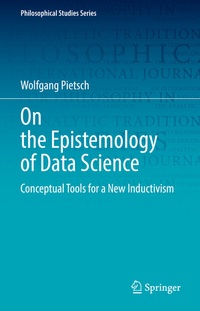
On the Epistemology of Data Science
Description

This book addresses controversies concerning the epistemological foundations of data science: Is it a genuine science? Or is data science merely some inferior practice that can at best contribute to the scientific enterprise, but cannot stand on its own? The author proposes a coherent conceptual framework with which these questions can be rigorously addressed.
Readers will discover a defense of inductivism and consideration of the arguments against it: an epistemology of data science more or less by definition has to be inductivist, given that data science starts with the data. As an alternative to enumerative approaches, the author endorses Federica Russo's recent call for a variational rationale in inductive methodology. Chapters then address some of the key concepts of an inductivist methodology including causation, probability and analogy, before outlining an inductivist framework.
The inductivist framework is shown to be adequate and useful for an analysis of the epistemological foundations of data science. The author points out that many aspects of the variational rationale are present in algorithms commonly used in data science. Introductions to algorithms and brief case studies of successful data science such as machine translation are included. Data science is located with reference to several crucial distinctions regarding different kinds of scientific practices, including between exploratory and theory-driven experimentation, and between phenomenological and theoretical science.
Computer scientists, philosophers and data scientists of various disciplines will find this philosophical perspective and conceptual framework of great interest, especially as a starting point for further in-depth analysis of algorithms used in data science.Reviews / Votes
"Readers are taken on a journey where they will discover step-by-step methodologies for data-driven research. Judiciously, each key concept of data science is concisely defined, and examples and the when, why, and how to use them are provided. . I fully recommend it." (Thierry Edoh, Computing Reviews, February 7, 2023)More details
Other editions
Additional editions
Person
Wolfgang Pietsch is a philosopher of science and technology with a background in physics, affiliated with the Munich Center for Technology in Society of Technical University Munich. His main research interest is scientific method, examining scientific practice in different disciplines, in particular the engineering sciences and data science. He works on fundamental concepts like causation and probability as well as different inductive methods, in particular analogical inferences and variational approaches to induction. Wolfgang was a Poiesis Fellow of the Institute for Public Knowledge of New York University and has co-directed for many years the working group on philosophy of physics of the German Physical Society. See also his website www.wolfgangpietsch.de.
Content
Preface.- Chapter 1. Introduction.- Chapter 2. Inductivism.- Chapter 3. Phenomenological Science.- Chapter 4. Variational Induction.- Chapter 5. Causation As Difference Making.- Chapter 6. Evidence.- Chapter 7. Concept Formation.- Chapter 8. Analogy.- Chapter 9. Causal Probability.- Chapter 10. Conclusion.- Index.
