

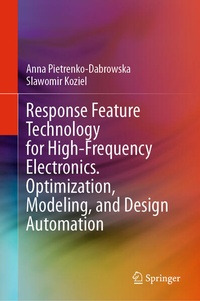
Response Feature Technology for High-Frequency Electronics. Optimization, Modeling, and Design Automation
Description

This book discusses response feature technology and its applications to modeling, optimization, and computer-aided design of high-frequency structures including antenna and microwave components. By exploring the specific structure of the system outputs, feature-based approaches facilitate simulation-driven design procedures, both in terms of improving their computational efficiency and reliability. These benefits are associated with the weakly nonlinear relationship between feature point coordinates and design variables, which-in the context of optimization-leads to inherent regularization of the objective functions. The book provides an overview of the subject, a definition and extraction of characteristic points, and feature-based design problem reformulation. It also outlines a number of numerical algorithms developed to handle local, global, and multi-criterial design, surrogate modeling, as well as uncertainty quantification. The discussed frameworks are extensively illustrated using examples of real microwave and antenna structures, along with numerous design cases. Introductory material on simulation-driven design, numerical optimization, as well as behavioral and physics-based surrogate modeling is also included. The book will be useful for readers working in the area of high-frequency electronics, including microwave engineering, antenna design, microwave photonics, magnetism and especially those who utilize electromagnetic (EM) simulation models in their daily routines.
More details
Other editions
Additional editions
Persons
Anna Pietrenko-Dabrowska received the M.Sc. and Ph.D. degrees in electronic engineering from Gdansk University of Technology, Poland, in 1998 and 2007, respectively. Currently, she is an Associate Professor with Gdansk University of Technology, Poland. She is the Associate Editor of Int. J. Numerical Modeling, and Academic Editor of Int. J. Ant. Prop. She is also a guest co-editor of special issue of Int. J. Numerical Modeling (Advances in Forward and Inverse Surrogate Modeling for High-Frequency Design). She is a program committee member of international conferences (IEEE MTT-s Int. Conf. Num. EM and Multiphysics Modeling and Optim., NEMO 2019, Int. Conf. Comp. Science, ICCS 2019). Her research interests include simulation-driven design, design optimization, experiment design, control theory, modeling of microwave and antenna structures, numerical analysis. She is also a co-author of the book "Performance-driven surrogate modeling of high-frequency structures," (Springer, 2020).
Slawomir Koziel received the M.Sc. and Ph.D. degrees in electronic engineering from Gdansk University of Technology, Poland, in 1995 and 2000, respectively. He also received the M.Sc. degrees in theoretical physics and in mathematics, in 2000 and 2002, respectively, as well as the PhD in mathematics in 2003, from the University of Gdansk, Poland. He is currently a Professor with the Department of Engineering, Reykjavik University, Iceland. His research interests include CAD and modeling of microwave circuits, simulation-driven design, surrogate-based optimization, space mapping, circuit theory, evolutionary computation and numerical analysis. In recent years, he has been working extensively on surrogate-based modeling and optimization techniques as well as computationally efficient simulation-driven design methods for microwave engineering and aerospace engineering. He has published several book chapters and over 1,000 research papers. He is a founder and director of Engineering Optimization & Modeling Center at Reykjavik University.
Slawomir Koziel is a recipient of Fulbright Scholarship for the academic year 2003/2004. He has served on the Editorial Board of various international journals, program committee member as well as co-organizer of numerous special sessions and workshops at international conferences. He is an Associate Editor of several journals (IET Microwaves Ant. Prop., El. Lett., Int. J. Math. Modeling Num. Opt., Int. J. Numerical Modeling). He has also been a guest co-editor of several special issues of international journals (including Optimization and Engineering, Int. J. RF and Microwave CAE, Int. J. Math. Modelling and Num. Opt, IEEE Trans. Microwave Theory Techn.), as well as a co-author of several books, including "Performance-driven surrogate modeling of high-frequency structures," (Springer, 2020), "Simulation-based optimization of antenna arrays," (World Scientific, 2019), "Simulation-driven design by knowledge-based response correction techniques" (Springer, 2016), and "Antenna design by simulation-driven optimization" (Springer, 2014), and a co-editor of several other books.
Content
Introduction.- Simulation-driven design of high-frequency structures.- Basics of response feature technology.- Response features for local optimization.- Expedited feature-based optimization.- Response features for global and multi-objective design.- Feature-based surrogate modeling.- Performance-driven modeling with response features.- Response features for uncertainty quantification.- Feature-based warm start optimization and database design acquisition.- Response features for reliability improvement.- Generalized features.- Summary and conclusion.
