

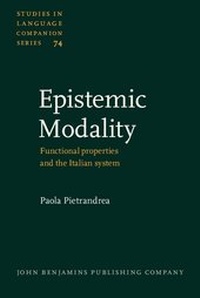
Epistemic Modality
Functional properties and the Italian system
1st Edition
Published on 13. October 2005
XII, 232 pages
978-90-272-8534-8 (ISBN)
Description

This volume offers an original theoretical and methodological approach to the hotly debated issue of epistemic modality. The analysis is conducted in a rigorous typological frame developed after a careful consideration of a wealth of cross-linguistic data, and focuses on Italian, a language often disregarded in comparative analyses. The complexity of the Italian epistemic system provides relevant information that will undoubtedly foster a better understanding of the topic. A new definition of epistemic modality is proposed on a functional basis and the structure of the Italian epistemic system is closely described. The morpho-syntactic characteristics of Italian epistemic forms are regarded as the result of the dialectic between universal functional pressures and peculiar system resistances. Shaped by the system, epistemic modality emerges as an intrinsically linguistic category, which cannot be downsized to a mere conceptual notion, as other approaches would propose.
More details
Other editions
Additional editions
Book
10/2005
John Benjamins Publishing Co
€111.30
Shipment within 10-15 days
Person
Content
- Epistemic Modality Functional properties and the Italian system
- Editorial page
- Title page
- Copyright page
- Table of contents
- ABBREVIATIONS
- INTRODUCTION
- 1. The theoretical approach
- 2. The structure of the book
- 3. Data
- I. THE NOTIONAL CATEGORY OF EPISTEMIC MODALITY
- 1. Introductory remarks
- 2. The boundaries of (epistemic) modality
- 2.1 Deontic and epistemic modality
- 2.2 Mood and modality
- 2.3 Illocution and modality
- 2.4 Reality status and modality
- 2.5 Evidentiality and modality
- 3. Modality as a non-designative category
- 4. Modality and subjectivity
- 4.1 Performativity
- 4.2 Meta-propositionality
- 4.3 Genuine Epistemicity
- 5. A working definition
- II. A TYPOLOGICAL CLASSIFICATION OF EPISTEMIC SYSTEMS
- 1. Parameters
- 2. Specific vs. parasitic markers
- 3. One form vs. degrees of certainty
- 4. Genuine epistemicity vs. inferential evidentiality
- 5. Reportive, modalized and complex evidential systems
- 6. Degrees of performativity
- 7. Summary
- III. EPISTEMIC MODALITY IN ITALIAN
- 1. Introductory remarks
- 2. Epistemic forms
- 3. Grammaticality scales
- 4. Grammaticalized epistemic forms
- 5. Summary
- IV. SEMANTIC OPPOSITIONS
- 1. Introductory remarks
- 2. Degrees of certainty
- 2.1. DEVE "must" vs. PUÔ "can
- 2.2. Degrees of certainty and inference conditions. DEVE "must" vs. DOVREBBE "should
- 3. The epistemic-deonttc axis
- 3.1 The asymmetry between dovere "muss" and potere "can
- 3.2 PUÔ "can" vs. PPTREBBE "could
- 4. Evidentialiy and epistemic modality. The opposition between modals and epistemic future
- 4.1 The evidential nature of DEVE "must
- 4.2 The evidential nature of the other modals
- 4.2.1 DOVREBBE "Should
- 4.2.2 PUò "can" and POTREBBE "could
- 4.3 The epistemic nature of the future
- 5. Summary
- V. A TYPOLOGICAL CHARACTERIZATION OF ITALIAN EPISTEMIC MODALITY
- 1. Introductory remarks
- 2. Parasitic forms
- 3. Three degrees of certainty
- 4. The distinction between genuine epistemicity and inferential evidentiality
- 5. A complex evidential system
- 6. Low performativity
- 7. Summary
- VI. INFLECTIONAL AND DISTRIBUTIONAL CONSTRAINTS. THE (LOW) PERFORMATIVITY OF ITALIAN EPISTEMIC MODALITY
- 1. Introductory Remarks
- 2. Constraints on the tense. The (low) performativity of Italian epistemic forms
- 2.1 Past tense
- 2.2 Future tense
- 2.3 Low performativity and the evidential nature of modals
- 3. Constraints on the personal inflection. Speech situation and epistemic control
- 3.1 DEVE, PUÔ, and the epistemic future
- 3.2 DOVREBBE and POTREBBE
- 4. Constraints on the distributton
- 4.1 Conditional constructtons
- 4.2 Interrogative contexts
- 5. Summary
- VII. ASPECTUAL CONSTRAINTS ON THE PROPOSITIONAL CONTENT
- 1. Introductory remarks
- 2. Tools of analysis. Actional class and aspect
- 3. Stativity of the propositional content
- 4. The aspect of the propositional content
- 4.1 Progressives
- 4.2. Habituais
- 4.3 Perfects
- 5. Conclusions
- 5.1. Asymmetries among epistemic forms
- 5.2. The incompleteness of the propositional content
- 5.3 A topological representation of aspeccual lncompleteness
- VIII. THE INCOMPLETENESS OF THE PROPOSITIONAL CONTENT AND THE METAPROPOSITIONALITY OF EPISTEMIC MODALITY
- 1. Introductory remarks
- 2. Semantic projections on complements
- 3. Incompleteness as an index of metapropositionality. A hypothesis
- 4. Linguistic relevance of the distinction between predications and propositions
- 5. The incompleteness of Italian propositional complements
- 5.1 Propositional predicates
- 5.2 The incompleteness of the infinitives governed by sapere
- 5.3 The incompleteness of the infinitives governed by dire
- 6. The aspectual completeness of predicational complements
- 6.1 Predicational predicates
- 6.2 The aspectual completeness of the infinitives governed by predicates of perception and practical manipulation
- 6.3 Refinements: the destativizaiion of some predicaiional complements
- 7. Incompleteness as an index of simultaneity with the ongoing speech process
- 7.1 The self-referentiality of linguistic tense. The enenciation process and other linguistic temporal references
- 7.2 The semiotic meaning of incompleteness
- 8. Typological validity of the relation between incompleteness and propositionality
- 9. Summary
- IX. A DIACHRONIC HYPOTHESIS
- 1. Introductory remarks
- 2. Background
- 2.1 The semantic relation between the deontic and the epistemic meaning of modals
- 2.2 The semantic relation between the temporal and the epistemic meaning of the future
- 2.3 Diachronic evidence
- 3. A new reconstructivist hypothesis
- 4. Summary
- CONCLUSIONS
- NOTES
- INTRODUCTION
- CHAPTER 2
- CHAPTER 3
- CHAPTER 4
- CHAPTER 5
- CHAPTER 6
- CHAPTER 8
- CHAPTER 9
- BIBLIOGRAPHY
- SUBJECT INDEX
