

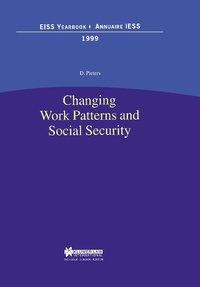
Changing Work Patterns and Social Security
Changing Work Patterns and Social Security
Published on 1. November 1999
182 pages
978-90-411-7501-4 (ISBN)
Description

The one-job wage-earner, for so many generations a bulwark of industrialized society seems to have passed away. We perceive this as contemporary reality, yet it has not been easy to cite the facts and figures necessary to build a stable foundation for the social security of tomorrow's population. Now the European Institute of Social Security, a leading multidisciplinary research group dedicated to exploring the frontiers of social security, has taken the crucial first steps with an in-depth examination of the new and atypical work relations that are emerging. The research and conclusions in this book will greatly help policymakers to identify the areas in which existing social security systems can meaningfully accommodate the new realities of work.
Changing Work Patterns and Social Security
records the proceedings of the 1999 Conference of the EISS, held at Limassol in Cyprus to consider the relations of atypical work patterns and social protection. Among the important issues raised are:
- the real extent of the atypical work phenomenon;
- the difficulties relating to the assessment of the incomes of the self-employed;
- the social protection of the farmer in Europe; and
- the shortcomings of existing social security systems vis-à-vis self-employment and part-time work.
The analysis of current trends presented in this book will interest and inform anyone - whether in government, business or academia - concerned with the development and future of social protection systems, not only in Europe but throughout the world.
Changing Work Patterns and Social Security
records the proceedings of the 1999 Conference of the EISS, held at Limassol in Cyprus to consider the relations of atypical work patterns and social protection. Among the important issues raised are:
- the real extent of the atypical work phenomenon;
- the difficulties relating to the assessment of the incomes of the self-employed;
- the social protection of the farmer in Europe; and
- the shortcomings of existing social security systems vis-à-vis self-employment and part-time work.
The analysis of current trends presented in this book will interest and inform anyone - whether in government, business or academia - concerned with the development and future of social protection systems, not only in Europe but throughout the world.
More details
Other editions
Additional editions
Book
11/1999
1st Edition
Kluwer Law International
€78.65
Shipment within 10-20 days
Content
- Cover
- Half Title Page
- Title Page
- Copyright Page
- Dedication
- Table of Contents
- Introduction
- Work Patterns in Europe and Related Social Security Issues: Coping with the Myth of Flexibility
- 1. STRUCTURAL CHANGES IN THE LABOUR MARKET
- 1.1. De-industrialisation
- 1.2. Unemployment
- 1.3. Polarisation
- 2. FLEXIBLE EMPLOYMENT PRACTICES
- 2.1. Numerical flexibility
- 2.2. Flexibility in hours
- 2.3. Wage fluctuations
- 2.4. Functional flexibility
- 3. PERCEPTIONS OF FLEXIBILITY AND INSECURITY
- 4. PATTERNS OF CHANGE
- 5. IMPLICATIONS FOR SOCIAL SECURITY
- 5.1. De-industrialisation
- 5.2. Flexible employment
- 6. POSTSCRIPT
- REFERENCES
- Atypical Work in the European Union
- 1. THE EMERGENCE OF ATYPICAL WORK
- 2. SELF-EMPLOYMENT
- 3. PART-TIME WORK
- 3.1. General trends
- 3.2. Short part-time work
- 3.3. Part time and job satisfaction
- 4. FIXED-TERM EMPLOYMENT
- 4.1. General trends
- 4.2. Agency work
- 5. SOCIAL PROTECTION AND ATYPICAL WORK
- REFERENCES
- Comparison of the Social Security Law for Self-Employed Persons in the Member-States of the European Union
- THE CONCEPT OF 'SELF-EMPLOYMENT'
- THE STRUCTURE OF THE SOCIAL PROTECTION FOR THE SELF-EMPLOYED
- The different systems in force
- The relativity of the distinctions
- THE PERSONAL SCOPE OF APPLICATION AND RELATED PROBLEMS OF DELIMITATION
- The need for differentiation
- The bond of subordination
- The self-employed as a leftover category
- The importance of the distinction
- Practising several professional activities
- THE ADMINISTRATIVE ORGANISATION AND THE FINANCING OF THE SOCIAL SECURITY SYSTEMS FOR THE SELF-EMPLOYED
- The administration
- Financing
- The determination of the income basis
- The co-operation with the tax services
- The fictitious basis for contribution
- Starting a self-employed activity
- The solidarity mechanisms
- THE SOCIAL SECURITY BENEFITS
- The old-age and survival pensions
- The other benefits for loss of income
- Benefits for incapacity for work
- Unemployment benefits
- Health care and family benefits
- FINAL REMARKS
- The Farmer and his Social Protection in Europe
- HEALTH INSURANCE
- Disability
- PROVISION FOR OLD AGE
- EARLY RETIREMENT
- OCCUPATIONAL ACCIDENTS AND OCCUPATIONAL DISEASES
- UNEMPLOYMENT
- FAMILY BENEFITS AND NURSING ALLOWANCE
- CONCLUSIONS
- Part-Time Work in Europe: Challenges and Outlook
- INTRODUCTION
- 1. THE STATISTICAL AND ANALYTICAL ASPECTS OF PART-TIME WORK
- 1.1. The many definitions of part-time work
- 1.2. Elements characterising part-time work and its deficiencies
- 1.3. The challenges of part-time work
- 2. THE OUTLOOK AND PROPOSALS CONCERNING PART-TIME WORK
- 2.1. European initiatives
- 2.2. Towards diversification in the methods of part-time work
- 2.3. Proposals for improving workers' prospects
- CONCLUSION
- REFERENCES
- International Social Security Instruments and Alternative Work Patterns
- PART-TIME WORK
- HOME-WORK
- TEMPORARY WORK
- SOCIAL SECURITY PROTECTION
- Protection of part-time workers
- Protection of home-workers
- Social protection for workers in atypical forms of employment in Cyprus
- SOCIAL SECURITY INTERNATIONAL INSTRUMENTS
- Instruments of the European Union
- Instruments of the Council of Europe
- ILO Social Security Instruments
- REFERENCES
- Assessing the Incomes of the Self-Employed
- WHY STUDY THE SELF-EMPLOYED?
- DEFINITION OF 'SELF-EMPLOYED'
- MAIN CHARACTERISTICS
- EXTENT OF SELF-EMPLOYMENT IN THE EU
- TRENDS IN SELF-EMPLOYMENT OVER THE PAST 10 YEARS
- ASSESSING THE INCOMES OF THE SELF-EMPLOYED
- SOME EXAMPLES
- SOME STRATEGIES FOR IMPROVING THE COLLECTION OF INCOME FROM SELF-EMPLOYMENT
- CONCLUSIONS
- REFERENCES
- Work Patterns and Social Security: Synoptic Report
- 1. WORK PATTERNS AND SOCIAL PROTECTION: THE GENERAL CONTEXT
- 1.1. The major changes
- 1.2. Paid work
- 1.3. Three questions
- 2. CURRENT CHANGES IN WORK PATTERNS: FLEXIBILITY OR INSECURITY?
- 2.1. Changes in companies
- 2.2. Trends in wages and jobs
- 2.3. The development of self-employed work
- 2.4. The expansion of atypical work
- 3. CURRENT CHANGES IN WORK PATTERNS: WHAT ARE THE IMPLICATIONS FOR SOCIAL SECURITY SYSTEMS?
- 3.1. General points. The issue of solidarity
- 3.2. Access to social security systems
- 3.3. Reduced protection?
- 3.4. What measures should be taken?
- 3.5. Final comment
- Back Cover
