

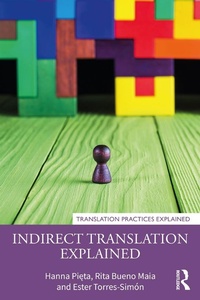
Indirect Translation Explained
1st Edition
Published on 5. July 2022
240 pages
978-1-000-59784-4 (ISBN)
Description

Indirect Translation Explained is the first comprehensive, user-friendly book on the practice of translating indirectly in today's world. Unlike previous scholarly approaches, which have traditionally focused on translating from the original, this textbook offers practical advice on how to efficiently translate from an already translated text and for the specific purpose of further translation.
Written by key specialists in this area of research and drawing on many years of translation teaching and practice, this process-focused textbook covers a range of languages, geographical settings and types of translation, including audiovisual, literary, news, and scientific-technical translation, as well as localization and interpreting. Since this topic addresses the concerns and practices of both more peripheral and more dominant languages, this textbook is usable by all, regardless of the language combinations they work with.
Featuring theoretical considerations, tasks for hands-on practice, suggestions for further discussion and diverse, real-world examples, this is the essential textbook for all students and autodidacts learning how to translate via a third language.
Additional resources are available on the Routledge Translation Studies Portal: http://routledgetranslationstudiesportal.com
Written by key specialists in this area of research and drawing on many years of translation teaching and practice, this process-focused textbook covers a range of languages, geographical settings and types of translation, including audiovisual, literary, news, and scientific-technical translation, as well as localization and interpreting. Since this topic addresses the concerns and practices of both more peripheral and more dominant languages, this textbook is usable by all, regardless of the language combinations they work with.
Featuring theoretical considerations, tasks for hands-on practice, suggestions for further discussion and diverse, real-world examples, this is the essential textbook for all students and autodidacts learning how to translate via a third language.
Additional resources are available on the Routledge Translation Studies Portal: http://routledgetranslationstudiesportal.com
Reviews / Votes
I am delighted by the innovative take of this textbook. With a rigorous focus on indirect translation, it caters for many different specialisations and course contexts. The approach is pragmatic, and chapters come with a plethora of ready-made assignments, but I trust the broad focus will also open up new avenues of thought in research.Kaisa Koskinen, Tampere University, Finland
A necessary and most timely textbook on how to translate through another language. The chapter on pivot audiovisual translation is a must-read for template makers.
Stavroula Sokoli, Computer Technology Institute & Press, Diophantus, Greece
Indirect Translation Explained is a richly described, theoretically motivated introductory coursebook dedicated to indirect translation in its many forms. Full of scaffolded activities and discussion points, this volume is certain to open new opportunities for instructors and students alike to delve into the increasingly complex nature of multilingual communication.
Christopher D. Mellinger, UNC Charlotte, USA
This book provides excellent practical grounding and training for a vital yet often overlooked - and even stigmatised - area of the language services industry. Through the authors' methodical approach and thorough coverage, readers will understand much better how and where to use indirect translation with success, and avoid many common pitfalls.
Richard Mansell, University of Exeter, UK
More details
Series
Edition
1. Auflage
Language
English
Place of publication
London
United Kingdom
Publishing group
Taylor & Francis Ltd
Target group
College/higher education
Illustrations
8 Tables, black and white; 19 Line drawings, black and white; 8 Halftones, black and white; 27 Illustrations, black and white
ISBN-13
978-1-000-59784-4 (9781000597844)
Copyright in bibliographic data and cover images is held by Nielsen Book Services Limited or by the publishers or by their respective licensors: all rights reserved.
Schweitzer Classification
Other editions
Additional editions
Hanna Pieta | Rita Bueno Maia | Ester Torres-Simon
Indirect Translation Explained
Book
07/2022
1st Edition
Routledge
€207.60
Shipment within 15-20 days
Hanna Pieta | Rita Bueno Maia | Ester Torres-Simon
Indirect Translation Explained
Book
07/2022
1st Edition
Routledge
€61.60
Shipment within 15-20 days
Persons
Hanna Pieta is an assistant professor at Universidade NOVA de Lisboa, Portugal, and a researcher at CETAPS (Translationality Research Group). She is co-coordinator of the international research network IndirecTrans and associate editor of the Translation Matters journal. She has recently co-edited a special issue of Target on what indirect translation can do for translation studies (2022) and is now co-editing a special issue of Perspectives on pivot audiovisual translation (2023).
Rita Bueno Maia is Assistant Professor of Spanish and Translation in the School of Human Sciences at the Catholic University of Portugal and a member of the Research Centre for Communication and Culture. She has recently co-edited Indirect Translation: Theoretical, Terminological and Methodological Issues (Routledge, 2019). She is co-coordinator of the international research network IndirecTrans and has worked as a literary translator for the theatre.
Ester Torres-Simon is an assistant professor at Universitat Autonoma de Barcelona (UAB), Spain. She is a researcher at GREGAL Research Group (at UAB), an external collaborator of the Research Group on Reception and Translation Studies (at the University of Lisbon, Portugal) and a member of the European Society for Translation Studies Wikipedia Committee. She has a keen interest in innovative teaching practices and has published about the topic in The Interpreter and Translator Trainer, the Journal of Higher Education Outreach and Engagement and Perspectives, among others.
Rita Bueno Maia is Assistant Professor of Spanish and Translation in the School of Human Sciences at the Catholic University of Portugal and a member of the Research Centre for Communication and Culture. She has recently co-edited Indirect Translation: Theoretical, Terminological and Methodological Issues (Routledge, 2019). She is co-coordinator of the international research network IndirecTrans and has worked as a literary translator for the theatre.
Ester Torres-Simon is an assistant professor at Universitat Autonoma de Barcelona (UAB), Spain. She is a researcher at GREGAL Research Group (at UAB), an external collaborator of the Research Group on Reception and Translation Studies (at the University of Lisbon, Portugal) and a member of the European Society for Translation Studies Wikipedia Committee. She has a keen interest in innovative teaching practices and has published about the topic in The Interpreter and Translator Trainer, the Journal of Higher Education Outreach and Engagement and Perspectives, among others.
Content
List of figures
List of tables
About this book
Acknowledgements
Chapter 1. Introduction
Chapter 2. Interpreting
Chapter 3. Scientific-Technical Translation
Chapter 4. Localization
Chapter 5: Literary Translation
Chapter 6. Audiovisual Translation
Chapter 7. News Translation
Chapter 8. Project Management
Chapter 9. Conclusions
Glossary
Index
List of tables
About this book
Acknowledgements
Chapter 1. Introduction
Chapter 2. Interpreting
Chapter 3. Scientific-Technical Translation
Chapter 4. Localization
Chapter 5: Literary Translation
Chapter 6. Audiovisual Translation
Chapter 7. News Translation
Chapter 8. Project Management
Chapter 9. Conclusions
Glossary
Index
