

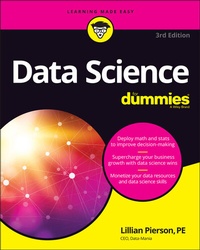
Data Science For Dummies
Description

What if there was one simple, clear process for ensuring that all your company's data science projects achieve a high a return on investment? What if you could validate your ideas for future data science projects, and select the one idea that's most prime for achieving profitability while also moving your company closer to its business vision? There is.
Industry-acclaimed data science consultant, Lillian Pierson, shares her proprietary STAR Framework - A simple, proven process for leading profit-forming data science projects.
Not sure what data science is yet? Don't worry! Parts 1 and 2 of Data Science For Dummies will get all the bases covered for you. And if you're already a data science expert? Then you really won't want to miss the data science strategy and data monetization gems that are shared in Part 3 onward throughout this book.
Data Science For Dummies demonstrates:
* The only process you'll ever need to lead profitable data science projects
* Secret, reverse-engineered data monetization tactics that no one's talking about
* The shocking truth about how simple natural language processing can be
* How to beat the crowd of data professionals by cultivating your own unique blend of data science expertise
Whether you're new to the data science field or already a decade in, you're sure to learn something new and incredibly valuable from Data Science For Dummies. Discover how to generate massive business wins from your company's data by picking up your copy today.
More details
Other editions
Additional editions
Person
Content
Part 1: Getting Started with Data Science 5
Chapter 1: Wrapping Your Head Around Data Science 7
Chapter 2: Tapping into Critical Aspects of Data Engineering 19
Part 2: Using Data Science to Extract Meaning from Your Data 37
Chapter 3: Machine Learning Means Using a Machine to Learn from Data 39
Chapter 4: Math, Probability, and Statistical Modeling 51
Chapter 5: Grouping Your Way into Accurate Predictions 77
Chapter 6: Coding Up Data Insights and Decision Engines 103
Chapter 7: Generating Insights with Software Applications 137
Chapter 8: Telling Powerful Stories with Data 161
Part 3: Taking Stock of Your Data Science Capabilities 187
Chapter 9: Developing Your Business Acumen 189
Chapter 10: Improving Operations 205
Chapter 11: Making Marketing Improvements 229
Chapter 12: Enabling Improved Decision-Making 245
Chapter 13: Decreasing Lending Risk and Fighting Financial Crimes 265
Chapter 14: Monetizing Data and Data Science Expertise 275
Part 4: Assessing Your Data Science Options 289
Chapter 15: Gathering Important Information about Your Company 291
Chapter 16: Narrowing In on the Optimal Data Science Use Case 311
Chapter 17: Planning for Future Data Science Project Success 327
Chapter 18: Blazing a Path to Data Science Career Success 341
Part 5: The Part of Tens 367
Chapter 19: Ten Phenomenal Resources for Open Data 369
Chapter 20: Ten Free or Low-Cost Data Science Tools and Applications 381
Index 397
Introduction
This book was written as much for expert data scientists as it was for aspiring ones. Its content represents a new approach to doing data science - one that puts business vision and profitably at the heart of our work as data scientists.
Data science and artificial intelligence (AI, for short) have disrupted the business world so radically that it's nearly unrecognizable compared to what things were like just 10 or 15 years ago. The good news is that most of these changes have made everyone's lives and businesses more efficient, more fun, and dramatically more interesting. The bad news is that if you don't yet have at least a modicum of data science competence, your business and employment prospects are growing dimmer by the moment.
Since 2014, when this book was first written (throughout the first two editions), I have harped on this same point. Lots of people listened! So much has changed about data science over the years, however, that this book has needed two full rewrites since it was originally published. What changed? Well, to be honest, the math and scientific approach that underlie data science haven't changed one bit. But over the years, with all the expansion of AI adoption across business and with the remarkable increase in the supply of data science workers, the data science landscape has seen a hundredfold increase in diversity with respect to what people and businesses are using data science to achieve.
The original idea behind this book when it was first published was to provide "a reference manual to guide you through the vast and expansive areas encompassed by data science." At the time, not too much information out there covered the breadth of data science in one resource. That has changed!
Data scientist as a title only really began to emerge in 2012. Most of us practitioners in the field back then were all new and still finding our way. In 2014, I didn't have the perspective or confidence I needed to write a book like the one you're holding. Thank you so much to all the readers who have read this book previously, shared positive feedback, and applied what they learned to create better lives for themselves and better outcomes for their companies. The positive transformation of my readers is a big part of what keeps me digging deep to produce the very best version of this book that I possibly can.
The Internet is full of information for the sake of information - information that lacks the depth, context, and relevance that's needed to transform that information to true meaning in the lives of its consumers. Publishing more of this type of content doesn't help people - it confuses them, overwhelms them, and wastes their precious time! When writing this book for a third time, I took a radical stance against "information for the sake of information."
I also want to make three further promises about the content in this book: It is meaningful, it is actionable, and it is relevant. If it isn't one of these three adjectives, I've made sure it hasn't made its way into this book.
Because this book is about data science, I spend the entirety of Parts 1 and 2 detailing what data science actually is and what its theoretical underpinnings are. Part 3 demonstrates the ways you can apply data science to support vital business functions, from finance to marketing, from decision support to operations. I've even written a chapter on how to use data science to create what may be a whole new function within your company: data monetization. (To ensure that the book's content is relevant to readers from all business functions and industries, I've included use cases and case studies from businesses a wide variety of industries and sectors.)
To enhance the relevance of this book's content, at the beginning of the book I guide readers in a self-assessment designed to help them identify which type of data science work is most appropriate for their personality - whether it's implementing data science, working in a management and leadership capacity, or even starting your own data science business.
Part 4 is the actionable part of this book - the part that shows you how to take what you've learned about data science and apply it to start getting results right away. The action you learn to take in this book involves using what you learn about data science in Parts 1 through 3 to build an implementation plan for a profit-forming data science project.
Throughout this book, you'll find references to ancillary materials that directly support what you're learning within these pages. All of these support materials are hosted on the website that companions this book, http://businessgrowth.ai/. I highly recommend you take advantage of those assets, as I have donated many of them from an archived, limited-edition, paid product that was only available in 2020.
Note: I have removed all coding examples from this book because I don't have adequate space here to do anything meaningful with coding demos. If you want me to show you how to implement the data science that's discussed in Part 2, I have two Python for Data Science Essential Training courses on LinkedIn Learning. You're most welcome to follow up by taking those courses. You access them both directly through my course author page on LinkedIn Learning here: www.linkedin.com/learning/instructors/lillian-pierson-p-e
This book is unlike any other data science book or course on the market. How do I know? Because I created it from scratch based on my own unique experience and perspective. That perspective is based on almost 15 years of technical consulting experience, almost 10 of which have been spent working as a consultant, entrepreneur, and mentor in the data science space. This book is not a remake of what some other expert wrote in their book - it's an original work of art and a labor of love for me. If you enjoy the contents of this book, please reach out to me at lillian@data-mania.com and let me know. Also, for free weekly video training on data science, data leadership, and data business-building, be sure to visit and subscribe to my YouTube channel: https://www.youtube.com/c/LillianPierson_Data_Business
Helping readers like you is my mission in life!
About This Book
In keeping with the For Dummies brand, this book is organized in a modular, easy-to-access format that allows you to use the book as an owner's manual. The book's chapters are structured to walk you through a clear process, so it's best to read them in order. You don't absolutely have to read the book through, from cover to cover, however. You can glean a great deal from jumping around, although now and then you might miss some important context by doing so. If you're already working in the data science space, you can skip the basic-level details about what data science is within Part 2 - but do read the rest of the book, because it's designed to present new and immensely valuable knowledge for data science practitioners of all skill levels (including experts).
Web addresses appear in monofont. If you're reading a digital version of this book on a device connected to the Internet, you can click a web address to visit that website, like this: www.dummies.com.
Foolish Assumptions
In writing this book, I've assumed that readers are comfortable with advanced tasks in Microsoft Excel - pivot tables, grouping, sorting, plotting, and the like. Having strong skills in algebra, basic statistics, or even business calculus helps as well. Foolish or not, it's my high hope that all readers have subject matter expertise to which they can apply the skills presented in this book. Because data scientists need to know the implications and applications of the data insights they derive, subject matter expertise is a major requirement for data science.
Icons Used in This Book
As you make your way through this book, you see the following icons in the margins:
The Tip icon marks tips (duh!) and shortcuts you can use to make subject mastery easier.
Remember icons mark information that's especially important to know. To siphon off the most important information in each chapter, just skim the material represented by these icons.
The Technical Stuff icon marks information of a highly technical nature that you can normally skip.
The Warning icon tells you to watch out! It marks important information that may save you headaches.
Beyond the Book
Data Science For Dummies, 3rd Edition, comes with a handy Cheat Sheet that lists helpful shortcuts as well as abbreviated definitions for essential processes and concepts described in the book. You can use this feature as a quick-and-easy reference when doing data science. To download the Cheat Sheet, simply go to www.dummies.com and search for data science for dummies cheat sheet in the Search box.
Where to Go from Here
If you're new to data science, you're best off starting from Chapter 1 and reading the book from beginning to end. If you already know the data science basics, I suggest that you read the last part of Chapter...
