

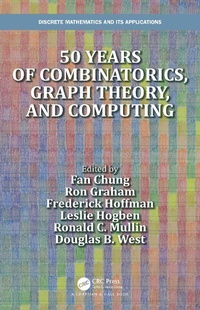
50 years of Combinatorics, Graph Theory, and Computing
1st Edition
Published on 15. November 2019
442 pages
978-1-000-75183-3 (ISBN)
Description

50 Years of Combinatorics, Graph Theory, and Computing advances research in discrete mathematics by providing current research surveys, each written by experts in their subjects.
The book also celebrates outstanding mathematics from 50 years at the Southeastern International Conference on Combinatorics, Graph Theory & Computing (SEICCGTC). The conference is noted for the dissemination and stimulation of research, while fostering collaborations among mathematical scientists at all stages of their careers.
The authors of the chapters highlight open questions. The sections of the book include: Combinatorics; Graph Theory; Combinatorial Matrix Theory; Designs, Geometry, Packing and Covering. Readers will discover the breadth and depth of the presentations at the SEICCGTC, as well as current research in combinatorics, graph theory and computer science.
Features:
Commemorates 50 years of the Southeastern International Conference on Combinatorics, Graph Theory & Computing with research surveys
Surveys highlight open questions to inspire further research
Chapters are written by experts in their fields
Extensive bibliographies are provided at the end of each chapter
The book also celebrates outstanding mathematics from 50 years at the Southeastern International Conference on Combinatorics, Graph Theory & Computing (SEICCGTC). The conference is noted for the dissemination and stimulation of research, while fostering collaborations among mathematical scientists at all stages of their careers.
The authors of the chapters highlight open questions. The sections of the book include: Combinatorics; Graph Theory; Combinatorial Matrix Theory; Designs, Geometry, Packing and Covering. Readers will discover the breadth and depth of the presentations at the SEICCGTC, as well as current research in combinatorics, graph theory and computer science.
Features:
Commemorates 50 years of the Southeastern International Conference on Combinatorics, Graph Theory & Computing with research surveys
Surveys highlight open questions to inspire further research
Chapters are written by experts in their fields
Extensive bibliographies are provided at the end of each chapter
More details
Series
Edition
1. Auflage
Language
English
Place of publication
London
United Kingdom
Publishing group
Taylor & Francis Ltd
Target group
College/higher education
Professional and scholarly
Illustrations
39 Tables, black and white; 40 Illustrations, black and white
ISBN-13
978-1-000-75183-3 (9781000751833)
Copyright in bibliographic data and cover images is held by Nielsen Book Services Limited or by the publishers or by their respective licensors: all rights reserved.
Schweitzer Classification
Other editions
Additional editions
Fan Chung | Ron Graham | Frederick Hoffman
50 years of Combinatorics, Graph Theory, and Computing
Book
10/2024
1st Edition
Chapman & Hall/CRC
€78.50
Shipment within 10-20 days
Book
11/2019
1st Edition
Chapman & Hall/CRC
€198.08
Shipment within 15-20 days
Persons
Fan Chung received her PhD from University of Pennsylvania in 1974. She is a Distinguished Professor of Mathematics, Professor of Computer Science and Engineering, and the Paul Erdos Professor in Combinatorics at the University of California, San Diego. She has written three books, Spectral Graph Theory, Complex Graphs and Networks (with Lincoln Lu), and Erdos on Graphs (with Ron Graham) and almost 300 papers. She is a member of the American Academy of Arts and Sciences, is an academician of Academic Sinica, and is a fellow of the American Mathematical Society and the Society for Industrial and Applied Mathematics. Her website is http://math.ucsd.edu/~fan/.
Ron Graham received his Ph. D. from the University of California at Berkeley in
1962. He holds the Irvin and Joan Jacobs Endowed Chair Professorship in the Computer Science and Engineering department of University of California at San Diego and was formerly at AT&T Bell Laboratories and Rutgers University. He has more than 350 publications. He is a member of the National Academy of Sciences and is a Fellow of the Association of Computing Machinery and the American Mathematical Society. He was the president of the American Mathematical Society from 1993 to 1995 and the president of the Mathematical Association of America from 2003 to 2005. His website is https://cseweb.ucsd.edu/~rgraham/.
Frederick Hoffman received his PhD from University of Virginia in 1964. He was a Founding Fellow of The Institute of Combinatorics and its Applications and serves on its Council. He has directed thirty-nine of the Southeastern International Conferences on Combinatorics, Graph Theory and Computing. He served as President and Governor of the Florida Section of the Mathematical Association of America and chaired the national MAA committee on mini-courses. He has published more than 20 papers. His website is http://www.math.fau.edu/people/faculty/
hoffman.php.
Leslie Hogben received her PhD from Yale in 1978. She is the Dio Lewis Holl Chair in Applied Mathematics, a Professor of Mathematics, and an Associate Dean of the College of Liberal Arts and Sciences at Iowa State University, and the Associate Director for Diversity of the American Institute of Mathematics. She is the author of more than 100 papers and is the editor of the books Handbook of Linear Algebra and Recent Trends in Combinatorics (with Andrew Beveridge, Jerrold R. Griggs, Gregg Musiker, Presad Tetali). She serves on the Scientific Review Panel of the Atlantic Association for Mathematical Research (Canada) and the editorial boards of several journals. Her webpage is https://orion.math.iastate.edu/lhogben/
homepage.html.
Ronald C. Mullin received his PhD from the University of Waterloo in 1964.
He is a Distinguished Professor of Combinatorics and Optimization (Emeritus)
at University of Waterloo and Professor of Mathematics Emeritus at Florida Atlantic University. He is the author of more than 180 papers. He is the first recipient of the Stanton Medal, which is awarded by the Institute for Combinatorics and its Applications (ICA). His website is https://uwaterloo.ca/
combinatorics-and-optimization/about/people/rcmullin.
Douglas B. West received his PhD from MIT in 1978. After retiring from the faculty at the University of Illinois, in 2012 he moved to Zhejiang Normal University under the 1000 Talents Plan. He has written about 250 papers and the books Introduction to Graph Theory and Combinatorial Mathematics. He is the Editor-in-Chief of the journal Discrete Mathematics and an Associate Editor of Order and the American Mathematical Monthly. His website is https://faculty.math.illinois.edu/
~west/.
Ron Graham received his Ph. D. from the University of California at Berkeley in
1962. He holds the Irvin and Joan Jacobs Endowed Chair Professorship in the Computer Science and Engineering department of University of California at San Diego and was formerly at AT&T Bell Laboratories and Rutgers University. He has more than 350 publications. He is a member of the National Academy of Sciences and is a Fellow of the Association of Computing Machinery and the American Mathematical Society. He was the president of the American Mathematical Society from 1993 to 1995 and the president of the Mathematical Association of America from 2003 to 2005. His website is https://cseweb.ucsd.edu/~rgraham/.
Frederick Hoffman received his PhD from University of Virginia in 1964. He was a Founding Fellow of The Institute of Combinatorics and its Applications and serves on its Council. He has directed thirty-nine of the Southeastern International Conferences on Combinatorics, Graph Theory and Computing. He served as President and Governor of the Florida Section of the Mathematical Association of America and chaired the national MAA committee on mini-courses. He has published more than 20 papers. His website is http://www.math.fau.edu/people/faculty/
hoffman.php.
Leslie Hogben received her PhD from Yale in 1978. She is the Dio Lewis Holl Chair in Applied Mathematics, a Professor of Mathematics, and an Associate Dean of the College of Liberal Arts and Sciences at Iowa State University, and the Associate Director for Diversity of the American Institute of Mathematics. She is the author of more than 100 papers and is the editor of the books Handbook of Linear Algebra and Recent Trends in Combinatorics (with Andrew Beveridge, Jerrold R. Griggs, Gregg Musiker, Presad Tetali). She serves on the Scientific Review Panel of the Atlantic Association for Mathematical Research (Canada) and the editorial boards of several journals. Her webpage is https://orion.math.iastate.edu/lhogben/
homepage.html.
Ronald C. Mullin received his PhD from the University of Waterloo in 1964.
He is a Distinguished Professor of Combinatorics and Optimization (Emeritus)
at University of Waterloo and Professor of Mathematics Emeritus at Florida Atlantic University. He is the author of more than 180 papers. He is the first recipient of the Stanton Medal, which is awarded by the Institute for Combinatorics and its Applications (ICA). His website is https://uwaterloo.ca/
combinatorics-and-optimization/about/people/rcmullin.
Douglas B. West received his PhD from MIT in 1978. After retiring from the faculty at the University of Illinois, in 2012 he moved to Zhejiang Normal University under the 1000 Talents Plan. He has written about 250 papers and the books Introduction to Graph Theory and Combinatorial Mathematics. He is the Editor-in-Chief of the journal Discrete Mathematics and an Associate Editor of Order and the American Mathematical Monthly. His website is https://faculty.math.illinois.edu/
~west/.
Content
Personal Reflections of the SEICCGTC: Origins and Beyond
I: Combinatorics
Some of My Favorite Problems
Variations on the Sequenceable Theme
Survey of Stack Sortable Permutations
Dimensions for Posets and Chromatic Number for Graphs
Edros Magic
II: Graph Theory
Developments on Saturated Graphs
Magic Labeling Basics
Block Colorings of Graph Decompositions
Reconfiguration of Colourings and Dominating Sets in Graphs
Edge Intersection Graphs of Paths on a Grid
III: Combinatorial Matrix Theory
A Jaunt in Spectral Graph Theory
Inverse Eigenvalue Problem of a Graph
Rank Functions
Permutation Matrices and Beyond: An Essay
IV: Designs, Geometry, Packing and Covering
Some New Families of 2-Resolutions
Graphical Designs
There Must be Fifty Ways to Miss a Cover
Combinatorial Designs and Cryptography, Revisited
A Survey of Scalar Multiplication Algorithms
Arcs, Caps, Generalisations: Results and Problems
I: Combinatorics
Some of My Favorite Problems
Variations on the Sequenceable Theme
Survey of Stack Sortable Permutations
Dimensions for Posets and Chromatic Number for Graphs
Edros Magic
II: Graph Theory
Developments on Saturated Graphs
Magic Labeling Basics
Block Colorings of Graph Decompositions
Reconfiguration of Colourings and Dominating Sets in Graphs
Edge Intersection Graphs of Paths on a Grid
III: Combinatorial Matrix Theory
A Jaunt in Spectral Graph Theory
Inverse Eigenvalue Problem of a Graph
Rank Functions
Permutation Matrices and Beyond: An Essay
IV: Designs, Geometry, Packing and Covering
Some New Families of 2-Resolutions
Graphical Designs
There Must be Fifty Ways to Miss a Cover
Combinatorial Designs and Cryptography, Revisited
A Survey of Scalar Multiplication Algorithms
Arcs, Caps, Generalisations: Results and Problems
