

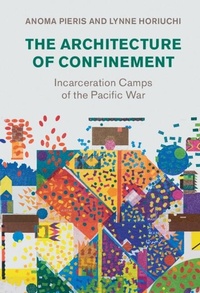
The Architecture of Confinement
Incarceration Camps of the Pacific War
Published on 9. February 2022
398 pages
978-1-009-02052-7 (ISBN)
Description

In this global and comparative study of Pacific War incarceration environments we explore the arc of the Pacific Basin as an archipelagic network of militarized penal sites. Grounded in spatial, physical and material analyses focused on experiences of civilian internees, minority citizens, and enemy prisoners of war, the book offers an architectural and urban understanding of the unfolding history and aftermath of World War II in the Pacific. Examples are drawn from Australia, New Zealand, Singapore, Japan, and North America. The Architecture of Confinement highlights the contrasting physical facilities, urban formations and material character of various camps and the ways in which these uncover different interpretations of wartime sovereignty. The exclusion and material deprivation of selective populations within these camp environments extends the practices by which land, labor and capital are expropriated in settler-colonial societies; practices critical to identity formation and endemic to their legacies of liberal democracy.
Reviews / Votes
'This is a pathbreaking transnational history of the architecture of internment of the Pacific War. In this theoretically informed and richly empirical study, Anoma Pieris and Lynne Horiuchi open up new interdisciplinary perspectives for us to think about how architecture mediates complex, intersectional expressions of sovereignty.' Jiat-Hwee Chang, National University of Singapore 'The Architecture of Confinement is a ground-breaking study of war-time built environments. It examines with erudition and complexity the legacy of rural concentration camps of the Pacific War. A pioneering work, it illuminates how a comparative and temporal approach can transform understandings of race, colonialism and imperial politics in war and beyond.' Joy Damousi, Australian Catholic University 'This is an ambitious transnational study of the built environments of mass confinement in World War II that bring together studies of confinement sites in the United States, Canada, Australia, and Singapore. It is magnificently eye-opening and informative.' Greg Robinson, Universite du Quebec a Montreal 'This is a pathbreaking transnational history of the architecture of internment of the Pacific War. In this theoretically informed and richly empirical study, Anoma Pieris and Lynne Horiuchi open up new interdisciplinary perspectives for us to think about how architecture mediates complex, intersectional expressions of sovereignty.' Jiat-Hwee Chang, National University of Singapore 'The Architecture of Confinement is a ground-breaking study of war-time built environments. It examines with erudition and complexity the legacy of rural concentration camps of the Pacific War. A pioneering work, it illuminates how a comparative and temporal approach can transform understandings of race, colonialism and imperial politics in war and beyond.' Joy Damousi, Australian Catholic University 'This is an ambitious transnational study of the built environments of mass confinement in World War II that bring together studies of confinement sites in the United States, Canada, Australia, and Singapore. It is magnificently eye-opening and informative.' Greg Robinson, Universite du Quebec a MontrealMore details
Series
Language
English
Place of publication
Cambridge
United Kingdom
Illustrations
Worked examples or Exercises; 40 Halftones, black and white; 34 Line drawings, black and white
File size
22,22 MB
ISBN-13
978-1-009-02052-7 (9781009020527)
Copyright in bibliographic data and cover images is held by Nielsen Book Services Limited or by the publishers or by their respective licensors: all rights reserved.
Schweitzer Classification
Other editions
Additional editions
Book
09/2024
Cambridge University Press
€42.90
Shipment within 15-20 days
Book
02/2022
Cambridge University Press
€130.00
Shipment within 15-20 days
Persons
Content
Introduction; 1. Carceral Archipelago; 2. A Network of Internment Camps; 3. Prisoner-of-War Resistance; 4. Land and Labor; 5. A Military Geography; 6. The Colonial Prison; 7. Empire of Camps; 8. Prison City; 9. Recovery, Redress, and Commemoration; 10. Intersectional Sovereignty; 11. Border Politics; Bibliography; Index.
