

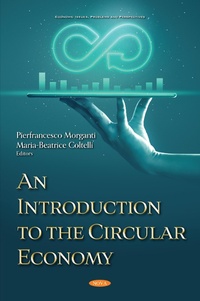
Introduction to the Circular Economy
Published on 7. May 2021
463 pages
978-1-5361-9661-0 (ISBN)
Description

This book tries to debate on the significance of circular economy, underlying the necessity to change our way of producing, consuming, and traveling on a daily basis. The passage from a linear economy to a circular economy will help us to reduce the degradation of the environment for avoiding future disastrous consequences, such as depletion of biodiversity, scarcity of raw materials and drinking water, rising waters, etc. The circular economy, therefore, involves designing a product so that it can be recycled or its components reused. Reuse consists of introducing the product back into the economic circuit in its original condition; repair makes it possible to fix a broken good; and recovery consists of reusing its components. This is the significance of the so-called 3R strategy, illustrated in this book.
More details
Other editions
Additional editions
Pierfrancesco Morganti
An Introduction to the Circular Economy
Book
05/2021
Nova Science Publishers Inc
€355.04
Shipment within 15-20 days
Content
- Intro
- Contents
- Foreword
- Preface
- Part I. Introduction
- Chapter 1
- Life Expectancy in the World and Relative Variables
- Abstract
- Introduction
- List of the Countries
- The Variables
- Results
- Discussion
- Conclusion
- Acknowledgments
- References
- Chapter 2
- Circular and Green Economy: Which Is the Difference?
- Abstract
- Introduction
- Linear and Circular Economy
- Food and Plastic Waste
- Circular and Green Economy
- Pollution and GHG Emissions
- Circular Economy and Innovation
- Waste Recycling and Research
- Conclusion
- References
- Part II. Building Blocks of Circular Economy
- Chapter 3
- Past, Present and Future of Industrial Symbiosis
- Abstract
- Introduction
- Past of Industrial Symbiosis
- Principle of Industrial Symbiosis
- Kalundborg's Case
- Eco-Industrial Parks and the Role of IS
- Main Challenges with IS
- Present of Industrial Symbiosis
- Projects and Implementations of IS and EIPs in the World
- Improvement Strategies for IS
- Future of Industrial Symbiosis
- Potentials of IS
- New Developments
- Conclusions
- References
- Chapter 4
- Development of Indicators of Circular Economy and Their Application in Water Management
- Abstract
- Introduction to Circular Economy
- The Need for Water Management within the Circular Economy Paradigm
- State of the Art About Indicators of Circular Economy Regarding Water Management
- Evolution of Scientific Production
- Distribution of Publications per Subject Category
- Evolution of Indicators of Circular Economy
- Methodology
- Results and Discussion
- Author's Productivity, Collaborations and Countries
- Keyword Analysis
- Proposal for Indicators of Circular Economy in Wastewater Treatment
- Introduction
- Indicators of Circular Economy for the Liquid Phase
- Indicators of Circular Economy for the Solid Phase
- Indicators of Circular Economy for the Gas Phase
- Application in Paper and Pig Industries
- References
- Reference List for the Tables
- Chapter 5
- The Present Contribution of Circular Economy to Stimulate Economic Growth in the World
- Abstract
- Introduction
- The Possible Basis for the Circular Economy
- Present Situation
- Conclusion
- References
- Chapter 6
- Circular Economy for a Healthy Living Environment
- Abstract
- Introduction
- Polysaccharides
- Chitin, Chitosan and Chitin Nanofibrils
- Skin Structure and Skin Scaffold
- Food Waste and Packaging
- Conclusion
- References
- Chapter 7
- Circular Economy in China
- Abstract
- Introduction
- The Status Quo of Circular Economy in China
- Air Pollution in China
- Plastics Waste and COVID-19 Pandemic
- Prospect of Circular Economy in China
- Evolution of Scientific Production
- Acknowledgments
- References
- Part III. Waste in Circular Economy
- Chapter 8
- Circular Economy in the European Union as an Example of Wasteless Processing of Crustacean's Waste
- Abstract
- Introduction
- Chitosan and Chitin Nanofibrils in Food Packaging
- Disposable Packaging Films from Chitosan and Chitin Nanofibrils
- Chitosan in Wound Dressing
- Conclusion
- Acknowledgments
- References
- Chapter 9
- Circular Economy: Valorization of Waste Plant Biomass to Produce Active Ingredients with Antimicrobial Activity against Human and Plant Pathogens
- Abstract
- Introduction
- Plant Biomass from Agro-Industrial Waste: Byproducts of Vine-Wine Production Chain
- Plant Biomass from Pomace
- Plant Biomass from Grape Seeds
- Plant Biomass from Unripe Grapes
- Plant Biomass from Agro-Industrial Waste: Byproducts of the Olive-Oil Extraction Industry
- Antimicrobial Activity against Human Pathogens
- Antimicrobial Activity against Plant Pathogens
- Valorization of Fruit By-Products as a Source of Bioactive Compounds with Antimicrobial Activity
- Wastes from Apple Processing
- Red Beet By-Products
- By-Products of the Pomegrate Processing Industry
- Citrus By-Products
- References
- Chapter 10
- The Circular Economy and Built Environment. Maintenance, Rehabilitation and Adaptive Reuse: Challenging Strategies for Closing Loops
- Abstract
- Introduction
- Building Renovation as a Driving Force in the Construction Market
- The Conceptual Framework: The Circular Economy and the Built Environment, a Commitment to Save the Planet
- Maintenance, Rehabilitation and Adaptive Reuse: Design Actions Aimed at Supporting the Transition towards a Circular Economy
- Best Practices Screening: Towards Circular Transitions for Built Environments
- Textiles Pigüé Cooperative
- Rimaflow
- OfficineZero
- Bonotto Fabbrica Lenta
- Borgo Solomeo
- COM.I.STRA
- Sugarhouse Studios
- Milan for Social
- Folly for a Flyover
- Conclusion
- References
- Chapter 11
- Waste Valuation for Environmental and Health Improvement on Circular Economy View
- Abstract
- Introduction
- Water Reuse, Eco-Building, and Responsible Consumption and Production
- Alternative Energy Generation (Biofuels) and Enzyme Production
- Enzymatic Technology
- Sanitation and Security Aspects
- Conclusion
- References
- Chapter 12
- Waste Recycling from Construction Sector within the Circular Economy Paradigm
- Abstract
- Introduction
- End of Linear Economy
- Origin of Circular Economy
- The Revolution of Circular Economy
- Background
- Definition
- A Shift to a New Business Model
- Circular Economy Principles
- Design out Waste
- Building Resilience through Diversity
- A Shift to Renewable Energy Resources
- Think in Systems
- Waste is Food
- Loops in the Economy
- Circular Economy and Construction Sector
- Introduction
- European Union Plays a Key Role
- The Paradigm of Circular Economy Related to Construction
- Application of Circular Economy in the Construction Sector
- Sewage Sludge
- Deconstruction
- Materials Passports
- 3D Printing
- BIM-Building Information Modeling
- Case Study: Clay Bricks Production
- Explanation of the Clay Brick Production Process
- Strip Mining
- Storage
- Preparation of Clay
- Grinding of Clay
- Sieving
- Mixture and Moisture
- Extrusion
- Drying
- Firing
- Problem Analysis and Potential Solutions
- CO2 Emission
- Use of Coal
- Waste Generated by Coal Mining
- Renewable Energies
- Conclusion
- Conclusion
- Acknowledgment
- References
- Chapter 13
- Circular Economy of Wastewater Streams by Means of Membrane Technologies
- Abstract
- Introduction
- Circular Economy by Valorization of Streams
- Circular Economy by Reuse of After-Life Membrane Modules
- Circular Economy by Membrane Engineering
- Conclusions
- References
- Part IV. Reuse, Reduce, Recycle in Circular Economy
- Chapter 14
- Sustainable Food Production: The Transition towards a Circular Economy of Plastic Food Packaging
- Abstract
- Introduction
- State of the Question of Plastic Food Packaging
- Disposable and Recyclable Plastic Containers
- Primary Recycling of Plastic Food Containers
- The Process of Mechanical and Chemical Recycling of Plastic Food Containers
- Circular Economy and Plastic Food Packaging
- Stakeholders and Transition to the Circular Economy
- Producers of Plastic Packaging
- Plastic Producers
- Food Producers
- Retailers
- Consumers
- Waste Managers
- Drivers to a CE and Sociological Institutional Theory
- Barriers to a CE
- Measurement of the Transition to the Circular Economy: Frameworks and Indicators
- Cradle-to-Cradle Design Frame
- Life Cycle Assessment Framework
- Material Circularity Indicator Framework
- Quantitative Indicators
- Qualitative Indicators
- Conclusions
- References
- Chapter 15
- Bioconverter Insects: A Good Example of Circular Economy, the Study Case of Hermetia illucens
- Abstract
- 1. Introduction
- 2. From Agrifood by-Products to Novel Feed and Food: A Process Mediated by Bioconverter Insects
- 2.1. Bioconverter Insects
- 2.2. Regulations
- 3. The Dipteran Hermetia Illucens Embraces the Concept of Circular Economy
- 3.1. Hermetia Illucens' Etology
- 3.2. Bioconversion Mediated by Hermetia Illucens
- 3.3. Hermetia Illucens, a Sustainable Source of Molecules of High Economic and Biological Value: Proteins, Lipids and Chitin
- 3.3.1. Why Insect Proteins? Hermetia Illucens, One of the Most Source
- 3.3.2. Characterization and Applications of Insect Lipids: Hermetia Illucens as an Interesting Source
- 3.3.3. Insects, an Innovative Source of Chitin, and Hermetia Illucens as One of the Most Promising Sources
- Conclusion
- Conflict of Interest
- Acknowledgment
- References
- Chapter 16
- Chitin and Lignin Waste in the Circular Economy
- Abstract
- Introduction
- Chitin Nanofibrils (CN)
- Lignin
- Circular Economy and Food Waste
- Conclusion
- References
- Chapter 17
- The Use of Coffee Waste to Produce Goods and Energy
- Abstract
- Introduction
- Coffee Ingredients and Waste
- Coffee in Italy
- The Coffee Waste Problem in Italy
- Company Program
- Conclusion
- References
- Chapter 18
- Natural Metabolites as Functional Additive of Biopolymers: Experimental Evidence and Industrial Constraint
- Abstract
- Introduction
- Synthetic Polymers
- Biopolymers
- Additive and Biopolymers in Food Packaging
- Poly (Lactic Acid) (PLA)
- Poly Butylene Succinate (PBS)
- Chitosan
- Mater-Bi
- Bioactive Natural Metabolites in Biopolymers as Bakery Bioactive Food Packaging Materials
- Ungeremine
- Cavoxin
- a-Costic Acid
- Industrial Constraint
- Conclusion
- Acknowledgments
- References
- Chapter 19
- Regenerated Cellulose Sheet as Natural Tissue to Make Biodegradable Baby Diapers
- Abstract
- Introduction
- Biodegradable Baby Diapers
- Regenerated Cellulose Fibers
- End of Life of Used Baby Diapers
- Conclusion
- Conflicts of Interest
- References
- Chapter 20
- Waste Recycling for Wound Care and Cosmetic Smart Economics: Chitin and Lignin
- Abstract
- Introduction
- Waste Problem and Recycling
- Natural Products, Bio Carriers and Consumer Requests
- Scaffold Activity and Functions in Regenerative Medicine
- Polysaccharide Nanocomposites
- Skin Barrier and Aging
- Conclusion
- References
- Chapter 21
- Biobased and Biodegradable Rigid and Flexible Polymeric Packaging
- Abstract
- Introduction
- Materials Correlation with the Environment: Definitions
- Biopolymers and Bioplastics
- Bioplastic Blends
- Biocomposites
- Innovation in Biobased Materials for Flexible and Rigid Packaging
- Conclusion
- References
- Chapter 22
- Reuse and Recycling of Post-Consumer Textile Waste in Smart Green Cities
- Abstract
- Introduction
- About Our Research
- The Post-Consumer Textile Waste Recycling in Green City
- Classification of Post-Consumer Textile Waste
- Prospects of Post-Consumer Textile Waste Recycling
- The Post-Consumer Textile Recycling Projects in Smart Green Cities
- Post-Consumer Textile Recycling in Fashion
- Marketing in Post-Consumer Textile Recycling
- Conclusion
- References
- Chapter 23
- Circular Economy in the Fashion Sector and Textile Goods
- Abstract
- Why Circular Economy For Fashion
- Go to a Circular Textile System
- Textile Fibers and Circular Economy
- Polyester
- Cotton
- Polyamide
- Wool
- Other Fibers
- Other Initiatives
- Circular Economy and Fashion Actions
- Risks for the Consumer
- What We Need to Do
- Production Monitoring
- Conclusion
- References
- Chapter 24
- Circular Economy in the Built Environment: A Strategy for Flexible Housing through Flexzhouse
- Abstract
- Introduction
- The Flexzhouse Business Model Components
- Value Propositions
- Target Customer
- Customer Relationship
- Revenue Streams
- Key Resources
- Cost Structure
- Partnership
- Channels
- Key Activities
- The Conceptual Model of Flexzhouse
- A Way Forward
- Conclusion
- References
- About the Editors
- List of Contributors
- Index
- Blank Page
