

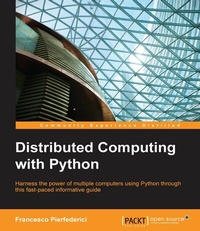
Distributed Computing with Python
Harness the power of multiple computers using Python through this fast-paced informative guide
Published on 13. January 2025
170 pages
978-1-78588-704-8 (ISBN)
Description

Harness the power of multiple computers using Python through this fast-paced informative guide
Key Features
[*] You'll learn to write data processing programs in Python that are highly available, reliable, and fault tolerant
[*] Make use of Amazon Web Services along with Python to establish a powerful remote computation system
[*] Train Python to handle data-intensive and resource hungry applications
Book DescriptionCPU-intensive data processing tasks have become crucial considering the complexity of the various big data applications that are used today. Reducing the CPU utilization per process is very important to improve the overall speed of applications. This book will teach you how to perform parallel execution of computations by distributing them across multiple processors in a single machine, thus improving the overall performance of a big data processing task. We will cover synchronous and asynchronous models, shared memory and file systems, communication between various processes, synchronization, and more. What you will learn
[*] Get an introduction to parallel and distributed computing
[*] See synchronous and asynchronous programming
[*] Explore parallelism in Python
[*] Distributed application with Celery
[*] Python in the Cloud
[*] Python on an HPC cluster
[*] Test and debug distributed applications
Who this book is forThis book is for Python developers who have developed Python programs for data processing and now want to learn how to write fast, efficient programs that perform CPU-intensive data processing tasks.
Key Features
[*] You'll learn to write data processing programs in Python that are highly available, reliable, and fault tolerant
[*] Make use of Amazon Web Services along with Python to establish a powerful remote computation system
[*] Train Python to handle data-intensive and resource hungry applications
Book DescriptionCPU-intensive data processing tasks have become crucial considering the complexity of the various big data applications that are used today. Reducing the CPU utilization per process is very important to improve the overall speed of applications. This book will teach you how to perform parallel execution of computations by distributing them across multiple processors in a single machine, thus improving the overall performance of a big data processing task. We will cover synchronous and asynchronous models, shared memory and file systems, communication between various processes, synchronization, and more. What you will learn
[*] Get an introduction to parallel and distributed computing
[*] See synchronous and asynchronous programming
[*] Explore parallelism in Python
[*] Distributed application with Celery
[*] Python in the Cloud
[*] Python on an HPC cluster
[*] Test and debug distributed applications
Who this book is forThis book is for Python developers who have developed Python programs for data processing and now want to learn how to write fast, efficient programs that perform CPU-intensive data processing tasks.
All prices
More details
Edition
Digital original
Language
English
Place of publication
Birmingham
United Kingdom
Target group
US School Grade: College Graduate Student
Edition type
Digital original
File size
6,38 MB
ISBN-13
978-1-78588-704-8 (9781785887048)
Copyright in bibliographic data and cover images is held by Nielsen Book Services Limited or by the publishers or by their respective licensors: all rights reserved.
Schweitzer Classification
Other editions
Additional editions
Francesco Pierfederici
Distributed Computing with Python
Book
04/2016
Packt Publishing
€38.50
No shipping information available
Person
Francesco Pierfederici is a software engineer who loves Python. He has been working in the fields of astronomy, biology, and numerical weather forecasting for the last 20 years. He has built large distributed systems that make use of tens of thousands of cores at a time and run on some of the fastest supercomputers in the world. He has also written a lot of applications of dubious usefulness but that are great fun. Mostly, he just likes to build things.
Content
Table of Contents
Introduction to Parallel and Distributed Computing
Synchronous and Asynchronous Programming
Parallelism in Python
Distributed Applications with Celery
Python in the Cloud
Python on a HPC Cluster
Testing and Debugging Distributed Applications
The Road ahead
Introduction to Parallel and Distributed Computing
Synchronous and Asynchronous Programming
Parallelism in Python
Distributed Applications with Celery
Python in the Cloud
Python on a HPC Cluster
Testing and Debugging Distributed Applications
The Road ahead

