
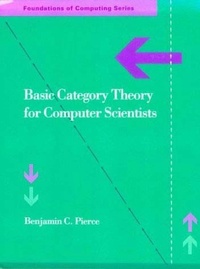
Basic Category Theory for Computer Scientists
Description
Alles über E-Books | Antworten auf Fragen rund um E-Books, Kopierschutz und Dateiformate finden Sie in unserem Info- & Hilfebereich.
Category theory is a branch of pure mathematics that is becoming an increasingly important tool in theoretical computer science, especially in programming language semantics, domain theory, and concurrency, where it is already a standard language of discourse. Assuming a minimum of mathematical preparation, Basic Category Theory for Computer Scientists provides a straightforward presentation of the basic constructions and terminology of category theory, including limits, functors, natural transformations, adjoints, and cartesian closed categories. Four case studies illustrate applications of category theory to programming language design, semantics, and the solution of recursive domain equations. A brief literature survey offers suggestions for further study in more advanced texts.
Contents Tutorial • Applications • Further Reading
More details
Other editions
Additional editions

Person
System requirements
File format: ePUB
Copy protection: Adobe-DRM (Digital Rights Management)
System requirements:
- Computer (Windows; MacOS X; Linux): Install the free reader Adobe Digital Editions prior to download (see eBook Help).
- Tablet/smartphone (Android; iOS): Install the free app Adobe Digital Editions or the app PocketBook before downloading (see eBook Help).
- E-reader: Bookeen, Kobo, Pocketbook, Sony, Tolino and many more (not Kindle).
The file format ePub works well for novels and non-fiction books – i.e., „flowing” text without complex layout. On an e-reader or smartphone, line and page breaks automatically adjust to fit the small displays.
This eBook uses Adobe-DRM, a „hard” copy protection. If the necessary requirements are not met, unfortunately you will not be able to open the eBook. You will therefore need to prepare your reading hardware before downloading.
Please note: We strongly recommend that you authorise using your personal Adobe ID after installation of any reading software.
For more information, see our ebook Help page.