

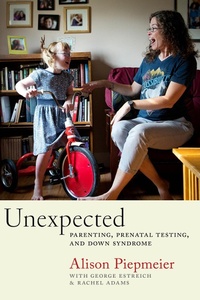
Unexpected
Parenting, Prenatal Testing, and Down Syndrome
1st Edition
Published on 23. February 2021
277 pages
978-1-4798-2718-3 (ISBN)
Description

What prenatal tests and down syndrome reveal about our reproductive choices
When Alison Piepmeier-scholar of feminism and disability studies, and mother of Maybelle, an eight-year-old girl with Down syndrome-died of cancer in August 2016, she left behind an important unfinished manuscript about motherhood, prenatal testing, and disability. In Unexpected, George Estreich and Rachel Adams pick up where she left off, honoring the important research of their friend and colleague, as well as adding new perspectives to her work.
Based on interviews with parents of children with Down syndrome, as well as women who terminated their pregnancies because their fetus was identified as having the condition, Unexpected paints an intimate, nuanced picture of reproductive choice in today's world. Piepmeier takes us inside her own daughter's life, showing how Down syndrome is misunderstood, stigmatized, and condemned, particularly in the context of prenatal testing.
At a time when medical technology is rapidly advancing, Unexpected provides a much-needed perspective on our complex, and frequently troubling, understanding of Down syndrome.
When Alison Piepmeier-scholar of feminism and disability studies, and mother of Maybelle, an eight-year-old girl with Down syndrome-died of cancer in August 2016, she left behind an important unfinished manuscript about motherhood, prenatal testing, and disability. In Unexpected, George Estreich and Rachel Adams pick up where she left off, honoring the important research of their friend and colleague, as well as adding new perspectives to her work.
Based on interviews with parents of children with Down syndrome, as well as women who terminated their pregnancies because their fetus was identified as having the condition, Unexpected paints an intimate, nuanced picture of reproductive choice in today's world. Piepmeier takes us inside her own daughter's life, showing how Down syndrome is misunderstood, stigmatized, and condemned, particularly in the context of prenatal testing.
At a time when medical technology is rapidly advancing, Unexpected provides a much-needed perspective on our complex, and frequently troubling, understanding of Down syndrome.
Reviews / Votes
"Asks questions such as, what is the line between illness and disability, and how can a parent deal with uncertainties? ... Shares rarely heard stories from parents and prospective parents who have confronted challenging decisions about a fetus with Down syndrome ... provides insight into a segment of the population rarely explored." (Library Journal) "A thought-provoking book at the value of all human life ... This book should reassure parents who choose to skip genetic testing or decide not to terminate pregnancies after learning their fetus may not be 'normal.' Like Piepmeier and her coauthors, they may well find unexpected joys in happy, loving kids." (Booklist) "Unexpected is a beautiful, thoughtful, and challenging co-authored and deeply reflexive book. It engages the porous lessons of disability, debility, death and an enduring love that is at once familial and friendship-centered. Collectively, Alison Piepmeier recruits George Estreich and Rachel Adams into a profound conversation that narrates their experiences of raising children with Down Syndrome as an optic on injustice, advocacy, and social transformation through this most intimate of parent-child relations." - Rayna Rapp, author of Testing Women, Testing the Fetus: The Social Impact of Amniocentesis in AmericaMore details
Language
English
Place of publication
New York
United States
Target group
Professional and scholarly
Illustrations
2 b/w illustrations
File size
2,37 MB
ISBN-13
978-1-4798-2718-3 (9781479827183)
Copyright in bibliographic data and cover images is held by Nielsen Book Services Limited or by the publishers or by their respective licensors: all rights reserved.
Schweitzer Classification
Other editions
Additional editions
Alison Piepmeier | George Estreich | Rachel Adams
Unexpected
Parenting, Prenatal Testing, and Down Syndrome
Book
02/2021
New York University Press
€107.90
Shipment within 10-20 days
Persons
Alison Piepmeier was Director and Professor of the Women's and Gender Studies Program at the College of Charleston in Charleston, South Carolina. She was the author of Girl Zines: Making Media, Doing Feminism, among other books.
Content
- Cover
- UNEXPECTED
- Title
- Copyright
- Dedication
- CONTENTS
- Preface
- 1. "I Wouldn't Change You If I Could": Disability as a Form of Human Diversity
- 2. The Inadequacy of "Choice": Disability, Feminism, and Reproduction
- 3. The Welcome Table
- 4. Saints, Sages, and Victims: Down Syndrome and Parental Narrative
- 5. Accessible Words: Alison Piepmeier and the Boundaries of Disability
- 6. Six Questions on the Special, the Inclusive, and the Universal
- Acknowledgments
- Notes
- Bibliography
- Index
- About Alison Piepmeier
- About George Estreich and Rachel Adams
