

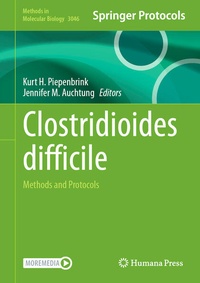
Clostridioides difficile
Description

This volume discusses the latest advancements on approaches used to characterize
C. difficile
physiology, including new methods for genetic modifications and novel models for studying host-pathogen interactions. The chapters in this book cover various topics such as FASTQ; CRISPR-AsCas12a and dAsCas 12a-mediated gene knockout and knockdown in
Clostridioides difficile;
preparation of spores with 70:30 method; measuring
C. difficile
adhesion to mucosal surfaces; and isolating
C. difficile
from animal samples. Written in the highly successful
Methods in Molecular Biology
series format, chapters include introductions to their respective topics, lists of the necessary materials and reagents, step-by-step, readily reproducible laboratory protocols, and tips on troubleshooting and avoiding known pitfalls.
Cutting-edge and practical,
Clostridioides difficile: Methods and Protocols
is a valuable resource for researchers interested in learning more about this field. Gaining a deeper understanding of
C. difficile
physiology is crucial for developing new therapies for treatment and predicting the future evolution of this important clinical pathogen.
More details
Other editions
Additional editions
Content
From FASTQ to Function to Phylogeny: In Silico Methods for Antimicrobial Resistance and Outbreak Investigation.- Generating Targeted Mutants Using a Riboswitch to Control Plasmid Behavior During Allelic Exchange Mutagenesis.- Use of the Golden Gate Cloning Technique for Plasmid Construction to Generate Conditional Lethal Mutants in C. difficile .- CRISPR-AsCas12a and dAsCas 12a-Mediated Gene Knockout and Knockdown in Clostridioides difficile.- Isolation and Characterization of Clostridioides difficile Bacteriophages.- Preparation of Spores with 70:30 Method.- An Integrated Workflow for the Purification and Fluorescence Imaging of Clostridioides difficile Spores Using Lanthanide Beta-Diketone Complexes.- Nanoluciferase-Based Reporters for Clostridioides difficile.- Working with C. difficile in a Hypoxia Chamber.- Dual Fluorescent Labeling for Bacterial Aggregation Assays.- In Vitro Measurement of Clostridioides difficile Biofilm Formation Induced by Gut and Microbiota-Derived Signals.- Measuring C. difficile Adhesion to Mucosal Surfaces.- An In Vitro Model for Studying Interactions between Gastrointestinal Microbes and Planktonic and Sessile Clostridioides difficile Populations.- Conventional, Gnotobiotic, and Humanized Microbiota Mouse Models of C. difficile Infection.- Visualizing C. difficile During Murine Infection.- Clostridioides difficile Infection in Animals.- Isolating C. difficile from Animal Samples.
