

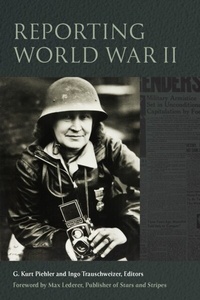
Reporting World War II
Published on 25. April 2023
304 pages
978-1-5315-0312-3 (ISBN)
Description

This set of essays offers new insights into the journalistic process and the pressures American front-line reporters experienced covering World War II. Transmitting stories through cable or couriers remained expensive and often required the cooperation of foreign governments and the American armed forces. Initially, reporters from a neutral America documented the early victories by Nazi Germany and the Soviet invasion of Finland. Not all journalists strove for objectivity. During her time reporting from Ireland, Helen Kirkpatrick remained a fierce critic of that country's neutrality. Once the United States joined the fight after the Japanese attack on Pearl Harbor, American journalists supported the struggle against the Axis powers, but this volume will show that reporters, even when members of the army sponsored newspaper, Stars and Stripes were not mere ciphers of the official line.
African American reporters Roi Ottley and Ollie Stewart worked to bolster the morale of Black GIs and undermined the institutional racism endemic to the American war effort. Women front-line reporters are given their due in this volume examining the struggles to overcome gender bias by describing triumphs of Therese Mabel Bonney, Iris Carpenter, Lee Carson, and Anne Stringer.
The line between public relations and journalism could be a fine one as reflected by the U.S. Marine Corps' creating its own network of Marine correspondents who reported on the Pacific island campaigns and had their work published by American media outlets. Despite the pressures of censorship, the best American reporters strove for accuracy in reporting the facts even when dependent on official communiques issued by the military. Many wartime reporters, even when covering major turning points, sought to embrace a reporting style that recorded the experiences of average soldiers. Often associated with Ernie Pyle and Bill Mauldin, the embrace of the human-interest story served as one of the enduring legacies of the conflict.
Despite the importance of American war reporting in shaping perceptions of the war on the home front as well as shaping the historical narrative of the conflict, this work underscores how there is more to learn. Readers will gain from this work a new appreciation of the contribution of American journalists in writing the first version of history of the global struggle against Nazi Germany, imperial Japan, and fascist Italy.
African American reporters Roi Ottley and Ollie Stewart worked to bolster the morale of Black GIs and undermined the institutional racism endemic to the American war effort. Women front-line reporters are given their due in this volume examining the struggles to overcome gender bias by describing triumphs of Therese Mabel Bonney, Iris Carpenter, Lee Carson, and Anne Stringer.
The line between public relations and journalism could be a fine one as reflected by the U.S. Marine Corps' creating its own network of Marine correspondents who reported on the Pacific island campaigns and had their work published by American media outlets. Despite the pressures of censorship, the best American reporters strove for accuracy in reporting the facts even when dependent on official communiques issued by the military. Many wartime reporters, even when covering major turning points, sought to embrace a reporting style that recorded the experiences of average soldiers. Often associated with Ernie Pyle and Bill Mauldin, the embrace of the human-interest story served as one of the enduring legacies of the conflict.
Despite the importance of American war reporting in shaping perceptions of the war on the home front as well as shaping the historical narrative of the conflict, this work underscores how there is more to learn. Readers will gain from this work a new appreciation of the contribution of American journalists in writing the first version of history of the global struggle against Nazi Germany, imperial Japan, and fascist Italy.
More details
Series
Edition
New edition
Language
English
Place of publication
New York
United States
Target group
Professional and scholarly
Edition type
New edition
Illustrations
20 b/w illustrations
File size
10,82 MB
ISBN-13
978-1-5315-0312-3 (9781531503123)
Copyright in bibliographic data and cover images is held by Nielsen Book Services Limited or by the publishers or by their respective licensors: all rights reserved.
Schweitzer Classification
Other editions
Additional editions
G. Kurt Piehler | Ingo Trauschweizer
Reporting World War II
Book
04/2023
Fordham University Press
€116.50
Shipment within 3-4 weeks
Persons
G. Kurt Piehler (Edited By)
G. Kurt Piehler is the author of A Religious History of the American GI in World War II (2021) and several reference works related to war and society. He is a member of the editorial board of the Service Newspapers of World War II digital publication (Adam Mathews) and on the advisory board of the NEH-funded American Soldier Project at Virginia Tech University (americansoldierww2.org).
Ingo Trauschweizer (Edited By)
Ingo Trauschweizer is a professor of history at Ohio University. He is the author of The Cold War U.S. Army: Building Deterrence for Limited War (Lawrence: University Press of Kansas, 2008) and Maxwell Taylor's Cold War: From Berlin to Vietnam (Lexington: University Press of Kentucky, 2019), and he is the editor or co-editor of three volumes in the Baker Series in Peace and Conflict Studies (Athens: Ohio University Press).
G. Kurt Piehler is the author of A Religious History of the American GI in World War II (2021) and several reference works related to war and society. He is a member of the editorial board of the Service Newspapers of World War II digital publication (Adam Mathews) and on the advisory board of the NEH-funded American Soldier Project at Virginia Tech University (americansoldierww2.org).
Ingo Trauschweizer (Edited By)
Ingo Trauschweizer is a professor of history at Ohio University. He is the author of The Cold War U.S. Army: Building Deterrence for Limited War (Lawrence: University Press of Kansas, 2008) and Maxwell Taylor's Cold War: From Berlin to Vietnam (Lexington: University Press of Kentucky, 2019), and he is the editor or co-editor of three volumes in the Baker Series in Peace and Conflict Studies (Athens: Ohio University Press).
Content
Foreword
Max D. Lederer Jr. vii
Introduction
G. Kurt Piehler and Ingo Trauschweizer 1
1. Learning and Adapting:
The American Media and the "Phony War," September 1939-April 1940
Steven Casey 15
2. Helen Kirkpatrick's Reporting to Undercut Irish Neutrality Policy, 1939-1942
Karen Garner 34
3. Miss Bonney Reporting from the Arctic Front
Henry Oinas-Kukkonen 55
4. Reporting from the Bureaus:
The Lesser-Known World War II Correspondents
Kendall Cosley 85
5. Two African American Journalists Confront World War II:
Perspectives on Nationalism, Racism, and Identity
Larry A. Greene and Alan Delozier 107
6. Bylines and Bayonets: How United States Marine Corps
Combat Correspondents in World War II Blended Journalism and Public Relations
Douglass K. Daniel 132
7. Reporting Reconnaissance to the Public:
A Comparative Analysis of Canadian and American Strategies
Victoria Sotvedt 159
8. Outstanding and Conspicuous Service:
Iris Carpenter, Lee Carson, and Ann Stringer in the European Theater
Carolyn M. Edy 172
9. A "Butcher and Bolt" Force:
Commandos, Rangers, and Newspaper Dramatics in World War II
James Austin Sandy 193
10. "A Major Readjustment": Omar Bradley's War against the Stars and Stripes
Alexander G. Lovelace 213
11. After the Shooting Stopped: Justice and Journalism at Nuremberg
Nathaniel L. Moir 234
Acknowledgments 259
List of Contributors 261
Index 265
Max D. Lederer Jr. vii
Introduction
G. Kurt Piehler and Ingo Trauschweizer 1
1. Learning and Adapting:
The American Media and the "Phony War," September 1939-April 1940
Steven Casey 15
2. Helen Kirkpatrick's Reporting to Undercut Irish Neutrality Policy, 1939-1942
Karen Garner 34
3. Miss Bonney Reporting from the Arctic Front
Henry Oinas-Kukkonen 55
4. Reporting from the Bureaus:
The Lesser-Known World War II Correspondents
Kendall Cosley 85
5. Two African American Journalists Confront World War II:
Perspectives on Nationalism, Racism, and Identity
Larry A. Greene and Alan Delozier 107
6. Bylines and Bayonets: How United States Marine Corps
Combat Correspondents in World War II Blended Journalism and Public Relations
Douglass K. Daniel 132
7. Reporting Reconnaissance to the Public:
A Comparative Analysis of Canadian and American Strategies
Victoria Sotvedt 159
8. Outstanding and Conspicuous Service:
Iris Carpenter, Lee Carson, and Ann Stringer in the European Theater
Carolyn M. Edy 172
9. A "Butcher and Bolt" Force:
Commandos, Rangers, and Newspaper Dramatics in World War II
James Austin Sandy 193
10. "A Major Readjustment": Omar Bradley's War against the Stars and Stripes
Alexander G. Lovelace 213
11. After the Shooting Stopped: Justice and Journalism at Nuremberg
Nathaniel L. Moir 234
Acknowledgments 259
List of Contributors 261
Index 265
