

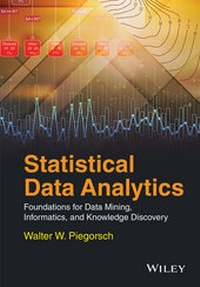
Statistical Data Analytics
Description

More details
Other editions
Additional editions
Person
Content
Part I Background: Introductory Statistical Analytics 1
1 Data analytics and data mining 3
1.1 Knowledge discovery: finding structure in data 3
1.2 Data quality versus data quantity 5
1.3 Statistical modeling versus statistical description 7
2 Basic probability and statistical distributions 10
2.1 Concepts in probability 10
2.1.1 Probability rules 11
2.1.2 Random variables and probability functions 12
2.1.3 Means, variances, and expected values 17
2.1.4 Median, quartiles, and quantiles 18
2.1.5 Bivariate expected values, covariance, and correlation 20
2.2 Multiple random variables* 21
2.3 Univariate families of distributions 23
2.3.1 Binomial distribution 23
2.3.2 Poisson distribution 26
2.3.3 Geometric distribution 27
2.3.4 Negative binomial distribution 27
2.3.5 Discrete uniform distribution 28
2.3.6 Continuous uniform distribution 29
2.3.7 Exponential distribution 29
2.3.8 Gamma and chi-square distributions 30
2.3.9 Normal (Gaussian) distribution 32
2.3.10 Distributions derived from normal 37
2.3.11 The exponential family 41
3 Data manipulation 49
3.1 Random sampling 49
3.2 Data types 51
3.3 Data summarization 52
3.3.1 Means, medians, and central tendency 52
3.3.2 Summarizing variation 56
3.3.3 Summarizing (bivariate) correlation 59
3.4 Data diagnostics and data transformation 60
3.4.1 Outlier analysis 60
3.4.2 Entropy* 62
3.4.3 Data transformation 64
3.5 Simple smoothing techniques 65
3.5.1 Binning 66
3.5.2 Moving averages* 67
3.5.3 Exponential smoothing* 69
4 Data visualization and statistical graphics 76
4.1 Univariate visualization 77
4.1.1 Strip charts and dot plots 77
4.1.2 Boxplots 79
4.1.3 Stem-and-leaf plots 81
4.1.4 Histograms and density estimators 83
4.1.5 Quantile plots 87
4.2 Bivariate and multivariate visualization 89
4.2.1 Pie charts and bar charts 90
4.2.2 Multiple boxplots and QQ plots 95
4.2.3 Scatterplots and bubble plots 98
4.2.4 Heatmaps 102
4.2.5 Time series plots* 105
5 Statistical inference 115
5.1 Parameters and likelihood 115
5.2 Point estimation 117
5.2.1 Bias 118
5.2.2 The method of moments 118
5.2.3 Least squares/weighted least squares 119
5.2.4 Maximum likelihood* 120
5.3 Interval estimation 123
5.3.1 Confidence intervals 123
5.3.2 Single-sample intervals for normal (Gaussian) parameters 124
5.3.3 Two-sample intervals for normal (Gaussian) parameters 128
5.3.4 Wald intervals and likelihood intervals* 131
5.3.5 Delta method intervals* 135
5.3.6 Bootstrap intervals* 137
5.4 Testing hypotheses 138
5.4.1 Single-sample tests for normal (Gaussian) parameters 140
5.4.2 Two-sample tests for normal (Gaussian) parameters 142
5.4.3 Walds tests, likelihood ratio tests, and 'exact' tests* 145
5.5 Multiple inferences* 148
5.5.1 Bonferroni multiplicity adjustment 149
5.5.2 False discovery rate 151
Part II Statistical Learning and Data Analytics 161
6 Techniques for supervised learning: simple linear regression 163
6.1 What is "supervised learning?" 163
6.2 Simple linear regression 164
6.2.1 The simple linear model 164
6.2.2 Multiple inferences and simultaneous confidence bands 171
6.3 Regression diagnostics 175
6.4 Weighted least squares (WLS) regression 184
6.5 Correlation analysis 187
6.5.1 The correlation coefficient 187
6.5.2 Rank correlation 190
7 Techniques for supervised learning: multiple linear regression 198
7.1 Multiple linear regression 198
7.1.1 Matrix formulation 199
7.1.2 Weighted least squares for the MLR model 200
7.1.3 Inferences under the MLR model 201
7.1.4 Multicollinearity 208
7.2 Polynomial regression 210
7.3 Feature selection 211
7.3.1 R2p plots 212
7.3.2 Information criteria: AIC and BIC 215
7.3.3 Automated variable selection 216
7.4 Alternative regression methods* 223
7.4.1 Loess 224
7.4.2 Regularization: ridge regression 230
7.4.3 Regularization and variable selection: the Lasso 238
7.5 Qualitative predictors: ANOVA models 242
8 Supervised learning: generalized linear models 258
8.1 Extending the linear regression model 258
8.1.1 Nonnormal data and the exponential family 258
8.1.2 Link functions 259
8.2 Technical details for GLiMs* 259
8.2.1 Estimation 260
8.2.2 The deviance function 261
8.2.3 Residuals 262
8.2.4 Inference and model assessment 264
8.3 Selected forms of GLiMs 265
8.3.1 Logistic regression and binary-data GLiMs 265
8.3.2 Trend testing with proportion data 271
8.3.3 Contingency tables and log-linear models 273
8.3.4 Gamma regression models 281
9 Supervised learning: classification 291
9.1 Binary classification via logistic regression 292
9.1.1 Logistic discriminants 292
9.1.2 Discriminant rule accuracy 296
9.1.3 ROC curves 297
9.2 Linear discriminant analysis (LDA) 297
9.2.1 Linear discriminant functions 297
9.2.2 Bayes discriminant/classification rules 302
9.2.3 Bayesian classification with normal data 303
9.2.4 Naïve Bayes classifiers 308
9.3 k-Nearest neighbor classifiers 308
9.4 Tree-based methods 312
9.4.1 Classification trees 312
9.4.2 Pruning 314
9.4.3 Boosting 321
9.4.4 Regression trees 321
9.5 Support vector machines* 322
9.5.1 Separable data 322
9.5.2 Nonseparable data 325
9.5.3 Kernel transformations 326
10 Techniques for unsupervised learning: dimension reduction 341
10.1 Unsupervised versus supervised learning 341
10.2 Principal component analysis 342
10.2.1 Principal components 342
10.2.2 Implementing a PCA 344
10.3 Exploratory factor analysis 351
10.3.1 The factor analytic model 351
10.3.2 Principal factor estimation 353
10.3.3 Maximum likelihood estimation 354
10.3.4 Selecting the number of factors 355
10.3.5 Factor rotation 356
10.3.6 Implementing an EFA 357
10.4 Canonical correlation analysis* 361
11 Techniques for unsupervised learning: clustering and association 373
11.1 Cluster analysis 373
11.1.1 Hierarchical clustering 376
11.1.2 Partitioned clustering 384
11.2 Association rules/market basket analysis 395
11.2.1 Association rules for binary observations 396
11.2.2 Measures of rule quality 397
11.2.3 The Apriori algorithm 398
11.2.4 Statistical measures of association quality 402
A Matrix manipulation 411
A.1 Vectors and matrices 411
A.2 Matrix algebra 412
A.3 Matrix inversion 414
A.4 Quadratic forms 415
A.5 Eigenvalues and eigenvectors 415
A.6 Matrix factorizations 416
A.6.1 QR decomposition 417
A.6.2 Spectral decomposition 417
A.6.3 Matrix square root 417
A.6.4 Singular value decomposition 418
A.7 Statistics via matrix operations 419
B Brief introduction to R 421
B.1 Data entry and manipulation 422
B.2 A turbo-charged calculator 426
B.3 R functions 427
B.3.1 Inbuilt R functions 427
B.3.2 Flow control 429
B.3.3 User-defined functions 429
B.4 R packages 430
References 432
Index 453
Preface
Every data set tells a story. Data analytics, and in particular the statistical methods at their core, piece together that story's components, ostensibly to reveal the underlying message. This is the target paradigm of knowledge discovery: distill via statistical calculation and summarization the features in a data set/database that teach us something about the processes affecting our lives, the civilization which we inhabit, and the world around us. This text is designed as an introduction to the statistical practices that underlie modern data analytics.
Pedagogically, the presentation is separated into two broad themes: first, an introduction to the basic concepts of probability and statistics for novice users and second, a selection of focused methodological topics important in modern data analytics for those who have the basic concepts in hand. Most chapters begin with an overview of the theory and methods pertinent to that chapter's focal topic and then expand on that focus with illustrations and analyses of relevant data. To the fullest extent possible, data in the examples and exercises are taken from real applications and are not modified to simplify or "clean" the illustration. Indeed, they sometimes serve to highlight the "messy" aspects of modern, real-world data analytics. In most cases, sample sizes are on the order of 10-10, and numbers of variables do not usually exceed a dozen or so. Of course, far more massive data sets are used to achieve knowledge discovery in practice. The choice here to focus on this smaller range was made so that the examples and exercises remain manageable, illustrative, and didactically instructive. Topic selection is intended to be broad, especially among the exercises, allowing readers to gain a wider perspective on the use of the methodologies. Instructors may wish to use certain exercises as formal examples when their audience's interests coincide with the exercise topic(s).
Readers are assumed to be familiar with four semesters of college mathematics, through multivariable calculus and linear algebra. The latter is less crucial; readers with only an introductory understanding of matrix algebra can benefit from the refresher on vector and matrix relationships given in Appendix A. To review necessary background topics and to establish concepts and notation, Chapters 1-5 provide introductions to basic probability (Chapter 2), statistical description (Chapters 3 and 4), and statistical inference (Chapter 5). Readers familiar with these introductory topics may wish to move through the early chapters quickly, read only selected sections in detail (as necessary), and/or refer back to certain sections that are needed for better comprehension of later material. Throughout, sections that address more advanced material or that require greater familiarity with probability and/or calculus are highlighted with asterisks (*). These can be skipped or selectively perused on a first reading, and returned to as needed to fill in the larger picture.
The more advanced material begins in earnest in Chapter 6 with techniques for supervised learning, focusing on simple linear regression analysis. Chapters 7 and 8 follow with multiple linear regression and generalized linear regression models, respectively. Chapter 9 completes the tour of supervised methods with an overview of various methods for classification. The final two chapters give a complementary tour of methods for unsupervised learning, focusing on dimension reduction (Chapter 10) and clustering/association (Chapter 11).
Standard mathematical and statistical functions are used throughout. Unless indicated otherwise-usually by specifying a different base- indicates the natural logarithm, so that is interpreted as . All matrices, such as X or M, are presented in bold uppercase. Vectors will usually display as bold lowercase, for example, b, although some may appear as uppercase (typically, vectors of random variables). Most vectors are in column form, with the operator T used to denote transposition to row form. In selected instances, it will be convenient to deploy a vector directly in row form; if so, this is explicitly noted.
Much of modern data analytics requires appeal to the computer, and a variety of computer packages and programming languages are available to the user. Highlighted herein is the R statistical programming environment (R Core Team 2014). R's growing ubiquity and statistical depth make it a natural choice. Appendix B provides a short introduction to R for beginners, although it is assumed that a majority of readers will already be familiar with at least basic R mechanics or can acquire such skills separately. Dedicated introductions to R with emphasis on statistics are available in, for example, Dalgaard (2008) and Verzani (2005), or online at the Comprehensive R Archive Network (CRAN): http://cran.r-project.org/. Also see Wilson (2012).
Examples and exercises throughout the text are used to explicate concepts, both theoretical and applied. All examples end with a symbol. Many present sample R code, which is usually intended to illustrate the methods and their implementation. Thus the code may not be most efficient for a given problem but should at least give the reader some inkling into the process. Most of the figures and graphics also come from R. In some cases, the R code used to create the graphic is also presented, although, for simplicity, this may only be "base" code without accentuations/options used to stylize the display.
Throughout the text, data are generally presented in reduced tabular form to show only a few representative observations. If public distribution is permitted, the complete data sets have been archived online at http://www.wiley.com/go/piegorsch/data_analytics or their online source is listed. A number of the larger data sets came from from the University of California-Irvine (UCI) Machine Learning Repository at http://archive.ics.uci.edu/ml (Frank and Asuncion, 2010); appreciative thanks are due to this project and their efforts to make large-scale data readily available.
Instructors may employ the material in a number of ways, and creative manipulation is encouraged. For an intermediate-level, one-semester course introducing the methods of data analytics, one might begin with Chapter 1, then deploy Chapters 2-5, and possibly Chapter 6 as needed for background. Begin in earnest with Chapters 6 or 7 and then proceed through Chapters 8-11 as desired. For a more complete, two-semester sequence, use Chapters 1-6 as a (post-calculus) introduction to probability and statistics for data analytics in the first semester. This then lays the foundations for a second, targeted-methods semester into the details of supervised and unsupervised learning via Chapters 7-11. Portions of any chapter (e.g., advanced subsections with asterisks) can be omitted to save time and/or allow for greater focus in other areas.
Experts in data analytics may canvass the material and ask, how do these topics differ from any basic selection of statistical methods? Arguably, they do not. Indeed, whole books can be (and have been) written on the single theme of essentially every chapter. The focus in this text, however, is to highlight methods that have formed at the core of data analytics and statistical learning as they evolved in the twenty-first century. Different readers may find certain sections and chapters to be of greater prominence than others, depending on their own scholarly interests and training. This eclectic format is unavoidable, even intentional, in a single volume such as this. Nonetheless, it is hoped that the selections as provided will lead to an effective, unified presentation.
Of course, many important topics have been omitted or noted only briefly, in order to make the final product manageable. Omissions include methods for missing data/imputation, spurious data detection, novelty detection, robust and ordinal regression, generalized additive models, multivariate regression, and ANOVA (analysis of variance, including multivariate analysis of variance, MANOVA), partial least squares, perceptrons, artificial neural networks and Bayesian belief networks, self-organizing maps, classification rule mining, and text mining, to name a few. Useful sources that consider some of these topics include (a) for missing data/imputation, Abrahantes et al. (2011); (b) for novelty detection, Pimentel et al. (2014); (c) for generalized additive models, Wood (2006); (d) for MANOVA, Huberty and Olejnik (2006); (e) for partial least squares, Esposito Vinzi and Russolillo (2013); (f) for neural networks, Stahl and Jordanov (2012); (g) for Bayesian belief networks, Phillips (2005); (h) for self-organizing maps, Wehrens and Buydens (2007); and (i) for text mining, Martinez (2010), and the references all therein. Many of these topics are also covered in a trio of dedicated texts on statistical learning-also referenced regularly throughout the following chapters-by Hastie et al. (2009), Clarke et al. (2009), and James et al. (2013). Interested readers are encouraged to peruse all these various sources, as appropriate.
By way of acknowledgments, sincere and heartfelt thanks are due numerous colleagues, including Alexandra Abate, Euan Adie, D. Dean Billheimer and the statisticians of the Arizona Statistical Consulting Laboratory (John Bear, Isaac Jenkins, and Shripad Sinari), Susan L. Cutter, David B. Hitchcock, Fernando D. Martinez, James Ranger-Moore, Martin Sill, Debra A. Stern, Hao Helen Zhang, and a series of anonymous...
