

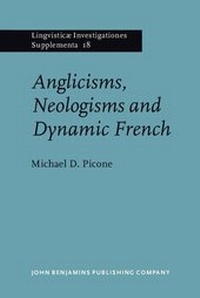
Anglicisms, Neologisms and Dynamic French
1st Edition
Published on 18. October 1996
XII, 462 pages
978-90-272-7614-8 (ISBN)
Description

This comprehensive study of Anglicisms in the context of accelerated neological activity in Contemporary Metropolitan French not only provides detailed documentation and description of a fascinating topic, but opens up new vistas on issues of general linguistic interest: the effects of technology on language, the analyticity-syntheticity controversy, the lexical contribution to language vitality, the study of compound word formation, the interplay between cultural and linguistic affectivity. By investigating the dynamics of borrowing within the larger framework of general neological productivity and by bringing to bear cognitive and pragmatic considerations, a much-needed fresh approach to the entire question of Anglicisms takes shape.
All pertinent phenomena regarding Anglicisms in French - a topic which continues to command the attention of language commentators and defenders in France and elsewhere - are explored: integral borrowings, semantic calques, structural calques, the generation of pseudo-Anglicisms and hybrids, graphological and phonological phenomena. In each case, the phenomenon is investigated in the proper context of its interaction with other pertinent neological, phonological and sociocultural developments. These include general changes in French compound word formation, modified derivational dynamics, the microsystem of pseudo-Classical morphology, historic phonological instabilities, the pressure for more synthetic types of lexical production in relation to the needs of technology and society.
Rather than adhering rigidly to any single theoretical model, there is an attempt to set up a dialog between differing models in order to arrive at a multidimensional view of the phenomena investigated.
All pertinent phenomena regarding Anglicisms in French - a topic which continues to command the attention of language commentators and defenders in France and elsewhere - are explored: integral borrowings, semantic calques, structural calques, the generation of pseudo-Anglicisms and hybrids, graphological and phonological phenomena. In each case, the phenomenon is investigated in the proper context of its interaction with other pertinent neological, phonological and sociocultural developments. These include general changes in French compound word formation, modified derivational dynamics, the microsystem of pseudo-Classical morphology, historic phonological instabilities, the pressure for more synthetic types of lexical production in relation to the needs of technology and society.
Rather than adhering rigidly to any single theoretical model, there is an attempt to set up a dialog between differing models in order to arrive at a multidimensional view of the phenomena investigated.
More details
Other editions
Additional editions
Michael D. Picone
Anglicisms, Neologisms and Dynamic French
Book
10/1996
John Benjamins Publishing Co
€137.80
Shipment within 10-15 days
Person
Content
- ANGLICISMS, NEOLOGISMS AND DYNAMIC FRENCH
- Editorial page
- Title page
- Copyright page
- Table of Contents
- Acknowledgments
- Chapter 1. Definitions and Issues
- 1.1 General Orientation
- Defining Anglicisms and Neologisms
- 1.2 Delimiting the Field of Investigation
- 1.3 Lexical vs. Syntactic Borrowing
- 1.4 Defining Derivation and Compounding
- 1.5 Innovations in French Lexicogenesis
- 1.5.1 Samples
- 1.5.2Sources
- 1.6 The Analyticity-Syntheticity Axis
- 1.6.1 The Controversy
- 1.6.2 Analyticity and the Legacy of Borrowing
- 1.7 Anglicisms in the Larger Neological Context
- 1.8 Accelerating and Revamping Traditional Neology
- 1.9 Normativity and Neology
- Chapter 2. Juxtapositional Neology
- 2.1 Describing Juxtapositional Neologisms
- 2.2 Anglicisms as Constituents in Juxtapositional Neology
- 2.2.1 Integral Borrowings, Pseudo-Anglicisms and Hybrids
- 2.2.2 Compositional Elements Borrowed from English
- 2.2.2.1 baby
- 2.2.2.2 big
- 2.2.2.3 black
- 2.2.2.4 blue
- 2.2.2.5 brown, green, pink, red, white
- 2.2.2.6 express
- 2.2.2.7 fast
- 2.2.2.8 first
- 2.2.2.9 free
- 2.2.2.10 happy
- 2.2.2.11 high (hi)
- 2.2.2.12 hot, cool, cold
- 2.2.2.13 new
- 2.2.2.14 quick
- 2.2.2.15 top
- 2.3 Selection Criteria
- 2.3.1 Selection of Borrowed Constituents
- 2.3.2 Selection of Structures and Graphological Representations
- 2.3.3.1 Selection of Native Constituents together with Innovative Structures and Graphological Representations
- 2.3.3.2 rapide
- 2.3.3.3 magique
- 2.3.3.4 moderne
- 2.3.3.5 Other Native Constituents
- 2.4 calques
- 2.4.1 Structural calques
- 2.4.2 Semantic calques
- 2.4.3 prêt-à-porter
- Chapter 3. Binomial Constructions
- 3.1 Generalities
- 3.2 Apposition
- 3.2.1 Accelerated Productivity
- 3.2.2 Appositionin Relation to Dvandvas
- 3.2.3 Appositional Binomials Viewed as Forming a Superclass Arranged along a Continuum
- 3.2.4 The NAGENT + [V-STEM + NOMINALIZER]N Formula
- 3.2.5 Appositional Designations of Gender, Status and Age: Comparing and Contrasting Native Stock and Anglicisms
- 3.2.5.1 femme
- 3.2.5.2 Miss, Lady
- 3.2.5.3 homme
- 3.2.5.4 Mister, Lord, King
- 3.2.5.5 enfant,fille , garçon , bébé
- 3.2.5.6 girl, boy, baby
- 3.2.6 Figurative Appositions
- 3.2.6.1 Parallel Incorporation of Anglicisms and Native Constituents
- 3.2.6.2 étoile/ star
- 3.2.6.3 soleil/sun
- 3.2.6.4 éclair/flash
- 3.2.6.5 Virtual Co-reference
- 3.3 Subordinating Ellipsis
- 3.3.1 Nature and Precedent
- 3.3.2 The Link to the Genitive of Juxtaposition
- 3.3.3 Anglicisms as Constituents in Genitive Binomials
- 3.3.4 Inversion in Genitive Binomials
- 3.3.5 Extensions in the Use of Subordinating Ellipsis
- 3.3.6 Animate Common Nouns as Genitive Constitue
- 3.3.7 English-Origin Constituents Licensing Inversion of Animate Common Nouns in Genitive Constructs
- 3.3.8 Pseudo-Anglicisms Incorporating -'s
- 3.3.9 Moving Beyond Animateness
- 3.3.10 Moving Beyond Genitivity and Tracing the Role ofAppositional Crossover
- 3.3.11 Ambivalent Constituents Contributing to Binomial Ellipsis
- 3.3.12 Summary Remarks on Subordinating Ellipsis
- More Patterns and Attestations
- 3.3.13 English Influence on French Subordinating Ellipsis
- 3.3.13.1 Generalities
- 3.3.13.2 Calques
- 3.3.13.3 At Issue: Caiques and the Cardinal Points
- 3.3.13.4 Integral Borrowings
- 3.3.13.5 Hybrids and Pseudo-Anglicisms
- 3.3.13.5.1 Generalities
- 3.3.13.5.2 An Example of Patterning
- 3.3.13.5.3 -burger
- 3.3.13.5.4 -ball
- 3.3.13.5.5 -room
- 3.3.13.5.6 show
- 3.3.13.5.7-story
- 3.3.13.5.8 -shop, -store
- 3.3.13.5.9 -center
- 3.3.13.5.10 test
- 3.3.13.6. Anglicisms Licensing Ellipsis without Benefit of Direct Patterning
- 3.3.13.6.1 Generalities
- 3.3.13.6.2 kit
- 3.3.13.6.3 look
- 3.3.13.6.4 star
- 3.3.13.7 Summary Remarks on English Influence on Subordinating Ellipsis in Binomials
- Chapter 4. Neological Diversity
- 4.1 Generalities
- 4.2 Trinomials
- 4.2.1 Describing Trinomials
- Presenting the Data
- 4.2.2 Analysis
- 4.2.3 Sorting out Pragmatics, Iconicity and Morphosyntax
- 4.2.4 Assigning Precedents and Origins
- 4.3 Compounds of the form VERB + COMPLEMENT
- 4.3.1 A Long-standing Theoretical Problem: Parsing the Verb Form
- 4.3.2 The Prolific VERB + D.O. Formula
- 4.3.3 VERB + COMPLEMENT Constructions in Relation to English
- 4.3.3.1 Origins
- Developments Concerning English
- 4.3.3.2 N + [V + N] Strings
- 4.3.3.3 Integral Borrowings of the Form VERB + ADV
- 4.4 Pseudo-Classical Neology
- 4.4.1 General Discussion
- A Note on -(o)rama
- 4.4.2 Truncation
- 4.4.3 self
- 4.4.4 -man
- 4.4.5. AF + QAF Compounds and N + [AF/ADJ + N] Strings
- 4.4.5.1 Origins and Extensions
- 4.4.5.2 N 4 + [ADJ + N] Strings: tout/haut/trois/long/high/top/new
- 4.4.5.3 N + [AF + N] Strings: multi-/anti-/inter- and the Link to N + [PREP + N] Strings
- 4.5 Derivational Morphology
- 4.5.1 Generalities
- Derivatives of Borrowings
- Derivatives of Abbreviations and Acronyms
- 4.5.2. The English-Origin Nominal Suffix -er
- 4.5.2.1 Generalities
- Impact on the Cognate -eur
- Agency
- A.5.2.2 A Variationist Approach to -er
- 4.5.3. The English-Origin Nominal Suffix -ing
- 4.5.3.1 Background
- 4.5.3.2 The Velar Nasal and Posterior Consonantal Instability
- 4.5.3.3 More History
- Citations
- 4.5.3.4 The Morphosyntax of French -ing
- Conclusion
- Bibliography
- Index of Names
- Index of Linguistic Forms
