

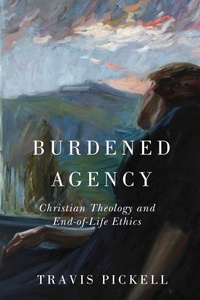
Burdened Agency
Christian Theology and End-of-Life Ethics
Published on 15. August 2024
277 pages
978-0-268-20896-7 (ISBN)
Description

Travis Pickell explores the paradoxes of choice in modern dying and the ways Christian theology can aid in navigating the relationship between moral agency and dignity at the end of life.
Burdened Agency addresses the problem of death and dying through Christian theology and ethics. In previous centuries, death was something that simply "happened" to us. To choose how or when one died was the exception, not the rule. However, due to advances in modern medicine, individuals are increasingly required to make concrete choices about the nature and timing of death. Modernity, with its emphasis on individualism, complicates this further because we are increasingly bereft of cultural and religious guidance regarding death. This gives rise to the phenomenon of "burdened agency": the predicament of having to make such difficult choices with so little to help us.
This engaging book offers a historical and philosophical account of the origins of our situation of burdened agency, as well as a Christian solution to the problems that it raises. Looking to theologians such as Karl Rahner, Karl Barth, and Stanley Hauerwas, Pickell devises a radically countercultural approach to death and dying rooted in Christian theological commitments and enacted in the practices of baptism, Eucharist, and prayer.
Burdened Agency addresses the problem of death and dying through Christian theology and ethics. In previous centuries, death was something that simply "happened" to us. To choose how or when one died was the exception, not the rule. However, due to advances in modern medicine, individuals are increasingly required to make concrete choices about the nature and timing of death. Modernity, with its emphasis on individualism, complicates this further because we are increasingly bereft of cultural and religious guidance regarding death. This gives rise to the phenomenon of "burdened agency": the predicament of having to make such difficult choices with so little to help us.
This engaging book offers a historical and philosophical account of the origins of our situation of burdened agency, as well as a Christian solution to the problems that it raises. Looking to theologians such as Karl Rahner, Karl Barth, and Stanley Hauerwas, Pickell devises a radically countercultural approach to death and dying rooted in Christian theological commitments and enacted in the practices of baptism, Eucharist, and prayer.
Reviews / Votes
"Well organized, thoughtful, and compelling, and deserves a broad readership." -Joel Shuman, co-author of Reclaiming the Body"Travis Pickell has given us a wise, timely, and lucidly written book. 'How to die well?' is a perennial question, but more choice and less cultural guidance have made it profoundly challenging. Drawing on Rahner, Barth, Hauerwas, and others, Pickell offers a path through this unavoidable thicket, a deeply Christian ethic of receptivity to the gift of our finitude and of openness to God's providential care." -Joseph E. Davis, co-editor of The Evening of Life
"Our society is strongest when religious communities, strengthened by the sort of moral formation that Pickell writes about so eloquently, join with others to protect and care for the most vulnerable." -Hedgehog Review
More details
Language
English
Place of publication
Notre Dame IN
United States
Target group
College/higher education
Product notice
Reflowable
File size
0,50 MB
ISBN-13
978-0-268-20896-7 (9780268208967)
Copyright in bibliographic data and cover images is held by Nielsen Book Services Limited or by the publishers or by their respective licensors: all rights reserved.
Schweitzer Classification
Other editions
Additional editions
Book
08/2024
University of Notre Dame Press
€59.40
Shipment within 10-20 days
Christopher Kaczor
Defense of Dignity
Creating Life, Destroying Life, and Protecting the Rights of Conscience
Book
05/2013
University of Notre Dame Press
€30.90
Shipment within 10-20 days
Person
Travis Pickell is an assistant professor of theology and ethics at George Fox University, where he also directs the Character Virtue Initiative and the Cornerstone Core curriculum.
Content
Acknowledgements
Introduction: The Landscape of Modern Dying
1. Burdened Agency
2. Scripts for Dying
3. Persons, Freedom, and a Catholic Spirituality of Martyrdom
4. Karl Barth on Agency-in-Dying: Accepting Creaturely Finitude
5. Stanley Hauerwas on Agency-in-Dying: Ethics of Dispossession
6. Prayer, Baptism, and Eucharist
Conclusion: Humanity Sub Specie Mortis
Bibliography
Index
Introduction: The Landscape of Modern Dying
1. Burdened Agency
2. Scripts for Dying
3. Persons, Freedom, and a Catholic Spirituality of Martyrdom
4. Karl Barth on Agency-in-Dying: Accepting Creaturely Finitude
5. Stanley Hauerwas on Agency-in-Dying: Ethics of Dispossession
6. Prayer, Baptism, and Eucharist
Conclusion: Humanity Sub Specie Mortis
Bibliography
Index
