

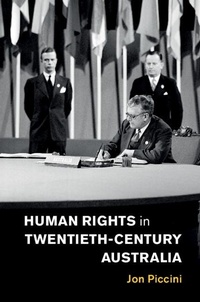
Human Rights in Twentieth-Century Australia
Published on 2. October 2019
222 pages
978-1-108-65823-2 (ISBN)
Description

This groundbreaking study understands the 'long history' of human rights in Australia from the moment of their supposed invention in the 1940s to official incorporation into the Australian government bureaucracy in the 1980s. To do so, a wide cast of individuals, institutions and publics from across the political spectrum are surveyed, who translated global ideas into local settings and made meaning of a foreign discourse to suit local concerns and predilections. These individuals created new organisations to spread the message of human rights or found older institutions amenable to their newfound concerns, adopting rights language with a mixture of enthusiasm and opportunism. Governments, on the other hand, engaged with or ignored human rights as its shifting meanings, international currency and domestic reception ebbed and flowed. Finally, individuals understood and (re)translated human rights ideas throughout this period: writing letters, books or poems and sympathising in new, global ways.
Reviews / Votes
'In this fascinating account of how global ideas travel, Jon Piccini illuminates how Australians invoked universal human rights in pursuit of political and social reforms. By carefully charting the ways the concept was deployed by groups ranging from Indigenous Australians to anti-abortion evangelicals, Piccini offers a fresh reading of the capacities and the limits of this supple moral language.' Barbara Keys, author of Reclaiming American Virtue: The Human Rights Revolution of the 1970s 'This major contribution to understanding Australia's national navigation of the human rights idea and its place within wider global rights represents a strikingly impressive intervention. It interacts with some of the key trends within the grander constellation of human rights history and connects with the changing contours of human rights as an international discourse and transnational social movement.' Roland Burke, author of Decolonisation and the Evolution of International Human Rights 'Australia has no bill of rights, but human rights talk permeates its culture and politics. Jon Piccini has for the first time explained the history of this paradox, in a significant contribution to our understanding of how the appeal to human rights became both pervasive and contested in modern Australia.' Frank Bongiorno, author of The Eighties: The Decade That Transformed Australia 'Human Rights in Twentieth-Century Australia is an important book and Jon Piccini has set out an agenda for further research which I hope students of Australian history will seek to follow. He has also presented Australias ... record on human rights to an international audience and this will no doubt inspire future conversations and comparisons in global settings.' Julia T. Martinez, History Australia 'Jon Piccini's excellent history of human rights in twentieth century Australia joins a growing number of 'national human rights histories' that seek to show how domestic political and civil movements engaged with the emergent global discourse of human rights ... This book, which draws on a wide range of Australian newspapers, manuscript collections, archives, and publications from a wide range of civil liberties, human rights, indigenous rights, and sectarian organizations, should appeal to historians of modern Australian politics and foreign policy, indigenous transnationalism, and human rights more generally.' Brad Simpson, Journal of Contemporary HistoryMore details
Series
Language
English
Place of publication
Cambridge
United Kingdom
Target group
Professional and scholarly
Illustrations
Worked examples or Exercises
File size
1,62 MB
ISBN-13
978-1-108-65823-2 (9781108658232)
Copyright in bibliographic data and cover images is held by Nielsen Book Services Limited or by the publishers or by their respective licensors: all rights reserved.
Schweitzer Classification
Other editions
Additional editions
Jon Piccini
Human Rights in Twentieth-Century Australia
Book
08/2021
Cambridge University Press
€48.70
Shipment within 15-20 days
Jon Piccini
Human Rights in Twentieth-Century Australia
Book
10/2019
Cambridge University Press
€116.40
Shipment within 15-20 days
Content
Acknowledgements; Introduction: bereft of words; 1. Inventing rights; 2. Cold War rights; 3. Experimental rights; 4. Who's rights? 5. Implementing rights; Epilogue: cascade or trickle?
