

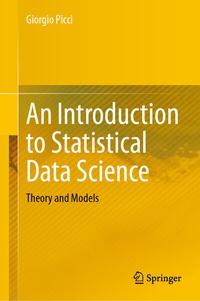
An Introduction to Statistical Data Science
Description

This graduate textbook on the statistical approach to data science describes the basic ideas, scientific principles and common techniques for the extraction of mathematical models from observed data. Aimed at young scientists, and motivated by their scientific prospects, it provides first principle derivations of various algorithms and procedures, thereby supplying a solid background for their future specialization to diverse fields and applications.
The beginning of the book presents the basics of statistical science, with an exposition on linear models. This is followed by an analysis of some numerical aspects and various regularization techniques, including LASSO, which are particularly important for large scale problems. Decision problems are studied both from the classical hypothesis testing perspective and, particularly, from a modern support-vector perspective, in the linear and non-linear context alike. Underlying the book is the Bayesian approach and the Bayesian interpretation of various algorithms and procedures. This is the key to principal components analysis and canonical correlation analysis, which are explained in detail. Following a chapter on nonlinear inference, including material on neural networks, the book concludes with a discussion on time series analysis and estimating their dynamic models.
Featuring examples and exercises partially motivated by engineering applications, this book is intended for graduate students in applied mathematics and engineering with a general background in probability and linear algebra.
More details
Other editions
Additional editions
Person
Giorgio Picci is Professor Emeritus at the Department of Information Engineering of the University of Padova, Italy. He has also held several long-term visiting positions at various American, European Japanese and Chinese universities. He has contributed to the field of systems and control theory, mostly in the areas of modeling, estimation and identification of stochastic systems, and has published about 200 papers. He has also published a book, co-authored with Anders Lindquist, Linear Stochastic Systems: A Geometric Approach to Modeling, Estimation and Identification in the Springer Series in Contemporary Mathematics, and edited three other books in this area. He has also been active in the field of dynamic vision and on-line scene and motion reconstruction, and is involved in various joint research projects with industry and state agencies. He is a Life Fellow of the IEEE, Fellow of IFAC, past chairman of the IFAC Technical Committee on Stochastic Systems and past member of the EUCA council. He is also a foreign member of the Swedish Royal Academy of Engineering Sciences and a member of the Galileian Academy in Padova.
Content
- 1. Introduction.- 2. Classical Statistical Inference.- 3. Linear Models.- 4. Conditioning and Regularization.- 5. Linear Hypotheses and LDA.- 6. Bayesian Statistics.- 7. Principal Component Analysis.- 8. Non Linear Inference.- 9. Time Series.
